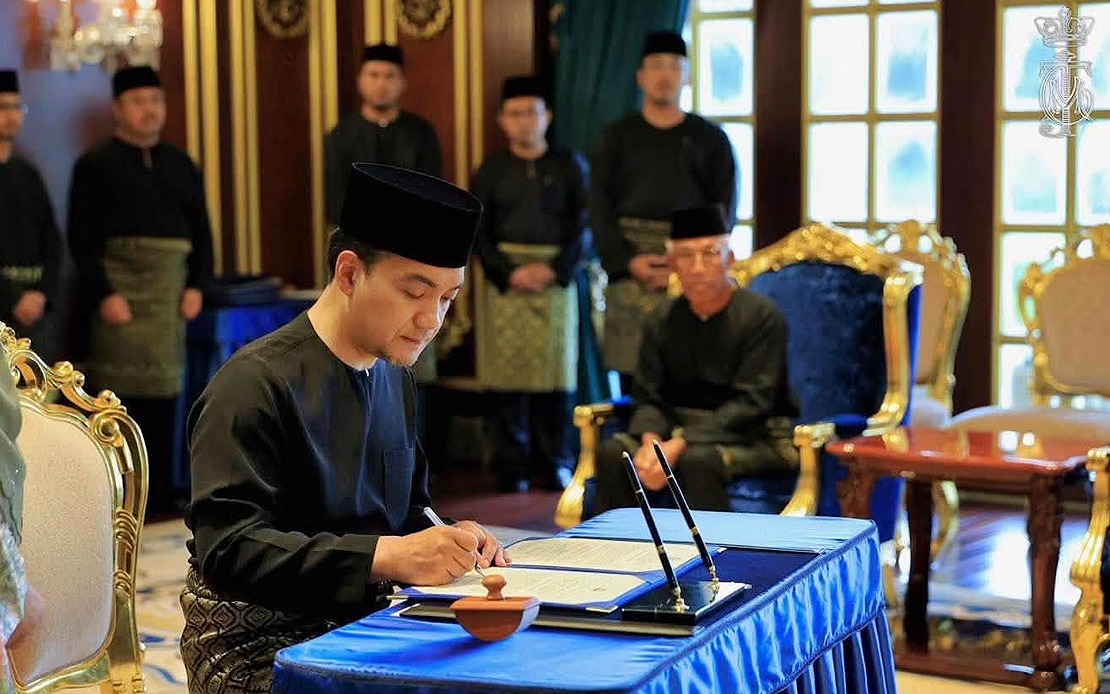
Datuk Onn Hafiz Ghazi has embarked on a second term as Johor Menteri Besar, commanding an enhanced legislative position after Barisan Nasional secured 48 of 56 state assembly seats in the recent election. The 48-year-old administrator takes office with a notably stronger mandate than his previous term, having improved the coalition's tally from 40 seats won in 2022, a gain that reflects sustained voter confidence in his stewardship of Southeast Asia's most industrialised state.
Onn Hafiz's political ascent carries particular historical resonance given his family's foundational role in Malaysia's governance. He is the great-grandson of the late Datuk Onn Jaafar, who established UMNO as the nationalist movement's institutional backbone and served as Johor's seventh Menteri Besar during the colonial transition period. More directly, he descends from the late Tun Hussein Onn, who held Malaysia's third Prime Ministership and shaped the nation's early constitutional framework. This genealogical connection positions Onn Hafiz not merely as a contemporary political figure but as a custodian of institutional memory within UMNO's upper echelons, a distinction that carries both opportunity and expectation in a party that values established lineages.
Following his swearing-in before the Regent of Johor, Tunku Mahkota Ismail, at Istana Bukit Serene, Onn Hafiz inherited the administrative machinery he had already begun operating during his initial appointment on March 15, 2022. His rise to the Menteri Besar's office occurred following the formation of the state government after the 2022 state election, succeeding Datuk Hasni Mohammad in a transition that consolidated UMNO's control over the southern powerhouse.
Before entering electoral politics formally, Onn Hafiz cultivated an extensive background in corporate finance and management that distinguishes his administrative philosophy from predecessors steeped primarily in party machinery. Born on March 2, 1978, he attended the Royal Military College for secondary education before pursuing tertiary qualifications at the University of Hertfordshire in the United Kingdom, where he specialised in accounting. These institutional credentials shaped his early career trajectory through PricewaterhouseCoopers between 2001 and 2004, where he developed exposure to multinational corporate governance standards and audit protocols.
Following his tenure at PwC, Onn Hafiz transitioned into the Malaysian corporate sector, occupying executive positions between 2005 and 2013 that included directorships at Chin Well Holdings Berhad and the chief executive role at KMB Sdn Bhd. These appointments exposed him to operational challenges spanning manufacturing, logistics, and business expansion in competitive Southeast Asian markets. This résumé shaped an administrative orientation emphasising measurable efficiency metrics, operational streamlining, and investor attraction—approaches that inform his governance methodology in Johor's state administration.
His entry into active electoral politics began through UMNO Youth structures, where he served on the party's executive council and as chief of the Sembrong UMNO Youth division from 2012 to 2018. This positioning provided conventional apprenticeship within party hierarchies while maintaining corporate engagement. Concurrently, he served as political secretary to the defence minister from 2013 to 2018, a role affording proximity to federal decision-making and exposure to national security policy frameworks. These parallel trajectories reflected UMNO's practice of grooming younger figures through both party and governmental channels simultaneously.
Onn Hafiz's electoral entry occurred in 2018 when he contested the Layang-Layang federal constituency during the general election, subsequently winning the seat and entering Parliament. This victory led to his appointment as chairman of the Johor Tourism, Youth and Sports Committee between 2019 and 2022, a portfolio allowing him to develop state-level policy expertise and administrative visibility. When the 2022 state election occurred, he successfully shifted his political base to the Machap state assembly seat, positioning himself within Johor's state politics proper rather than relying solely on federal representation. This transition preceded his appointment as the state's 19th Menteri Besar, demonstrating UMNO's calculation that his corporate background and federal experience warranted elevation to the topmost state executive position.
During his initial mandate from 2022 onwards, Onn Hafiz articulated and began operationalising the "Maju Johor 2030" development framework, a long-term strategic vision centring on economic expansion, sectoral diversification, and sustained foreign and domestic investment attraction. This agenda reflects his corporate-sector inclinations toward strategic planning and performance metrics. The expanded mandate from the recent election provides enhanced legislative capacity to advance initiatives under this framework, particularly in infrastructure development, business incubation, and skill-building initiatives aimed at Johor's workforce. The improved majority also strengthens his hand in navigating intra-party dynamics within UMNO, particularly given his parallel responsibilities as chairman of the Johor UMNO Liaison Committee and chief of the Simpang Renggam UMNO division since 2023.
Onn Hafiz's positioning as a second-generation figure within UMNO's governance echelons reflects broader patterns within the party, where family networks and institutional inheritance remain significant determinants of elite circulation. However, his corporate credentials and technical background differentiate him from earlier Menteri Besar cohorts, suggesting that UMNO has progressively incorporated professional administrative expertise alongside political machinery skills. His expanded mandate provides four years to deepen implementation of the Maju Johor 2030 agenda and potentially position himself as a model for technocratic governance within UMNO's state-level operations.
For Malaysian and Southeast Asian observers, Onn Hafiz's return to office carries implications extending beyond Johor's borders. As the region's most economically integrated state, Johor's investment climate and infrastructure development trajectory influence broader Southeast Asian economic competitiveness. His corporate background and explicit focus on economic expansion position him to influence policy directions that could affect Malaysia's positioning within regional value chains. Moreover, his family lineage and enhanced mandate may position him as a contender for higher office within UMNO's future leadership contests, suggesting that developments in Johor's governance may presage shifts in national political dynamics beyond the state's borders.
The expanded legislative majority also provides latitude for policy experimentation in areas such as green economy transition, digital infrastructure, and cross-border economic integration with Singapore. These policy domains carry relevance for Malaysian economic strategy at the national level, potentially allowing Johor to serve as a laboratory for initiatives that could inform federal policy development. Onn Hafiz's second term thus represents both continuity with established development blueprints and opportunity for deepened institutional innovation within Malaysia's political landscape.

