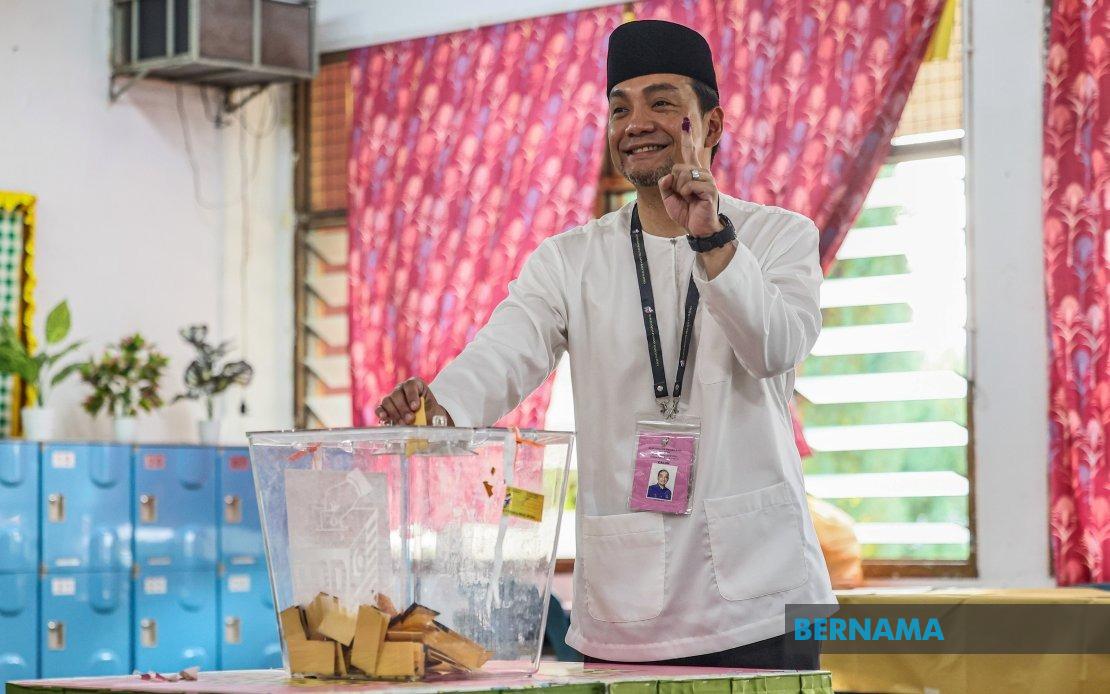
Johor Menteri Besar Datuk Onn Hafiz Ghazi fulfilled his electoral duty early on July 11, casting his vote at Sekolah Kebangsaan Simpang Renggam at 8.33 am during the 16th Johor state election. The senior Barisan Nasional figure, who chairs the coalition's Johor branch, took the opportunity to greet fellow voters queuing at the polling station before entering Stream 4 to submit his ballot. His appearance underscored the significance of the day's electoral contest and the coalition's push for voter participation across the state.
Onn Hafiz is defending his seat against Nur Hafiz Roslan of Pakatan Harapan in what amounts to a two-cornered fight. The contest carries weight not merely for his personal political future but for the broader balance of power in Johor, Malaysia's second-largest state by population and a traditional BN stronghold. A second term would reinforce his position as a rising establishment figure, while a loss would represent a significant shift in voter sentiment in the southern region.
Immediately after voting, Onn Hafiz appealed to the electorate to arrive at polling stations early and discharge their civic obligation responsibly. His remarks reflected a broader concern among electoral administrators about maintaining orderly queues and efficient vote-casting throughout the day. By encouraging early turnout, he sought to distribute voters across the opening hours rather than creating congestion in the final period before polls close, a practical consideration that affects both voter experience and the integrity of the tallying process.
The Johor state election showcased the competitive diversity of Malaysian politics beyond the traditional two-coalition framework. In the Puteri Wangsa state seat, voters confronted a five-way contest that illustrated how the political landscape has fragmented since the 2018 general election. Pakatan Harapan fielded Dr Maszlee Malik, the former education minister whose portfolio experience might appeal to constituencies prioritising school accessibility and curriculum development. Maszlee arrived at his polling station, SJK (C) Tuan Poon in Simpang Renggam, at 8.58 am to cast his vote.
Maszlee's challengers represented a spectrum of political alignments. Rashifa Aljunied ran under the banner of MUDA, the newer reform-oriented movement that has attracted voters seeking alternatives to both establishment coalitions. Teow Chia Ling represented the Barisan Nasional slate, maintaining the coalition's presence in a seat where it sought to retain or recover ground. Parti Bersama Malaysia, through candidate Nicholas Paul Vincent, appealed to voters attracted by its platform of unity and pragmatic governance beyond partisan divides. Independent candidate Wang Wee Siong completed the field, reflecting the continuing appeal of non-partisan candidacy in certain constituencies.
The diversity of candidates in Puteri Wangsa mirrors broader patterns emerging across Malaysian electoral contests. Voters in urbanising states like Johor increasingly encounter multiple options beyond the traditional BN-opposition binary that characterised elections prior to 2018. This fragmentation requires candidates to build broader coalitions and tailor messaging to diverse interest groups rather than relying on entrenched party loyalty. For Maszlee specifically, his previous cabinet experience carried both advantages and liabilities—voters might credit his administrative competence, yet others might hold him accountable for educational policies implemented during his tenure.
The Simpang Renggam area emerged as a focal point on election day, hosting polling stations for multiple contests. The concentration of candidates casting ballots in the same geographic location highlighted how electoral contests often cluster geographically when constituencies and administrative divisions overlap. Both Onn Hafiz and Maszlee selected polling stations in this area, suggesting its significance to their respective campaigns and its role as a representative microcosm of Johor's diverse demographics.
For Onn Hafiz, securing a second term would validate the development trajectory he has charted as Menteri Besar and confirm voter confidence in his governance record. Since assuming office, he has overseen various state-level initiatives affecting infrastructure, education, and economic development. The election outcome would reveal whether Johor voters perceive his tenure positively or whether they harbour concerns about state performance that make them receptive to Pakatan Harapan's alternative vision. In a state housing nearly two million voters, individual seat contests aggregate into broader judgments about leadership and direction.
The timing of the 16th Johor state election reflected Malaysia's post-2020 political realignment. Following the collapse of Pakatan Harapan's federal government, state-level contests became important arenas for testing coalition strength and electoral viability. Johor, as a large and economically significant state with a mixed urban-rural composition, carried particular weight as a bellwether for regional and national political sentiment. The results would signal whether BN could consolidate its recent federal recovery at the state level or whether opposition parties could mount effective challenges in constituencies previously considered secure.
Onn Hafiz's call for early voting reflected election management best practices increasingly adopted across Southeast Asia. Early turnout distribution reduces peak-hour congestion, minimises queueing time, and facilitates smoother vote counting procedures. It also enhances accessibility for voters with occupational or caregiving constraints. By encouraging responsible, orderly participation, political leaders can strengthen electoral legitimacy and demonstrate commitment to institutional integrity beyond partisan competition. Onn Hafiz's exhortation thus served simultaneously as campaign messaging and civically minded leadership.
The election day represented a moment of democratic renewal for Johor, offering voters opportunity to assess incumbent performance and consider alternative visions for their state. The presence of established figures like Onn Hafiz and Maszlee, combined with newer political movements and independent candidates, created a dynamic in which Malaysian democracy's continuing evolution was visibly enacted. As voters moved through polling stations from early morning onward, they participated in the ongoing process of negotiating their state's direction and priorities, affirming democratic principles through the ordinary act of casting a ballot.

