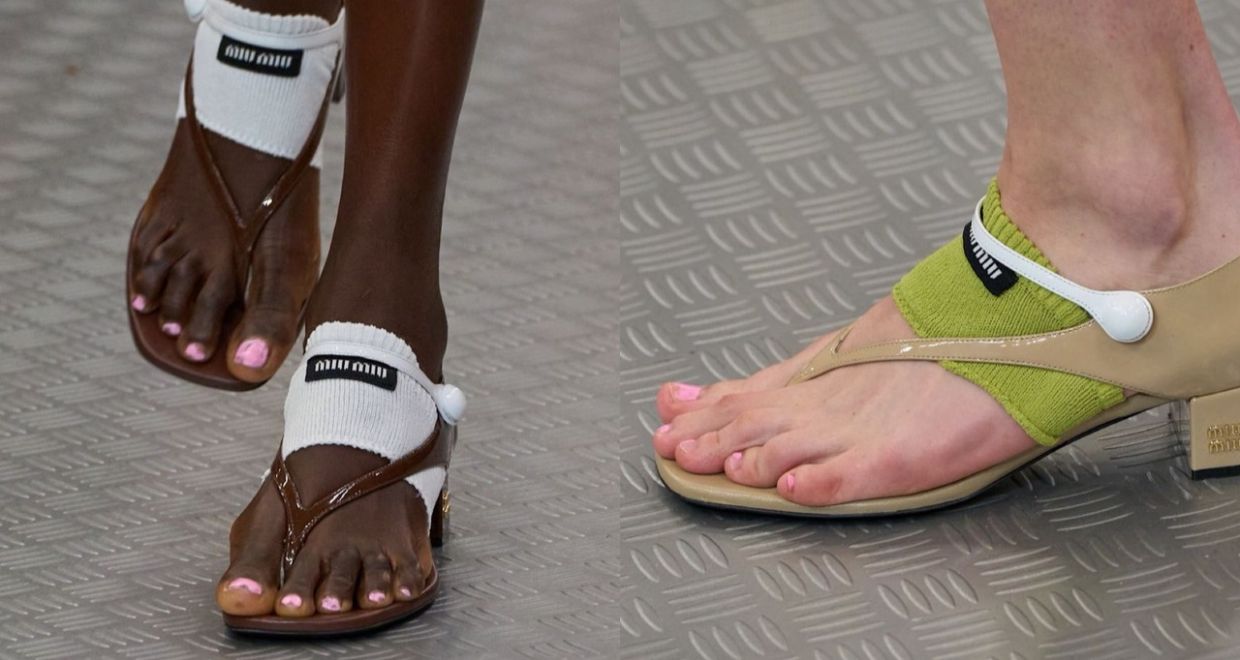
When faced with the perpetual summer dilemma—feet too exposed in sandals, too warm in full socks—a growing number of fashion-conscious consumers are discovering an unconventional middle path. Open-toe socks, a garment category that few would have imagined viable just months ago, are now carving out a distinctive niche in the wardrobes of style-savvy shoppers across East and Southeast Asia. Rather than abandoning hosiery altogether during the scorching months, these innovative cropped socks maintain coverage over the foot's arch and upper portion while deliberately exposing the toes to air and visibility, creating a silhouette that challenges conventional fashion wisdom.
The trend's sudden acceleration owes much to elite fashion houses setting the creative tone. Luxury Italian brand Miu Miu introduced this unexpected styling approach through its 2025 Spring/Summer collection, presenting socks that wrapped deliberately around only the arch of the foot, bypassing centuries of conventional sock design. This high-fashion validation proved catalytic, signalling to the broader market that what might initially seem impractical or aesthetically jarring could indeed constitute legitimate style innovation. When prestigious design houses present novel ideas on their runways, the reverberations ripple through retail ecosystems and social media platforms within weeks, transforming niche concepts into mainstream conversations.
Retail data from South Korea, where an unseasonably early heat wave accelerated consumer appetite for warm-weather footwear, demonstrates the trend's commercial momentum with striking clarity. Between May 31 and June 7, sales of summer shoes including mules, slides, and flip-flops climbed approximately 80 percent year-over-year according to online fashion platform W Concept. More dramatically, transaction values specifically for socks designed to pair with flip-flops surged 1,664 percent over the month spanning May 14 to June 14, according to style commerce platform Ably, while search volume exploded by 3,227 percent. These figures reveal not merely incremental interest but rather a sudden rupture in consumer behaviour, suggesting that once fashion gatekeepers and digital algorithms began amplifying the concept, adoption rates accelerated exponentially.
Celebrity endorsement accelerated legitimacy further when Korean actor Cha Jung-won shared social media posts featuring sky-blue flip-flops paired with beige knit leg warmers, demonstrating how the aesthetic functioned within actual lifestyle contexts rather than exclusively on fashion runways. Such visible celebrity adoption proves far more persuasive than editorial recommendations alone, particularly among younger consumers who view social media as the authentic arbiter of what constitutes wearable style. The democratisation of fashion influence through platforms where celebrities share unfiltered glimpses of their personal styling extends validation beyond traditional fashion institutions.
What distinguishes contemporary open-toe socks from their winter predecessors is fundamentally their material composition and functional philosophy. Rather than prioritising thermal insulation, modern versions employ sheer, mesh, and loosely knitted fabrics specifically engineered for maximum breathability whilst maintaining the visual and tactile presence of a sock. This represents a recalibration of how we conceive the sock's purpose—from purely utilitarian thermal barrier to aesthetic accessory capable of adding dimensional layering and chromatic interest to otherwise minimal summer silhouettes. The socks function less as protection against cold and more as styling elements that rescue predictable warm-weather dressing from visual blandness.
Beyond purely aesthetic appeal, practical advantages emerge upon closer examination. By covering the upper foot and arch, open-toe socks substantially reduce friction and abrasion from flip-flop and sandal straps, addressing a genuine comfort concern that plagues many summer wearers. During monsoon season prevalent throughout Southeast Asia, these garments can be worn in combination with rain boots, creating a protective barrier that mitigates moisture-related skin irritation and discomfort. For Malaysian consumers particularly, where tropical humidity and sudden downpours characterise much of the year, this multifunctional capacity transforms the garment from frivolous novelty into genuinely practical wardrobe component.
Styling guidance suggests that newcomers to the trend should commence with neutral foundational shades—grey, black, and white—which integrate seamlessly with established summer wardrobes without requiring wholesale style recalibration. Grey socks coordinate effectively with black flip-flops or ballerina flats when paired with denim, Bermuda shorts, or satin skirts, creating refined visual coherence. Those embracing bolder aesthetic sensibilities can experiment with vivid chromatic choices such as yellow, pink, or sky blue, with intentional mismatching between socks and footwear actually intensifying the overall effect rather than undermining it. The deliberate coordination strategy emphasises that contemporary fashion increasingly values controlled dissonance and personalised expression over rigid matching conventions.
Stylist guidance emphasises that maintaining visual balance requires restraint in accompanying garments. When socks and shoes already command significant visual attention through colour, pattern, or unexpected combination, the remainder of the ensemble should remain deliberately understated—a simple t-shirt with shorts or classic shirt with skirt permits the footwear styling to occupy appropriate prominence without the entire look becoming overwhelming. Patterns such as dots or florals within the socks create particularly striking results, especially when surrounded by solid-coloured, neutral clothing items that create visual breathing room.
The emergence of open-toe socks within mainstream fashion consciousness represents something more significant than merely another ephemeral seasonal trend. It reflects contemporary fashion's accelerating trajectory toward challenging established conventions, embracing apparent contradictions, and permitting individual interpretation to supersede rigid historical precedent. For Malaysian consumers and broader Southeast Asian audiences accustomed to tropical conditions that render traditional hosiery impractical for much of the year, this trend offers validation for exploring alternative approaches to summer dressing that acknowledge both comfort requirements and aesthetic aspirations. As fashion continues its trajectory toward greater creative experimentation and less dogmatic rule adherence, open-toe socks exemplify how even the most seemingly mundane garment categories remain subject to complete reconceptualisation, proving that innovation can flourish within even the most established fashion categories when designers and consumers collectively embrace unconventional thinking.

