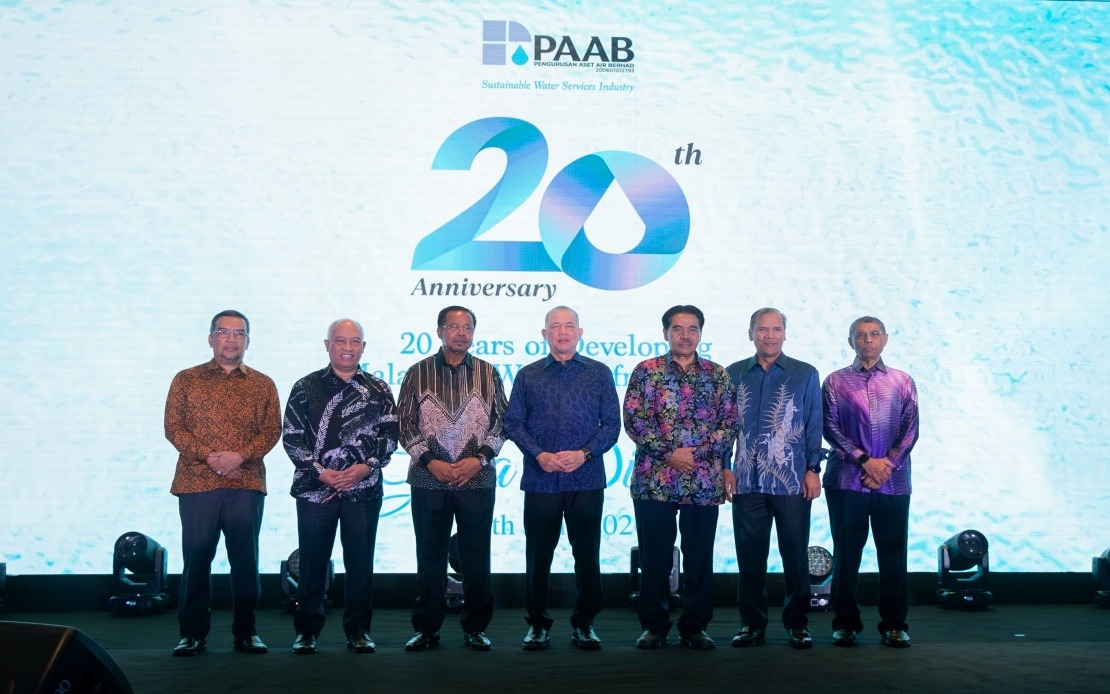
Malaysia's water sector restructuring agency, Pengurusan Aset Air Berhad (PAAB), has reached a significant milestone this month, marking two decades of efforts to modernise the country's water services infrastructure and bolster supply security. Since its establishment on May 5, 2006, the wholly-owned Finance Ministry company has channelled enormous resources into transforming a fragmented and ageing water system that serves 33 million people across the peninsula and East Malaysia. The scale of this undertaking has become increasingly apparent as PAAB's portfolio now encompasses financing totalling RM46.88 billion—a figure that underscores both the ambition and the considerable financial burden of revamping one of the country's most critical public utilities.
The financial architecture supporting PAAB's work reveals the magnitude of the transition underway. Over two decades, the agency has absorbed water industry debts amounting to RM23.04 billion, assuming liabilities that would otherwise constrain operators' ability to invest in essential upgrades. Simultaneously, PAAB has deployed RM23.84 billion directly into capital projects, creating tangible improvements in water treatment, storage, and distribution infrastructure. This dual role—debt manager and infrastructure investor—positions PAAB as a crucial stabiliser of a sector that historically suffered from chronic underinvestment and fragmented governance. By separating asset management from operational responsibilities, Malaysia has attempted to insulate long-term infrastructure development from the shorter-term pressures facing individual water companies.
Tangible progress has materialised across states that have formally committed to the National Water Services Industry Restructuring Plan. As of December 2025, ten state governments have signed on to the framework, unlocking coordinated development. The infrastructure gains achieved so far represent meaningful advances in water treatment and distribution capacity. Twenty-one water treatment plants now operational have combined production capacity of 2,085 million litres daily, while 42 new storage tanks add 783 million litres of buffering capacity. An extensive pipeline modernisation programme spanning 3,263 kilometres has expanded and replaced aging distribution networks that once lost water to leakage before reaching consumers. These projects address fundamental infrastructure deficits that have plagued Malaysia's water systems for decades.
Yet Deputy Prime Minister Fadillah Yusof, who oversees both energy transition and water transformation portfolios, sounded an urgent note during the agency's 20th anniversary dinner. Non-revenue water (NRW)—water lost to leakage, theft, and metering inaccuracies—remains stuck at approximately 40 per cent nationwide, a figure that rivals or exceeds rates in many developing nations. The persistence of such massive losses despite two decades of restructuring efforts suggests systemic challenges that incremental improvements alone cannot resolve. Fadillah's remarks reflected frustration with timelines that extend to 2050, characterising a decade-long implementation window as insufficient given the scale of problems. His emphasis on immediate, coordinated action involving federal agencies and state governments acknowledged that Malaysia's ability to attract foreign investment and support industrial expansion hinges on reliable water supply.
The data centre sector exemplifies the urgency underlying Fadillah's remarks. Malaysia has positioned itself as a regional hub for hyperscale data infrastructure, with international technology companies committing substantial capital to facilities requiring stable, abundant water and electricity supplies. Disruptions to water availability or quality could undermine these investments and damage Malaysia's competitive positioning in the Asia-Pacific region. The tension between Malaysia's long-term infrastructure timeline and the immediate expectations of global investors reflects a broader challenge: the legacy deficits accumulated over decades of underinvestment demand faster remediation than traditional government project cycles typically deliver. This dynamic has led policymakers to emphasise urgency and coordination, recognising that sectoral restructuring alone cannot substitute for political will and resource prioritisation.
PAAB's governance structure reveals how the agency attempts to balance strategic long-term planning with operational realities. The organisation implements the National Water Services Industry Restructuring Plan through a phased approach extending to 2050. The Migration phase (2008–2020) focused on transferring assets and establishing new governance frameworks. The current Stabilisation phase (2021–2030) emphasises strengthening operational efficiency and financial sustainability. Subsequent Consolidation (2031–2040) and Full Cost Recovery (2041–2050) phases envisage progressively higher tariffs and operational independence for water companies. This sequencing reflects an understanding that restructuring requires gradual tariff increases that society must absorb, balanced against the political risks of rapid utility cost escalation.
The RM23.84 billion capital expenditure portfolio reveals the project pipeline's composition and execution pace. Completed projects already handed over to operators account for RM8.33 billion in investment, while construction projects under way represent RM1.84 billion. The largest proportion—RM13.67 billion—remains in design and planning stages, indicating that the most substantial infrastructure expansion still lies ahead. This distribution suggests a multi-year execution period, requiring sustained political commitment and budgetary allocations across multiple government cycles. The concentration of uncommenced projects reflects both the planning demands of large-scale infrastructure and the financing challenges inherent in accelerating implementation.
PAAB's framing of success around water quality and supply reliability rather than purely financial metrics signals a shift in accountability thinking. The agency explicitly states that impact on consumers—measured through stable, clean, and quality water supply—constitutes its primary performance measure. This consumer-centred orientation acknowledges that Malaysian water sector reform ultimately serves public welfare and economic competitiveness, not investor returns or accounting metrics. The emphasis reflects learning from earlier utility restructuring experiences elsewhere in the region, where purely commercial frameworks sometimes overlooked equity and affordability considerations. For Malaysian policymakers, demonstrating tangible improvements in service reliability and water quality has become essential to maintaining public support for tariff increases and structural changes.
The participation of ten states in the restructuring framework represents progress, but also illustrates governance fragmentation that complicates sector-wide coordination. Malaysia's federal structure divides water authority between national and state governments, with peninsular states retaining significant control over water resources and service delivery. Full participation by all states remains incomplete, creating inconsistencies in implementation standards and investment timelines. This fragmentation partly explains why national aggregate metrics like the 40 per cent NRW figure mask considerable variation across regions. Some high-performing urban systems achieve NRW rates approaching 30 per cent, while others exceed 50 per cent, reflecting disparities in investment, technical capacity, and political commitment. Expanding the restructuring framework to encompassing states remains a priority.
International comparisons provide sobering context for Malaysia's water sector challenges. Many developed nations achieve NRW rates below 15 per cent through continuous investment and system maintenance, while developing countries often report figures between 35 and 50 per cent. Malaysia's persistent 40 per cent figure places it among the worse performers in its income category, representing enormous waste of a increasingly precious resource. The economic opportunity cost extends beyond the water itself; the energy consumed in treating and pumping water that never reaches paying customers constitutes a major hidden cost. Climate change intensifies pressure to address these inefficiencies, as prolonged droughts in Southeast Asia have demonstrated water's strategic importance. PAAB's two-decade tenure has established foundational infrastructure, yet the next phase must focus on operational excellence and distribution system integrity.
Looking ahead, PAAB's continued success depends on accelerating the shift from infrastructure construction to operational efficiency. While completing treatment plants and expanding storage capacity addresses supply-side constraints, the NRW problem demands intensive focus on distribution networks, metering, maintenance practices, and commercial management. Malaysian water companies must invest in digital technologies for leak detection, customer data systems, and demand management. The agency's evolving priorities reflect recognition that infrastructure assets, however well-constructed, cannot generate value without excellence in operations. The transition from Stabilisation to Consolidation phases will require water companies to demonstrate that restructuring creates genuine efficiency improvements visible to consumers through better service and potentially moderated tariff growth.

