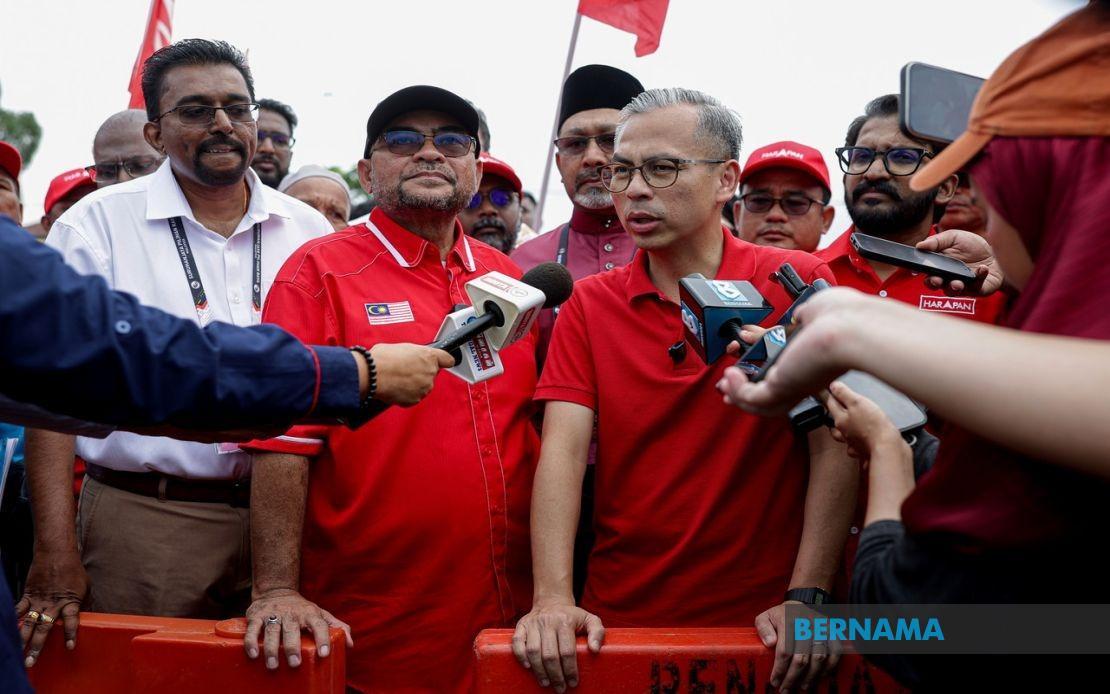
Pakatan Harapan is staking its campaign for the forthcoming Negeri Sembilan state election squarely on the administrative performance of incumbent Menteri Besar Datuk Seri Aminuddin Harun, positioning continuity as the linchpin of sustained prosperity. Communications Director Datuk Seri Fahmi Fadzil outlined the coalition's strategy at the candidate nomination centre in Jempol on July 18, emphasizing that voters should view the election as a referendum on six years of governance under the PH administration rather than a wholesale change of direction.
The performance metrics Fahmi presented paint a picture of a state government that has delivered tangible economic outcomes. Increased zakat collections signal stronger religious institutional capacity and community engagement, whilst surging revenue generation demonstrates improved fiscal management. Most significantly, the continued attraction of foreign direct investment—bolstered by the construction of a new port facility—suggests that Negeri Sembilan has positioned itself competitively within Malaysia's broader economic landscape. For a state that historically depended on mining and light manufacturing, these shifts represent meaningful diversification and economic modernization.
This messaging resonates within the broader Malaysian political context. As states across the country grapple with post-pandemic recovery and fiscal pressures, Aminuddin's administration has avoided the trajectory of declining revenues that plague less efficiently managed states. The administrative continuity argument also implicitly contrasts PH's governance model with the fracturing political coalitions in other states, where constant leadership transitions have disrupted policy implementation and investor confidence.
Fahmi, who holds dual responsibility as Communications Minister and coalition spokesperson, carefully framed the campaign as one of performance validation rather than partisan attack. This posture reflects PH's broader strategy of defending incumbency on technocratic grounds—a calculated shift from the ideological mobilization that characterized the 2018 general election. For Malaysian voters increasingly focused on pocketbook issues and service delivery, this pragmatic approach may prove more compelling than abstract political philosophy.
The specific case of the Jeram Padang seat illustrates how PH is tailoring its campaign to address constituency-level concerns. The selection of G. Manivannan, a lawyer and political secretary to Prime Minister Datuk Seri Anwar Ibrahim, signals an attempt to connect federal developmental resources directly to local employment anxieties. Young voters in the constituency have consistently raised job creation and economic opportunity, and PH's campaign will emphasize the infrastructure projects and investment initiatives cascading through the state. By deploying a candidate with direct access to the Prime Minister's office, the coalition sends a powerful signal about resource allocation and constituency priority.
Yet Manivannan faces a genuinely competitive four-cornered contest. Incumbent Datuk Mohd Zaidy Abdul Kadir represents Barisan Nasional's residual institutional strength in Negeri Sembilan, where the grand coalition has governed for decades. Perikatan Nasional's presence via R. Sri Sanjeevan reflects the fractious opposition dynamics plaguing the federal government—a split vote that could conceivably benefit PH if polarization fails to consolidate behind a single challenger. Most intriguingly, Dayana Dal's candidacy as Asli's sole Orang Asli representative introduces a genuine articulation of indigenous community interests, an increasingly important variable in Malaysian electoral contests as marginalized groups demand direct political representation.
Across the four Jempol parliamentary constituency seats up for grabs, the contests display Malaysia's evolving electoral complexity. Serting and Palong will feature three-way battles, suggesting fragmented voter bases where plurality victories become possible. Bahau's straight fight between PH's incumbent Teo Kok Seong (DAP) and BN's Chong Fui Ming (MCA) represents the sort of direct partisan clash that characterized earlier electoral cycles. The diversity of contest formats underscores how Malaysian state elections increasingly defy simple narratives of two-coalition competition.
Fahmi's appeal for responsible campaigning—explicitly invoking the need to avoid inflammatory rhetoric around the three Rs and combat misinformation—reflects growing institutional concern about social cohesion during electoral periods. As Communications Minister, his dual role positions him as both political operative and custodian of democratic norms, a tension inherent in Malaysian governance structures. His commitment to monitor media practitioner welfare during the campaign reflects acknowledgment that election periods can create hostile environments for independent journalism, a concern that has intensified across Southeast Asia.
The Election Commission's schedule—early voting on July 28 and polling day on August 1—compresses the campaign into a two-week window, limiting time for voter persuasion and coalition-building. This compressed timeline may advantage the incumbent, whose administrative machinery and media access provide built-in amplification. For opposition forces, the tight calendar requires surgical targeting of swing constituencies rather than sustained grassroots mobilization.
Negeri Sembilan's state election carries implications extending well beyond the state's boundaries. As a relatively affluent state with diversified economic foundations, its electoral outcome will signal whether Malaysian voters reward performance-based governance or whether political realignment continues to override incumbency advantages. If PH successfully defends its administration on administrative grounds, the model becomes exportable to other states where the coalition holds power. Conversely, if opposition fragmentation delivers unexpected gains, it could embolden anti-PH forces nationwide and destabilize the coalition's federal dominance.
The broader significance lies in whether Malaysian electoral politics is consolidating around technocratic performance metrics or remaining volatile terrain where institutional competence counts for less than tribal political affiliation. PH's Negeri Sembilan campaign essentially tests this proposition, betting that six years of demonstrable administrative achievement will convince voters that continuity trumps partisan cycles. The August 1 results will provide revealing evidence about the trajectory of Malaysian democracy.

