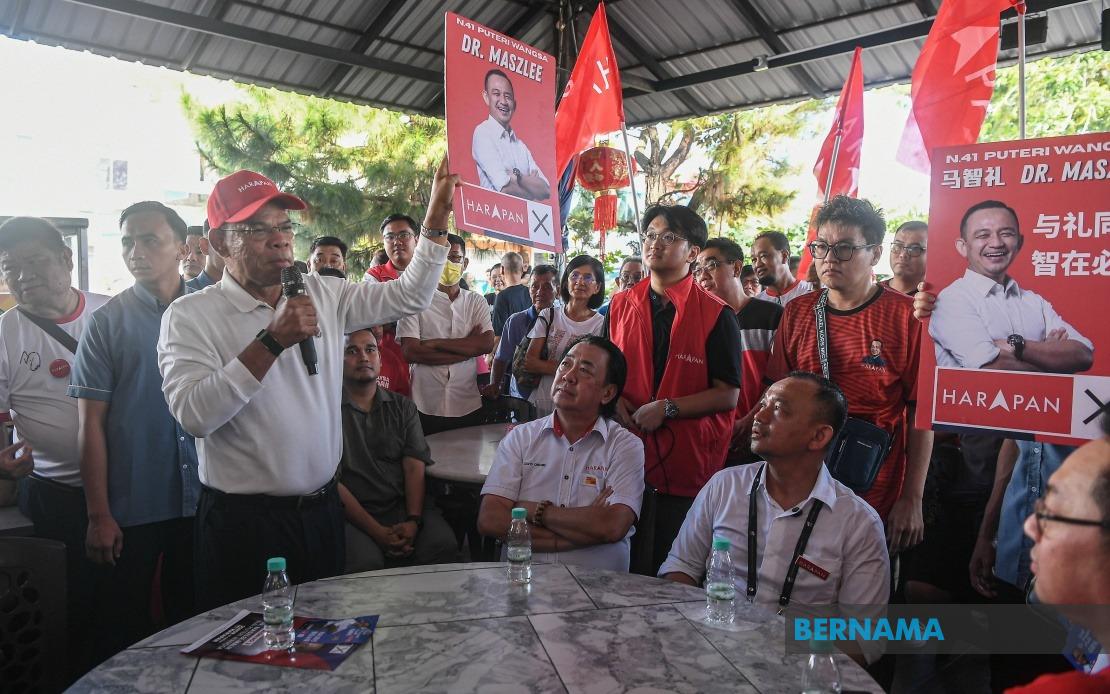
Pakatan Harapan's momentum in the Johor state election campaign reflects the strategic depth of its ground operation, according to coalition leadership. Speaking in Johor Bahru on July 5, PH secretary-general Datuk Seri Saifuddin Nasution Ismail attributed the coalition's rising electoral prospects to a carefully calibrated campaign methodology that differentiates between the 56 contested seats based on realistic assessments of support levels across the state.
The coalition's approach treats each constituency as a distinct political and demographic landscape rather than applying a uniform campaign formula. Saifuddin Nasution explained that PH has categorized seats according to priority tiers, enabling the coalition to allocate campaigning resources and messaging to areas where such investments yield maximum returns. This nuanced methodology acknowledges that a seat like Puteri Wangsa requires fundamentally different organisational approaches than Johor Lama, just as Larkin cannot be treated identically to Endau. By clustering constituencies into priority-based groupings, PH aims to concentrate its finite human and financial resources on areas where incremental gains are most achievable.
The strategic sophistication extends beyond internal resource allocation to encompass comparative positioning against rival political forces. Saifuddin Nasution pointed to decisions by PAS as inadvertently advantageous to PH's campaigning environment. PAS's choice to contest only 11 seats and explicitly direct supporters to back Barisan Nasional in remaining constituencies creates a fragmented opposition message that potentially confuses voters and consolidates anti-BN sentiment around PH as the clearer alternative. In contrast, PH has announced its seat distribution across all 56 constituencies with transparent clarity, allocating 20 seats to PKR, 19 to Amanah, and 17 to DAP. This comprehensive approach, paired with what the coalition describes as a realistic and implementable manifesto, presents voters with a coherent narrative of unity and credible governance.
The confluence of these strategic factors—granular constituency targeting combined with opposition fragmentation—explains the measurable support trends PH claims to observe across Johor. Saifuddin Nasution characterised the support pattern as driven by both PH's disciplined campaign architecture and unforced errors by competing political forces. The coalition's willingness to fight every seat contrasts sharply with PAS's selective engagement, signalling confidence and comprehensive commitment to Johor voters across urban, suburban, and rural constituencies alike.
Beyond campaign mechanics, PH has sought to build momentum through high-profile endorsements and cross-factional coalition-building. The appearance of Datuk Dr Mohd Puad Zarkashi, a former UMNO Supreme Council member, alongside Prime Minister Datuk Seri Anwar Ibrahim at Felda Ulu Tiram was framed as adding credibility to PH's governance narrative. The visible presence of defectors or sympathetic figures from the ruling coalition's traditional power base signals that PH's appeal transcends its traditional voter base, potentially attracting dissatisfied segments within the UMNO-BN coalition itself.
Candidate quality has emerged as another dimension of PH's strategic messaging. Saifuddin Nasution characterised Dr Maszlee Malik, PH's Puteri Wangsa candidate, as exemplifying the calibre of candidates the coalition is fielding. Such endorsements serve dual purposes: they reinforce local constituency-level support while simultaneously constructing a broader narrative about PH's ability to field qualified, capable individuals capable of governing effectively. This emphasis on candidate competence becomes particularly relevant in constituencies where voters harbour doubts about PH's governance track record or administrative capacity.
The electoral mechanics of the Johor contest provide context for these strategic calculations. A total of 172 candidates are contesting across the 56 state seats, indicating relatively fragmented competition. Polling day is scheduled for July 11, with early voting occurring on July 7, compressing the campaign window and placing a premium on efficient, targeted voter contact efforts. In this compressed timeframe, PH's prioritization strategy becomes even more critical—every campaign hour and every door knock must count toward victory in winnable constituencies.
For Malaysian observers and regional analysts, the Johor election represents a microcosm of broader trends in Malaysian electoral politics. The increasing sophistication of constituency-level campaign analytics, the fragmentation of the Malay-Muslim opposition through PAS's selective participation, and the continued significance of cross-ethnic coalition-building through visible UMNO defections all signal an evolving competitive landscape. PH's confidence in announcing full 56-seat participation, despite not being guaranteed victory in every constituency, suggests the coalition believes its political positioning and candidate quality are sufficiently strong to warrant comprehensive engagement.
The election also illuminates tensions within Malaysia's opposition landscape. PAS's tactical decision to contest minimally and direct supporters elsewhere reflects fundamentally different electoral philosophies from PH's approach. Whether PAS's strategy represents pragmatic realism about its competitive capabilities or a political miscalculation that fragments anti-BN votes remains to be tested on July 11. PH's messaging—that its transparent, comprehensive approach offers superior governance prospects compared to opposition fragmentation—will resonate only if translated into actual electoral victories.
Looking forward, the Johor results will provide data points on whether PH's strategy of granular constituency prioritisation combined with message consistency actually delivers superior electoral outcomes compared to traditional blanket campaigning approaches. Success in Johor would validate PH's methodology and likely influence the coalition's approach in subsequent elections, including future federal contests. Conversely, underperformance would suggest that strategic sophistication alone cannot overcome deeper structural challenges facing the coalition.

