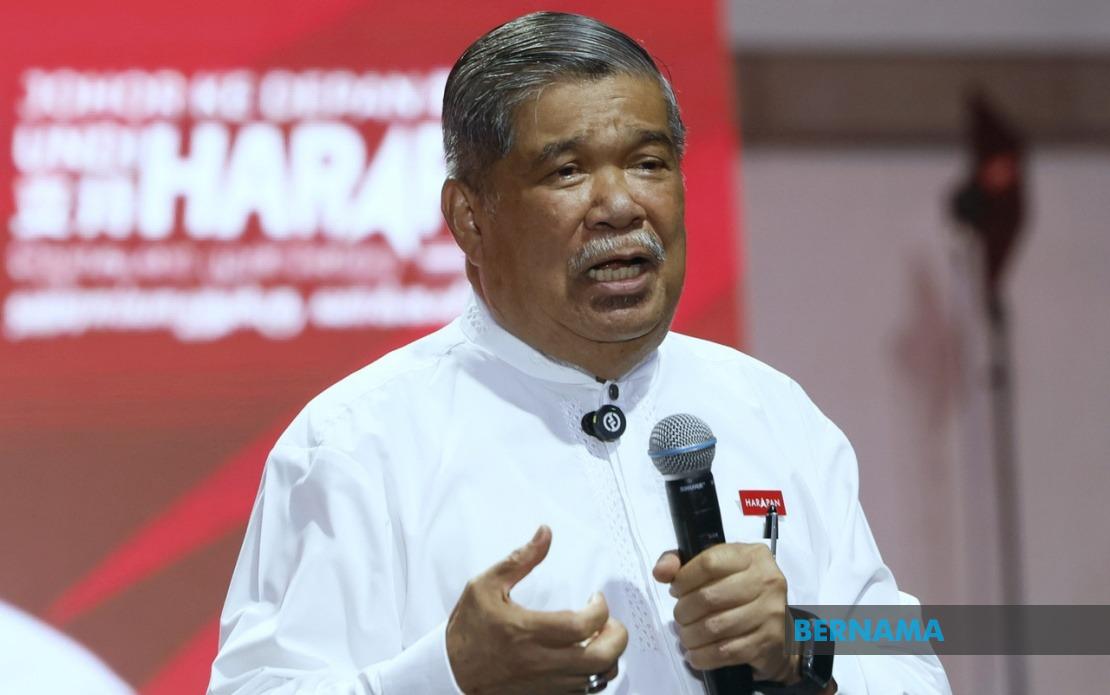
Pakatan Harapan has dismissed concerns about a PAS directive that would see the Islamist party's supporters back Barisan Nasional candidates in seats the coalition is not contesting in the Johor state election. Amanah president Datuk Seri Mohamad Sabu told reporters in Johor Bahru that the opposition coalition's campaign machinery remains unfazed by the move, which represents a significant juncture in Malaysian electoral politics given the historical tensions between PAS and other opposition parties.
Speaking after a PH event in Permas Jaya on July 1, Mohamad Sabu stressed that the opposition would proceed with its planned campaign schedule without allowing tactical maneuvers by rivals to dictate its strategy. The comments underscore a growing confidence within PH ranks heading into the July 11 polling day, when voters across all 56 state seats will cast their ballots. The Amanah chief and current Minister of Agriculture and Food Security rejected suggestions that external pressure or competitive positioning from opposing camps would alter PH's approach or messaging.
At the heart of PH's counter-strategy lies an appeal grounded in the coalition's foundational strength: its commitment to multiracial and multi-religious cooperation. Mohamad Sabu framed this as more than mere political packaging, contending instead that such collaboration represents the bedrock upon which genuine political stability must be constructed and economic progress ultimately depends. He argued that voters ought to resist appeals based on narrow communal or sectarian considerations, advocating instead for a more rational calculus based on individual competence, demonstrated service records, and demonstrated commitment to principles of justice and equitable governance.
The Amanah leader called on Johor voters to grant PH the electoral mandate needed to ensure governmental alignment between the state and federal levels, a critical consideration in Malaysia's federal system where policy implementation frequently requires coordination across multiple administrative tiers. Such alignment, he suggested, would unlock the potential for accelerated development projects tailored to Johor's specific needs and advantages. He highlighted several concrete initiatives that would benefit from this coordinated approach, including a comprehensive overhaul of the public transport infrastructure, modernization of facilities at international border crossings, and targeted efforts to attract high-value foreign investment into the state economy.
DAP strategic director Liew Chin Tong, who also serves as Deputy Finance Minister, injected a different analytical dimension into the campaign conversation by emphasizing the critical role of voter participation in determining electoral outcomes. He specifically highlighted the youth vote as a potentially decisive factor that could tip the balance in PH's favor, arguing that mobilization efforts must prioritize younger voters who have historically demonstrated lower turnout rates. This calculation reflects lessons drawn from the 2022 Johor state election, when BN benefited significantly from suppressed voter participation among opposition-leaning demographics.
Liew pointed to the previous election cycle as instructive on how structural factors can advantage certain political camps. In 2022, the combination of low overall turnout and the inability of Johor residents employed in Singapore to return home and cast votes—owing to COVID-19 travel restrictions still in force at that time—created conditions that substantially benefited BN. While those pandemic-related constraints no longer apply to the same degree, the underlying challenge of mobilizing Johor workers in neighboring Singapore remains relevant, particularly given the significant number of state residents who commute across the causeway for employment.
The DAP official pivoted the campaign conversation toward substantive policy differentiation, arguing that the second phase of campaigning should transcend the customary ritual of political rivalry and instead emphasize concrete policy proposals with tangible benefits for ordinary voters. He identified employment as a primary concern, particularly the creation of high-quality jobs offering competitive compensation that would reduce the necessity for young Johoreans to seek work across the border in Singapore. This framing transforms a demographic problem—youth outmigration—into a policy challenge that the state government must actively address through economic development initiatives.
Liew outlined an expansive agenda of state-level priorities that extend well beyond traditional economic metrics. Infrastructure challenges, particularly those related to urban flooding and the maintenance of drainage and river systems, featured prominently in his enumeration of urgent concerns. Additionally, he emphasized the state government's responsibility to anticipate demographic shifts associated with population aging and to establish robust childcare facilities that would support workforce participation among families. These issues reflect the granular, service-delivery-oriented concerns that often determine voter satisfaction with state governments, particularly in urban and semi-urban constituencies.
Central to PH's electoral pitch is the argument that close cooperation between the federal government and the state administration is not merely desirable but essential for unlocking development potential. Liew emphasized this point in discussing the Johor-Singapore Special Economic Zone, a major infrastructure and economic initiative that requires coordination between multiple governmental jurisdictions and levels. He contended that PH control of both the state and federal apparatus would facilitate seamless implementation of such cross-border projects, thereby generating the high-quality employment opportunities that younger voters increasingly demand. This logic positions federal-state alignment as a practical economic necessity rather than a theoretical political virtue.
The positioning reflects a broader strategic recognition within PH that voters, particularly in economically sophisticated states like Johor, increasingly demand technical competence and results-oriented governance rather than appeals based primarily on historical narratives or ideological abstractions. By grounding its campaign messaging in concrete development outcomes and addressing tangible quality-of-life concerns, PH attempts to reframe the electoral contest around delivery capacity and future vision rather than reactive politics or factional maneuvering.
As the campaign enters its final phase before early voting on July 7 and general polling on July 11, the positioning of both coalitions has become increasingly clear. BN, with PAS support in certain constituencies, appeals to communal and historical solidarities, while PH emphasizes institutional effectiveness and multiracial cooperation. The outcome will likely reflect which messaging framework resonates more powerfully with Johor voters, particularly in a state where rapid urbanization and economic integration have transformed electoral calculations compared to earlier election cycles.

