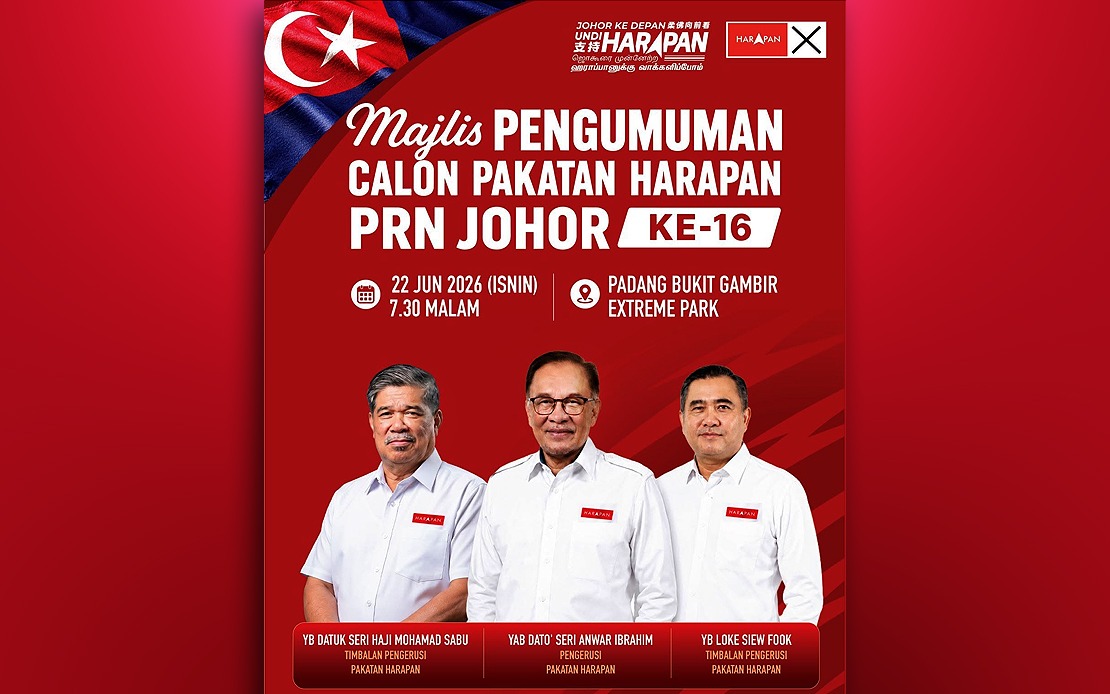
Pakatan Harapan plans to release a comprehensive election manifesto for the Johor state contest within days of the June 27 nomination deadline, signalling the coalition's confidence in presenting a detailed platform to voters ahead of the July 11 polling day. PKR vice president Datuk Seri Amirudin Shari made the announcement at a candidate unveiling ceremony in Tangkak, emphasizing that the manifesto's preparation is well advanced and ready for public presentation once the formal nomination process concludes this Saturday.
The manifesto, carrying the banner 'Johor Ke Depan', represents a deliberate strategy by the coalition to position itself as a proven administrator capable of delivering tangible results. Rather than offering mere promises, PH intends to ground its campaign narrative in concrete evidence drawn from its governance record across multiple Malaysian states. This approach reflects a calculated decision to counter any suggestions that the coalition lacks practical experience or credibility in state administration.
The coalition's foundation for this manifesto rests on its track record in managing three significant states: Selangor, Penang, and Negeri Sembilan. Each of these administrations has demonstrated particular strengths in areas ranging from infrastructure development to fiscal management, providing what PH views as compelling benchmarks for what voters might expect in Johor. The manifesto is designed to translate these achievements into specific policy commitments tailored to Johor's distinctive economic and social landscape.
For Malaysian voters and political observers, this timing carries strategic implications. By announcing the manifesto after nomination day rather than before, PH ensures that its candidate slate is finalized and committed before the public examination of specific pledges begins. This sequencing allows the party to calibrate its promises with full knowledge of its parliamentary team's composition and capabilities, reducing the risk of commitments that exceed organizational capacity.
The announcement also reflects confidence among PH leadership regarding the composition of its Johor candidates. Senior figures including PH chairman Datuk Seri Anwar Ibrahim, DAP secretary-general Anthony Loke, and Amanah president Datuk Seri Mohamad Sabu attended the ceremony, signalling unified coalition messaging. This broad leadership presence suggests harmony within PH's three-party coalition structure, at least regarding the campaign direction.
Election Commission schedules indicate that the campaign period will be relatively compressed. With nomination day on June 27, early voting on July 7, and election day on July 11, the manifesto launch will occupy a crucial window during the formal campaign phase. The timing allows PH approximately two weeks to promote its policy platform and respond to competing narratives from other political blocs before voters cast their ballots.
For Johor specifically, the manifesto represents PH's attempt to present a forward-looking vision distinct from governance approaches offered by rivals. The 'Johor Ke Depan' branding explicitly emphasizes progress and advancement, positioning the coalition as forward-thinking and development-focused rather than status quo-oriented. This messaging proves particularly significant in Johor, traditionally one of Malaysia's economically important states with distinct regional identity and governance expectations.
The coalition's emphasis on drawing from experience in Selangor, Penang, and Negeri Sembilan acknowledges that Malaysian voters increasingly evaluate political parties on administrative performance. These three states represent different demographic and economic profiles, allowing PH to demonstrate adaptability and capability across diverse contexts. Selangor's urbanized, high-density characteristics contrast with Penang's island economy and tourism-dependent sectors, while Negeri Sembilan presents a more mixed rural-urban profile, suggesting PH has grappled with varied governance challenges.
This approach also positions PH competitively against incumbent governments and opposition blocs that must justify their own records or propose untested policies. By anchoring campaign promises in documented achievements rather than theoretical frameworks, PH attempts to shift electoral discourse toward evaluation of proven competence rather than ideological positioning or historical grievances. For Johor voters assessing which coalition is genuinely capable of delivering promised developments, such an evidence-based approach carries particular weight.
The broader context matters for understanding PH's campaign strategy. Malaysian electoral politics increasingly emphasizes state-level governance competence, reflecting voter concerns about corruption, service delivery, and economic management. PH's determination to highlight its administrative track record in three states reflects recognition that opposition voters and swing voters weigh demonstrated capability heavily. The manifesto launch thus becomes not merely a formal campaign obligation but a central element of PH's narrative framework.
The compressed timeline between nomination and polling creates urgency around manifesto presentation and dissemination. Media coverage of the manifesto announcement, coupled with traditional campaign activities, must accomplish significant persuasion work within fourteen days. PH's decision to finalize and announce the manifesto quickly after nominations reflects understanding that the campaign window permits minimal delay in reaching voters with substantive policy messaging.
For Southeast Asian observers monitoring Malaysian politics, the Johor election demonstrates how regional political coalitions increasingly ground campaigns in administrative performance records rather than abstract principles or personality politics. PH's approach suggests that competitive multiparty democracy in Malaysia has evolved toward demanding specific, evidence-backed commitments from competing coalitions. This evolution reflects growing voter sophistication and heightened expectations for transparency regarding governance capacity and policy implementation.

