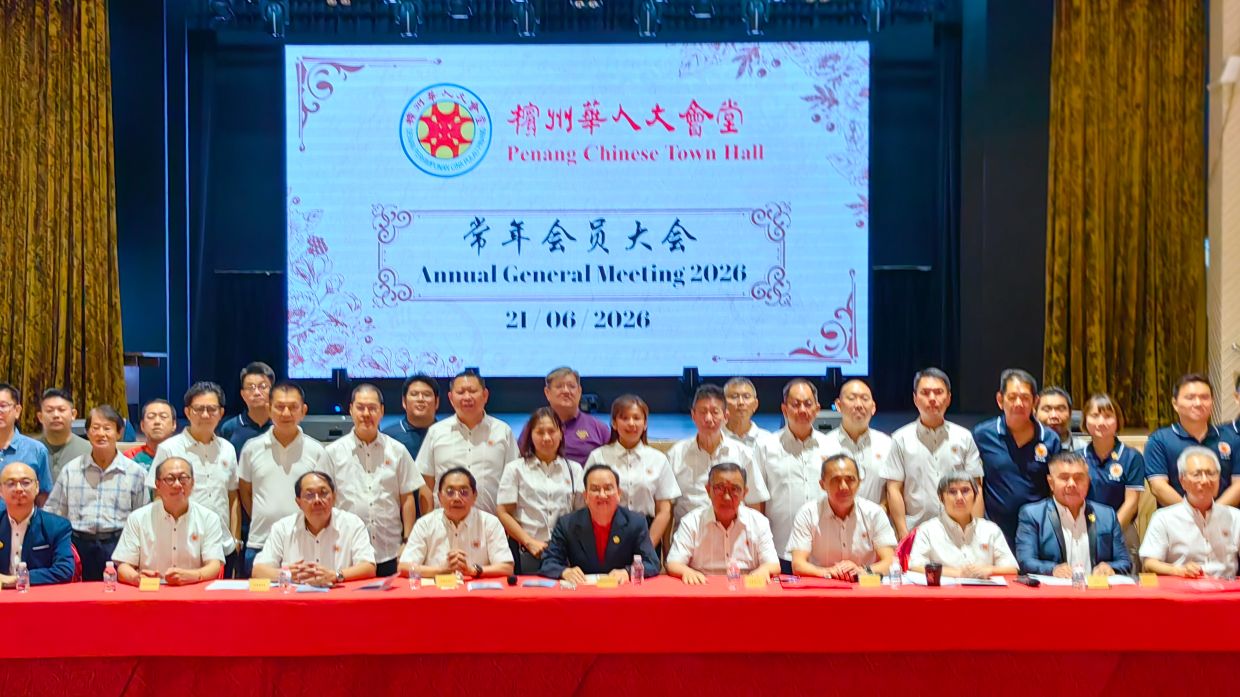
Penang Chinese Town Hall has closed its 2025 financial year with total revenue of RM12.61mil and expenditure of RM12.55mil, generating a modest surplus of RM59,191. The result reflects the organisation's continued reliance on community support alongside its diversified income streams, though the tight margin between revenue and spending underscores the operational pressures facing longstanding cultural and community institutions in the region.
Donations remain the financial backbone of PCTH's operations, contributing RM11.24mil or nearly 89 per cent of total income during the year. This substantial inflow of philanthropic support from members and community contributors demonstrates the enduring relevance and trust placed in the hall's mission within Penang's Chinese community. Beyond donations, the organisation generates revenue through rental and maintenance fees totalling RM439,671, auditorium rental income of RM361,245, and anniversary-related receipts amounting to RM222,498. This diversification, though modest in scale relative to donation income, provides some stability and reduces dependency on voluntary contributions alone.
On the spending side, donations distributed to various community causes and charities consumed RM11.12mil, representing approximately 88.6 per cent of total expenditure and reflecting PCTH's commitment to philanthropic work within the community. This represents a significant decrease from RM12.35mil in charitable disbursements during 2024, signalling either a more selective approach to fund allocation or changed priorities in grant-making. Meanwhile, personnel costs have climbed, with salaries and allowances reaching RM502,625 compared to RM452,761 in the previous year—a rise of nearly 11 per cent that mirrors broader wage pressures across Malaysian organisations and raises questions about staffing expansion or wage adjustments necessary to retain talent.
At its annual general meeting held on June 21, attended by approximately 200 members, PCTH's chairman Tan Sri Prof Tan Khoon Hai seized the opportunity to address broader civic concerns, urging Malaysians to exercise their electoral responsibilities thoughtfully. His remarks carry particular weight given the state election calendar, with Johor and Negri Sembilan scheduled to conduct polls during 2025. Tan's call for voters to assess party performance and manifestos objectively, rather than succumbing to partisan emotion, reflects a measured approach to democratic participation that many civil society voices in Malaysia have championed as essential to national stability.
Tan's emphasis on electing candidates capable of promoting unity, driving economic growth, and maintaining social stability positions elections not merely as local contests but as determinative moments in shaping Malaysia's trajectory. This framing resonates particularly in multiethnic Malaysia, where community leaders often face pressure to mobilise their constituencies along ethnic or religious lines. By encouraging rational evaluation of candidates and platforms, the chairman articulates a vision of elections as mechanisms for selecting capable administrators rather than zero-sum competitions between identity groups—a perspective that carries implications for how Penang's Chinese community participates in the broader democratic process.
Capital investment in facility modernisation represents another dimension of PCTH's 2025 activity. The organisation has completed extensive renovation and upgrading of Ping Zhang Hall, introducing contemporary infrastructure including professional-grade sound, lighting, and LED systems alongside improved spatial design. The refurbished venue now positions itself as suitable for corporate dining events, association celebrations, anniversary functions, charity gatherings, and broader community assemblies. This infrastructure upgrade signals confidence in sustained demand for cultural and civic gathering spaces even as digital platforms proliferate, and reflects investment in physical community assets that remain central to social cohesion in Malaysian Chinese communities.
Perhaps most significantly, PCTH has announced plans to jointly organise the 2026 China-Asean Artificial Intelligence Cooperation Forum in Penang during November, partnering with technology and business organisations from China and across the Asean region. This initiative positions the hall not merely as a community centre but as a platform for facilitating regional technological collaboration and knowledge exchange. Penang's established identity as the Silicon Valley of the East, underpinned by its robust electrical and electronics manufacturing base, provides natural foundation for such technological forums.
Tan emphasised that the AI cooperation forum would convene experts, business leaders, and industry representatives across Southeast Asia to examine emerging artificial intelligence technologies, practical industrial applications, and transnational collaborative opportunities. The forum's staging in Penang reflects strategic recognition that the state possesses both the technological infrastructure and the international connectivity necessary to host substantive regional conversations about artificial intelligence's trajectory and deployment. For Malaysia more broadly, hosting such platforms strengthens Penang's position within regional innovation networks and potentially elevates the nation's profile in Asean technological development discussions.
The forum initiative also invites PCTH members with relevant expertise to participate actively, transforming the organisation from primarily a custodian of cultural heritage into a convener of contemporary technological discourse. This dual function—maintaining tradition whilst engaging cutting-edge industrial transformation—reflects how established community institutions are adapting to remain relevant in rapidly evolving economic and technological contexts. By leveraging its standing and facilities to facilitate regional AI cooperation, PCTH exemplifies how cultural organisations can position themselves at intersections of heritage, community service, and contemporary economic participation.

