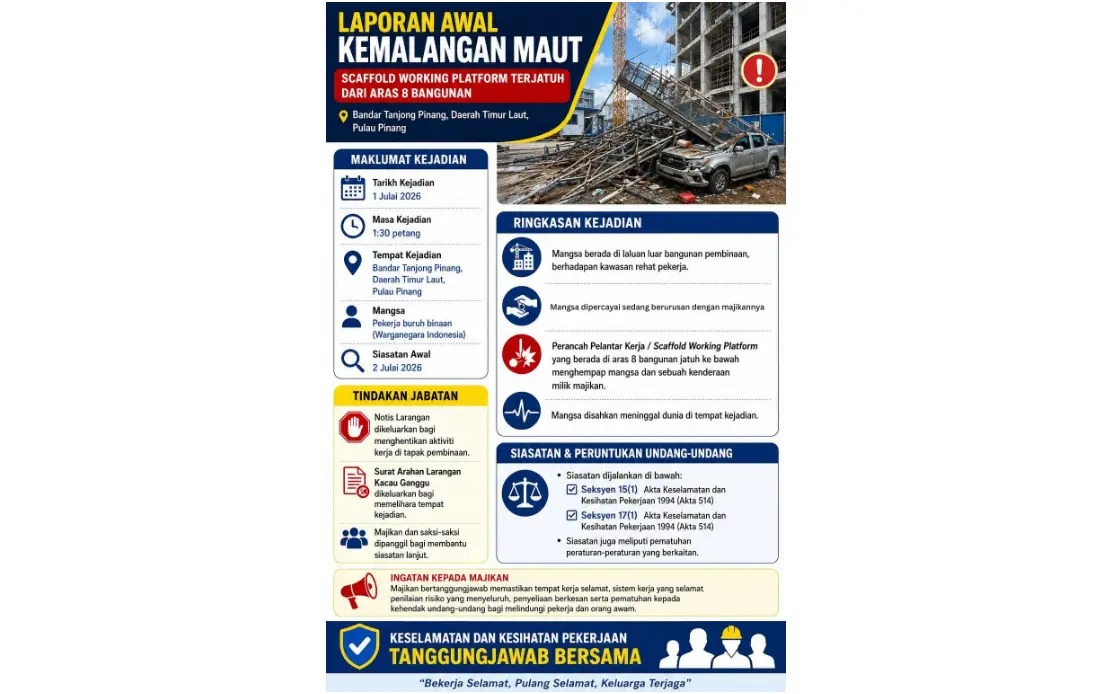
The Department of Occupational Safety and Health (DOSH) Penang branch has moved swiftly to shut down operations at a Bandar Tanjong Pinang building site where an Indonesian construction worker died after being struck by a collapsed scaffolding platform on July 1. The incident has prompted renewed scrutiny of workplace safety protocols in Penang's booming construction sector, an industry that continues to attract significant migrant worker participation across Malaysia.
According to DOSH, the fatal accident occurred at 1.30 pm when a working platform fell from the eighth storey of the building. The worker was positioned at a lower level on an external walkway situated in front of a rest area designated for construction personnel. He was reportedly engaged in communication with his employer at the moment of impact. The falling scaffold not only struck the victim but also damaged a vehicle belonging to the employer, underscoring the force and unexpected nature of the collapse.
In response to the tragedy, authorities have implemented comprehensive containment measures. A prohibition notice was immediately issued to cease all construction-related work at the site, while a non-disturbance order has been placed to maintain the scene in its original state. These measures are critical for investigators who need to preserve physical evidence and reconstruct the sequence of events that led to the platform's failure.
The investigation now underway carries significant legal weight. DOSH personnel are examining whether the employer and other relevant parties complied with Sections 15(1) and 17(1) of the Occupational Safety and Health Act 1994 (Act 514), provisions that mandate employers to take reasonable steps to ensure the safety of workers and to provide adequate information, instruction, training, and supervision. These statutory obligations form the backbone of Malaysia's workplace safety regime and apply uniformly across the country to both local and foreign workers.
Investigators are systematically collecting statements from employers and witnesses to establish a comprehensive timeline and identify contributing factors. The focus extends beyond simple negligence to encompass systemic failures in planning, execution, and safety management that may have enabled this tragedy. Such inquiries frequently uncover multiple deficiencies rather than single points of failure, offering valuable lessons for the broader construction industry.
Penang's regulatory stance reflects a growing intolerance for workplace fatalities in an era when construction standards and safety awareness have substantially improved. The state has positioned itself as relatively stringent in enforcing occupational safety requirements, a posture that carries implications for developers and contractors operating in the region. Companies operating across Malaysia's states must navigate varying enforcement intensities, with Penang consistently ranking among stricter jurisdictions.
The incident raises questions about temporary worker protections, particularly for migrant labourers who often occupy precarious positions on construction sites. Indonesian workers comprise a substantial portion of Malaysia's foreign construction workforce, yet language barriers, limited familiarity with local regulations, and hierarchical workplace dynamics can combine to place them at heightened risk. This case will likely prompt review of how employers communicate safety protocols to non-Malaysian-speaking personnel.
DOSH has indicated that enforcement action will be pursued if violations are discovered during the investigation. Such actions can range from substantial financial penalties imposed under Act 514 to potential criminal prosecution of responsible individuals if negligence or recklessness is substantiated. High-profile enforcement decisions send powerful signals throughout the construction sector regarding regulatory expectations.
The agency has used this incident as an opportunity to issue broader reminders to employers, developers, main contractors, and subcontractors about fundamental safety obligations. Construction site work must be thoroughly planned before commencement, with hazards identified and mitigated through appropriate control measures. Scaffolding and temporary access equipment require particular attention given their critical role in enabling safe worker access and their potential to cause catastrophic harm if they fail.
For Malaysia's construction industry, which continues to expand amid infrastructure development projects nationwide, this incident serves as a sobering reminder that growth must be accompanied by uncompromising safety standards. The sector employs hundreds of thousands of workers, including substantial numbers of foreign nationals, and construction-related fatalities remain a persistent problem despite regulatory frameworks and awareness campaigns.
The suspension of work at the Bandar Tanjong Pinang site will impose costs on the project owner and contractors, but such consequences are precisely designed into occupational safety legislation as deterrents against corner-cutting. When a worker loses his life due to preventable causes, regulatory agencies must respond decisively to demonstrate that human safety supersedes commercial timelines.
As the investigation progresses, the findings will likely be documented and shared across the construction industry through DOSH channels and professional bodies. Such dissemination of lessons learned helps establish best practices and provides cautionary examples that might prevent similar incidents elsewhere in Malaysia and the region. The incident underscores that workplace fatalities are not inevitable consequences of construction work but rather preventable outcomes of inadequate planning, maintenance, and supervision.

