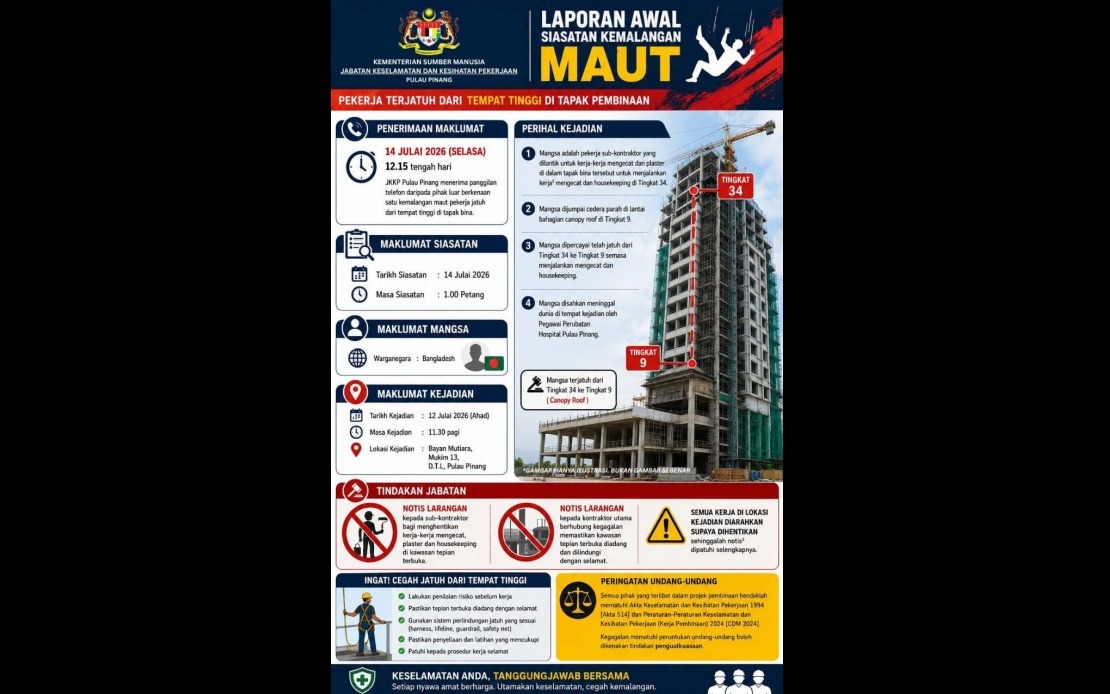
The Penang Department of Occupational Safety and Health has launched a formal investigation into the death of a Bangladeshi construction worker who plummeted from an upper floor of a building still under development in Bayan Mutiara, highlighting persistent safety concerns at Malaysian construction sites. Penang DOSH director Hairozie Asri disclosed that the department was alerted to the fatal incident at 12.15 pm on July 14, prompting an immediate dispatch of investigating officers to the location.
According to preliminary findings, the deceased worker was employed as a subcontractor engaged in painting, plastering, and housekeeping duties on the building project. The investigation revealed that he had been assigned to work on the 34th floor before sustaining fatal injuries, with his body subsequently discovered on the canopy roof structure at Level 9. Medical personnel from Penang Hospital later pronounced him dead at the scene, establishing what appears to be a fall of approximately 25 storeys.
The incident underscores the vulnerability of foreign workers in Malaysia's construction sector, where Bangladeshi nationals comprise a significant portion of the frontline labour force. Migrant workers frequently undertake the most hazardous roles on building sites, often with limited safety training, language barriers that impede communication of hazard warnings, and inadequate protective equipment. The nature of the fatal fall—from open-edge areas on upper floors—suggests that essential fall-prevention measures may have been lacking or improperly implemented.
In response to the fatality, DOSH has initiated enforcement action against both the subcontractor and main contractor responsible for the site. The department issued a prohibition notice specifically targeting the subcontractor, directing the immediate cessation of all painting, plastering, and housekeeping operations in open-edge areas. This targeted prohibition reflects regulatory concern that these particular work categories were being performed without adequate fall protection systems.
Simultaneously, a comprehensive prohibition notice was served on the main contractor, resulting in a complete work stoppage across the entire accident site. All construction activities have been ordered to halt entirely until both contractors can demonstrate full compliance with the issued notices and satisfy the department's safety requirements. This blanket suspension represents a significant operational and financial consequence for the project, with the duration of the stoppage dependent on how swiftly remedial safety measures are implemented.
The incident reinforces systemic challenges within Malaysia's construction industry regarding worker safety management. Despite regulatory frameworks including the Occupational Safety and Health Act 1994 and various industry guidelines, fatal accidents continue to claim lives at alarming rates. Many construction firms prioritise schedule and cost considerations over comprehensive safety protocols, particularly when employing vulnerable migrant workers who may lack awareness of their legal entitlements or fear jeopardising their employment by reporting unsafe conditions.
From a regulatory perspective, the incident highlights the critical distinction between nominal compliance and genuine safety culture. While prohibition notices demonstrate that authorities possess enforcement powers, the tragic fatality indicates that preventive mechanisms upstream—such as rigorous pre-construction safety planning, mandatory worker training in appropriate languages, regular workplace inspections, and accountability mechanisms for contractors with poor safety records—require strengthening. The fact that the worker was found on a structure 25 storeys below his assigned work area raises questions about whether appropriate guardrails, safety nets, or personal protective equipment were in place.
For Malaysian businesses and foreign worker advocates, this case exemplifies the precarious situation faced by migrant labourers in the construction sector. Bangladeshi workers, many of whom support families back home through remittances, often accept roles with minimal negotiation of safety terms, creating an environment where employers face limited pressure to invest in comprehensive fall protection systems. The language barrier compounds these vulnerabilities, as safety instructions and warnings may not be adequately conveyed to non-Malay-speaking workers.
The Penang DOSH investigation will likely examine multiple dimensions of site safety management, including whether a safe work method statement existed for work at height, whether workers received appropriate induction and toolbox briefings, whether fall protection equipment was provided and maintained to regulatory standards, and whether supervision protocols included regular monitoring of high-risk activities. These investigative findings will inform potential prosecution decisions and may shape future enforcement approaches across the construction industry.
Beyond immediate enforcement, this fatality should prompt serious reflection within Malaysia's construction sector regarding the true cost of safety shortcuts. The incident represents not merely a regulatory violation or statistical addition to occupational fatality records, but a human tragedy with ripple effects extending across continents—affecting the deceased worker's dependents in Bangladesh and fundamentally undermining trust between migrant workers and Malaysian employers. Construction industry associations, multinational corporations operating in Malaysia, and government agencies must collectively establish stronger accountability mechanisms to ensure that foreign workers are afforded protection equivalent to that of Malaysian nationals.

