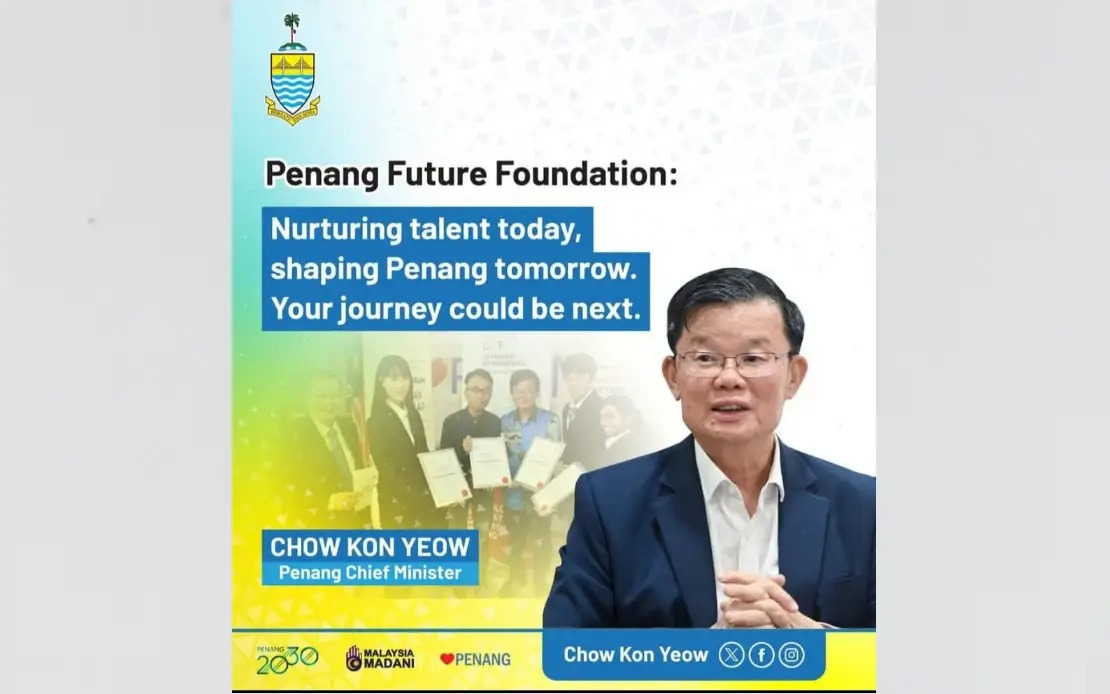
The Penang Future Foundation, a publicly and privately funded initiative launched by the Penang state government in 2015, has become a significant engine for talent development across Malaysia. Since its establishment, the foundation has channelled approximately RM47.7 million towards supporting 863 outstanding students, with the scholarship programme now entering its eleventh year of operation. This sustained commitment to educational financing reflects Penang's strategic approach to human capital investment in an increasingly competitive regional economy.
Chief Minister Chow Kon Yeow emphasised that the foundation serves a crucial economic function beyond mere philanthropic intent. As Penang positions itself for another five decades of growth and investment attraction, the state recognises that retaining home-grown talent has become inseparable from its industrial competitiveness. The foundation operates on a hybrid funding model that blends government resources with private sector participation, creating a collaborative framework where businesses directly support the workforce pipeline they will eventually draw from. This partnership approach reduces the fiscal burden on public coffers whilst ensuring that scholarship criteria remain aligned with actual market demands.
In the most recent cycle, the foundation extended financial support to 58 students across multiple disciplines. The concentration on STEM fields—Science, Technology, Engineering, and Mathematics—alongside Accountancy and Finance reflects where Malaysian employers face the most acute skills shortages. This targeted approach differs from undirected scholarship models that may inadvertently support students in oversupplied professions, making the foundation's discipline selection particularly efficient for state economic planning.
The foundation's tiered scholarship structure accommodates students across different academic performance bands. The flagship PFF Penang Scholar programme targets high achievers with a Cumulative Grade Point Average of 3.67 and above, typically drawn from the nation's top secondary schools and pre-university institutions. This elite tier ensures that the foundation captures Malaysia's brightest students and equips them with the credentials and networks necessary for leadership roles in their chosen industries. The recognition and prestige associated with the Penang Scholar award itself functions as intangible capital, enhancing recipients' professional prospects beyond the direct financial benefit.
Complementing this tier is the PFF Mutiara Scholar programme, which opens opportunities to students with a CGPA between 3.00 and 3.66. This second track democratises access to foundation support, recognising that academic performance metrics do not capture all dimensions of potential or talent. By casting a wider net, the foundation mitigates the risk of overlooking capable students from less privileged educational backgrounds or those whose potential emerges through extra-curricular achievement or resilience rather than pure grade accumulation. The coexistence of these two pathways reveals a sophisticated understanding of talent identification that goes beyond narrow meritocratic measures.
The timing of the 2026 application window—opening July 15 and closing August 5—aligns with the Malaysian academic calendar, allowing students completing their secondary studies or preparing for tertiary education to apply whilst they assess their final results. This administrative synchronisation reduces information barriers and ensures that deserving students do not miss application deadlines due to calendar misalignment. The foundation's emphasis on digital accessibility through its dedicated website signals awareness that many applicants may lack direct connections to traditional institutional networks that provide scholarship information.
For Malaysian students across the country, the foundation's openness to applicants from all states represents a subtle but important development in Penang's regional positioning. Rather than restricting scholarships to Penang-based applicants, the foundation implicitly invites talented individuals nationwide to contribute to the state's economy, whether through eventual employment or through diaspora networks that benefit Penang long-term. This inclusive geographic approach acknowledges that talent is nationally distributed and that Penang's competitive advantage depends on its ability to attract the best regardless of origin.
The RM47.7 million cumulative investment also deserves contextualisation within Malaysia's broader higher education financing ecosystem. Public funding constraints and the rising cost of quality education have intensified competition among states to provide alternative scholarship pathways. Penang's sustained commitment to this scheme, maintaining steady disbursements across eleven years despite economic fluctuations, demonstrates political consistency in treating talent development as strategic infrastructure rather than discretionary spending subject to annual budget cycles. This stability becomes a powerful recruiting message to students evaluating their educational options.
The foundation's emphasis on student diversity merits examination. By deliberately opening applications to students from varied backgrounds rather than restricting awards to specific communities or family circumstances, the foundation signals commitment to meritocratic principles whilst building a more heterogeneous talent pool. Research in organisational performance suggests that diverse workforces—whether by ethnicity, socioeconomic background, or educational pathway—generate more innovative solutions and better reflect the customer bases they serve. Penang's industries, particularly in manufacturing, technology, and services sectors, benefit directly from this diversity premium.
Looking forward, the foundation's trajectory suggests expansion rather than consolidation. The annual number of supported students has grown over time, and the foundation's visibility through digital platforms and state-level promotion continues increasing. For aspirant students, the clear messaging about academic thresholds removes ambiguity about eligibility, enabling confident application from those meeting criteria. The public articulation of these requirements also creates transparency that builds trust in the foundation as a meritocratic institution rather than one allocating resources through opaque or patronage-based mechanisms.
For Southeast Asia more broadly, Penang's foundation model offers a replicable template for states seeking to retain talent amidst regional competition. The hybrid public-private funding structure proves particularly attractive to neighbouring jurisdictions with limited public resources but robust private sectors eager to invest in workforce development. As talent mobility within ASEAN increases and skilled workers migrate across borders seeking superior opportunities and remuneration, regional governments increasingly compete through educational investment. Penang's sustained commitment to this space positions the state advantageously within this emerging competition.
The foundation ultimately represents Penang's wager that today's scholarship recipients will become tomorrow's entrepreneurs, investors, and senior professionals who maintain ties to the state. Whether through direct employment in Penang-based companies, through business establishment that creates local jobs, or through mentoring relationships with younger cohorts, scholarship recipients generate returns that far exceed the initial investment. As the foundation approaches a decade and a half of operation, emerging evidence from earlier cohorts about career trajectories and economic contribution will increasingly validate or challenge this investment thesis.

