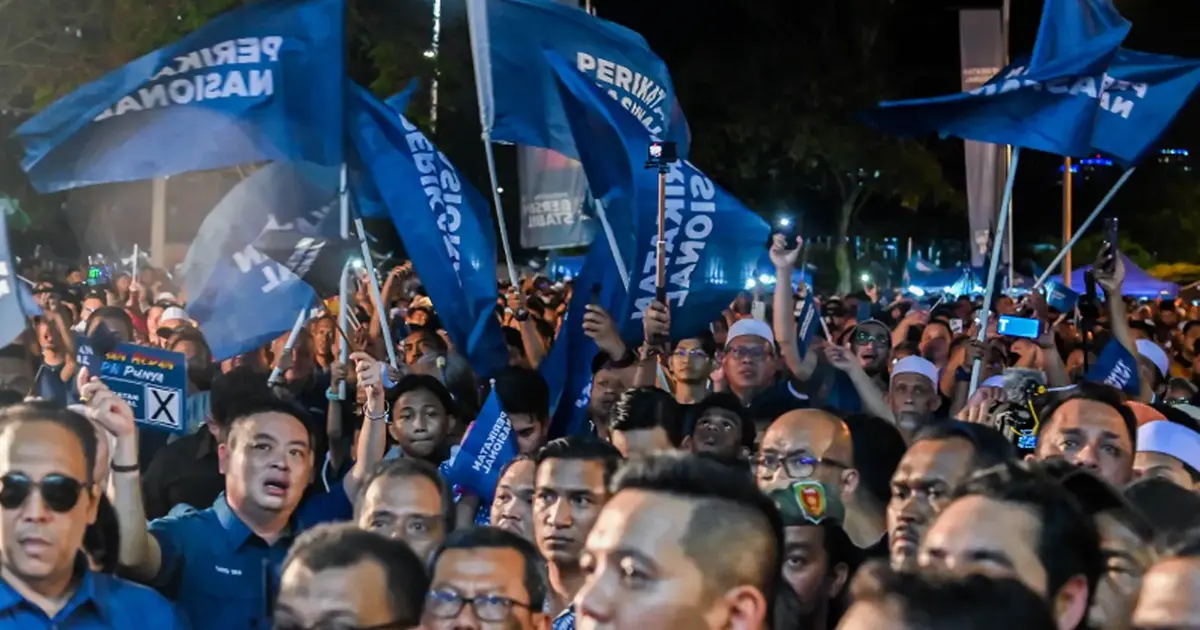
The Perikatan Nasional coalition faces an existential threat from deepening conflict between its two largest constituent parties, with respected analysts now questioning whether the alliance can survive its internal fractures. The deterioration has progressed beyond conventional political disagreement into what observers characterise as open partisan hostility, raising serious questions about the coalition's capacity to function as a unified force in Malaysia's fractious political landscape.
According to Ilham Centre chief researcher Yusri Ibrahim, the rupture between PAS and Bersatu has advanced into what he describes as a "guerrilla war" phase—a characterisation suggesting the conflict has become chronic, decentralised, and potentially destructive to the broader coalition structure. This assessment reflects growing alarm among political observers who track inter-party dynamics within Perikatan Nasional, which positions itself as a significant alternative to Pakatan Harapan's governance framework.
The tensions between PAS and Bersatu have their roots in competing visions for the coalition's direction and ideological orientation. PAS, anchored in conservative Islamic politics, and Bersatu, originally conceived as a Malay-nationalist party, have fundamentally different strategic priorities. These differences, previously managed through careful negotiation and power-sharing arrangements, have increasingly erupted into public disputes that undermine coalition unity and public confidence in collective decision-making.
The descent into what analysts term guerrilla warfare represents a qualitative shift in inter-party conflict. Rather than high-level negotiations or formal mechanisms for dispute resolution, the parties now engage in sustained campaigns of mutual criticism, factional manoeuvring, and strategic positioning that occurs across multiple institutional and media channels simultaneously. This fragmentation of conflict into countless smaller battlegrounds makes traditional coalition management substantially more difficult.
For Malaysian observers and stakeholders, the implications extend beyond internal party mechanics. A collapsing Perikatan Nasional would reshape the nation's broader political equilibrium, potentially forcing realignment among smaller parties and independent politicians currently anchored within the coalition framework. Such a rupture would reverberate through state-level politics, where Perikatan holds significant influence in several jurisdictions including Terengganu, Kelantan, and Perlis, potentially destabilising governments and forcing premature elections.
The crisis carries particular significance for Malaysia's already fragmented political ecosystem. Unlike Westminster-style systems where two-party dominance simplifies coalition mathematics, Malaysia's multi-party landscape creates numerous pathway dependencies. A Perikatan collapse would not automatically strengthen Pakatan Harapan but rather could trigger opportunistic realignments by smaller parties seeking optimal negotiating positions in a reconfigured parliament.
The "guerrilla war" characterisation also signals that traditional peace-making mechanisms within Perikatan may have lost efficacy. Coalition leadership's ability to enforce party discipline or negotiate compromises that all members accept has clearly diminished, suggesting the organisation's formal structures no longer command sufficient authority to contain internal conflicts. This institutional weakness compounds the substantive disagreements driving the conflict.
Bersatu's position has become increasingly precarious given its smaller parliamentary footprint compared to PAS's substantial representation. The party faces difficult choices between accommodating PAS's demands to maintain coalition membership or pursuing independent political positioning that might better protect its organisational interests and ministerial portfolios. These strategic calculations inevitably intensify friction as each party optimises for survival in scenarios where coalition membership becomes untenable.
PAS, conversely, appears increasingly confident in its capacity to operate independently or forge alternative coalitions, evidenced by the assertiveness with which it pursues partisan interests within Perikatan. This asymmetry in perceived alternatives further destabilises the coalition, as one partner increasingly doubts the other's commitment to joint survival. Such confidence disparities often prove self-fulfilling as they encourage the more optimistic party to raise demands, ultimately triggering the rupture that less confident parties fear.
The timing of this escalation coincides with Malaysia's political calendar considerations. With no immediate threat of parliamentary dissolution, both parties may calculate they have time to manoeuvre for advantage rather than compromise for unity. This removes pressure for emergency conflict resolution, allowing festering disputes to fester until they become irreversible. Conversely, if national elections approach, both parties face opposing pressures—the party ahead wants stability while the trailing partner may prefer fragmentation and realignment.
Regional implications also merit consideration. A Perikatan collapse would potentially reshape Malaysia's relationship with Indonesia and Thailand, given the coalition's role in articulating certain forms of Malay-Muslim politics at the regional level. Fracturing this coalition might create space for alternative diplomatic partnerships or shift Malaysia's weight within ASEAN's internal balance.
For investors and business observers, political instability of this magnitude typically constrains governance capacity and increases policy uncertainty. A weakened Perikatan unable to maintain coalition discipline faces greater difficulty pursuing coherent economic agendas or maintaining institutional reform momentum, implications that extend well beyond partisan political concern into economic management.
Whether Perikatan can recover from this descent into internal warfare remains unclear. Historical Malaysian precedent suggests coalitions can survive remarkable levels of internal conflict when mutual survival interest appears paramount. However, the "guerrilla war" phase may represent an inflection point beyond which restoration becomes structurally impossible, requiring either fundamental organisational restructuring or frank acknowledgement that coalition viability has expired.