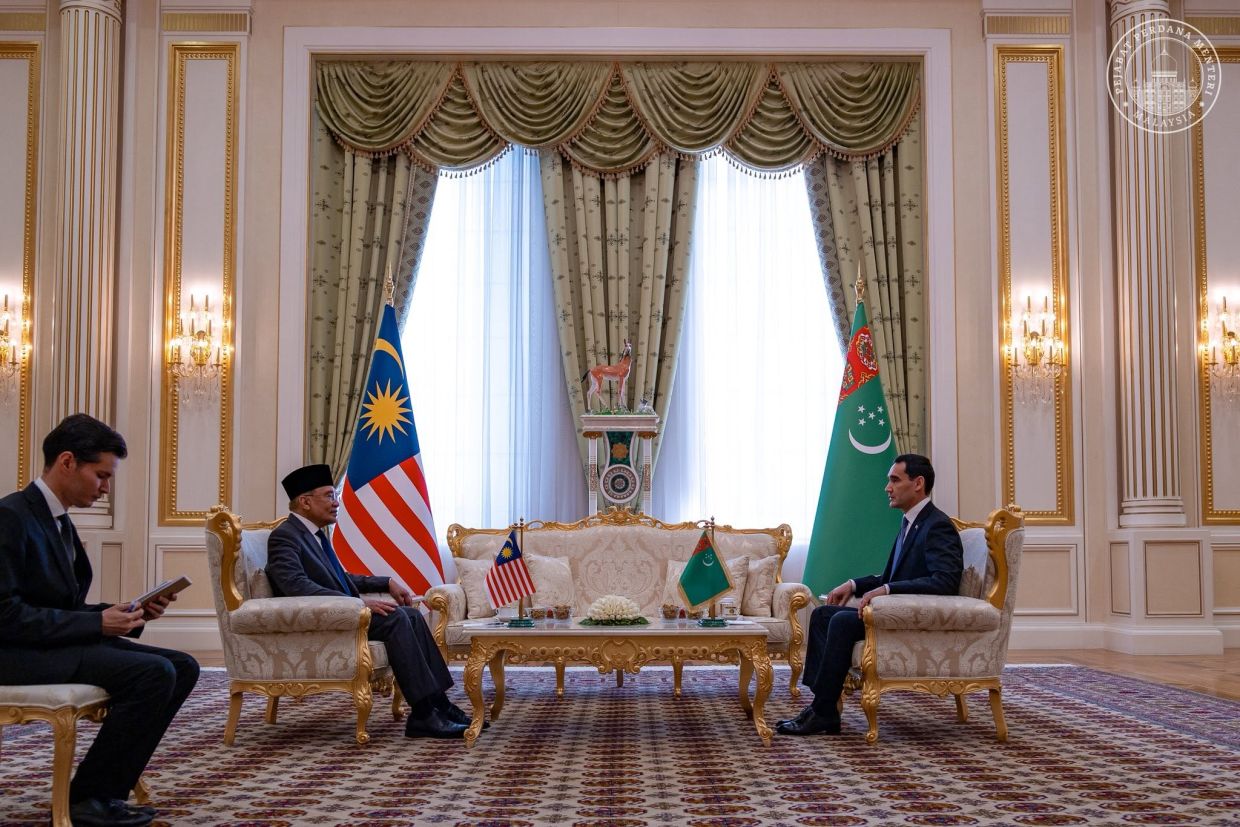
Prime Minister Datuk Seri Anwar Ibrahim and Turkmenistan President Serdar Berdimuhamedov formalised a significant strategic partnership between Petronas and Turkmenistan authorities in Ashgabat today, symbolising a strengthened chapter in the two nations' longstanding economic and energy alliance. The agreement, signed during Anwar's two-day official visit, builds on three decades of collaborative work in the energy sector that has become fundamental to Malaysia-Turkmenistan relations.
The timing of this partnership carries symbolic weight, arriving precisely as Malaysia and Turkmenistan mark 30 years of coordinated energy sector engagement. According to the Prime Minister's Office, this milestone underscores how energy cooperation has evolved into the bedrock of bilateral diplomacy and economic activity between the countries. The partnership represents not merely a commercial transaction but a deepening of institutional ties between two nations increasingly focused on positioning themselves as reliable players in global energy markets.
Beyond the immediate commercial dimensions, the partnership framework encompasses knowledge transfer, technological advancement, and human capital development. The PMO emphasised that both countries stand to gain from shared expertise and the movement of professional talent across sectors. This multifaceted approach reflects contemporary thinking in energy partnerships, where competitive advantage stems not only from resource access but also from accumulated technical expertise and institutional learning.
Central to this partnership's strategic value is Turkmenistan's extraordinary natural gas endowment. The nation sits atop some of the world's largest proven natural gas reserves, resources that have remained significantly underutilised relative to their potential. By positioning Petronas as a partner in developing these reserves, Malaysia gains exposure to one of Central Asia's most valuable economic assets whilst Turkmenistan benefits from the Malaysian state oil company's operational know-how and international market connections. This complementarity explains why Petronas has maintained such substantial long-term engagement with the country.
Petronas's historical commitment to Turkmenistan demonstrates the seriousness with which Malaysia views Central Asian energy development. The company's cumulative investments in Turkmenistan have reached RM52.73 billion since 1996, making it among the most significant foreign investors in the nation's hydrocarbon sector. This quarter-century of presence reflects patient capital deployment and faith in the long-term viability of energy operations in the region, even through periods of global energy market turbulence.
From Malaysia's diplomatic perspective, this partnership validates the nation's positioning as a credible energy player capable of competing globally. The PMO statement highlighted how this development demonstrates Malaysian expertise, talent, and technological capability can function effectively on the world stage. For a mid-sized Asian economy, such partnerships provide tangible evidence of competitive advantage extending beyond Malaysia's immediate regional sphere, offering domestic audiences reassurance about the country's standing in global energy markets.
The bilateral trade statistics reflect the economic substance underpinning diplomatic engagement. In 2025, Turkmenistan ranked as Malaysia's fourth-largest trading partner among Central Asian nations, with bilateral trade reaching RM75.80 million. Malaysian exports valued at RM75.50 million represented a nine percent annual increase, suggesting growing commercial momentum between the countries. Whilst these figures appear modest in global context, they indicate expanding commercial activity and provide a foundation upon which deeper economic relationships can be constructed.
The MADANI government's explicit welcomeness to this development signals commitment to expanding Malaysia's engagement with Central Asia beyond traditional Southeast Asian spheres of influence. Energy security concerns, coupled with Malaysia's recognised capabilities in hydrocarbon exploration and production, position Central Asian partnerships as strategically important. Diversifying energy partnerships across geographies reduces Malaysia's dependence on any single region whilst offering export opportunities for Malaysian energy sector expertise and services.
Turkmenistan's significance as an investment destination for Petronas cannot be separated from the geopolitical importance of Central Asia in contemporary global energy markets. As traditional energy suppliers face transition pressures and market volatility, stable, long-term partnerships in resource-rich regions become increasingly valuable. Petronas's sustained presence provides Malaysia with strategic influence in a region increasingly courted by global powers and investors seeking reliable hydrocarbon supplies.
Looking forward, the partnership framework likely contemplates phased development of additional natural gas projects, potential liquefied natural gas opportunities, and technological collaboration in extraction and processing methodologies. Such expanded cooperation would generate employment opportunities in both nations, attract ancillary investment across supply chains, and deepen institutional relationships between Malaysian and Turkmen energy sector professionals and institutions.
The partnership also reflects broader Southeast Asian interest in Central Asian energy resources. As the region grows economically and energy demand increases, diversifying supplier relationships away from Middle Eastern concentration becomes strategically prudent. Malaysia's pioneering role in developing partnerships with Turkmenistan positions it as a potential bridge connecting Southeast Asian energy needs with Central Asian supplies, creating value-added opportunities for Malaysian intermediaries and service providers throughout the energy value chain.

