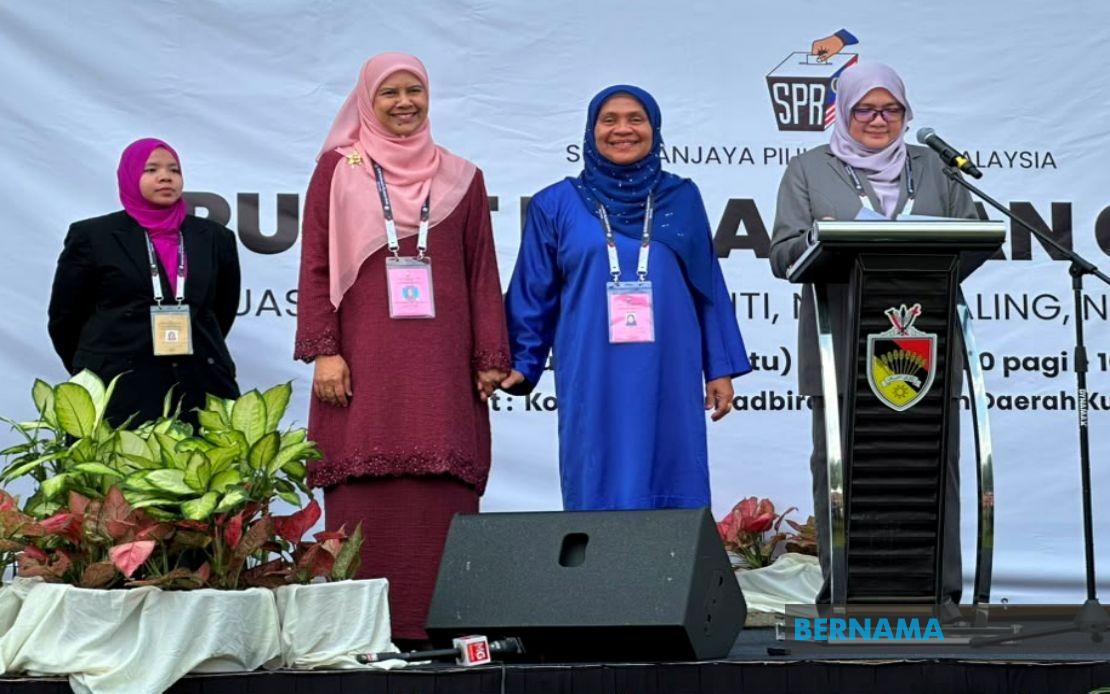
The Pilah state constituency will deliver a notable moment in Negeri Sembilan's political landscape when voters head to the polls on August 1, as two women candidates from Malaysia's largest political coalitions compete directly for the seat. Datuk Noorzunita Begum Mohd Ibrahim, the incumbent representative from Pakatan Harapan, will defend her position against S. Leza Md Yasin of Barisan Nasional in what returning officer Nawal Mohammed Amin officially confirmed following the close of nominations on July 18.
The gender composition of the Pilah race reflects broader shifts within Malaysian politics, where women's participation in electoral contests at the state level has gradually increased. The straight fight between these two candidates simplifies the choice for voters in a district where representation has become more competitive in recent election cycles. Noorzunita submitted her nomination papers at 9.03 am, with her rival following nine minutes later at 9.09 am, establishing the official parameters for what will be closely watched as a barometer of voter sentiment in the state.
The broader Negeri Sembilan state election presents a more fragmented political battlefield elsewhere across the nine constituencies. While Pilah's binary contest provides clarity, four other seats—Juasseh, Seri Menanti, Senaling, and Johol—feature multi-party competition that could influence overall state outcomes. The emergence of Bersatu as a significant contender in several constituencies demonstrates the fractured nature of Malaysia's ruling coalition, with the party fielding candidates in three three-cornered contests despite its formal alliance with Barisan Nasional.
In Juasseh, Mohd Aidil Abdullah representing Pakatan Harapan will contend against two opponents: the sitting member Datuk Ismail Lasim from Barisan Nasional and Bersatu's Mohd Zuhami Md Yusof. The Seri Menanti seat presents another three-way battle involving PH's Mohd Kamarul Arifin Mohd Wafa, incumbent Muhammad Sufian Maradzi of Barisan Nasional, and Bersatu's Datuk Seri Megat D. Shahriman Zaharuddin, a figure with substantial political pedigree from his prior state and federal roles. The Senaling seat rounds out the triple contests, pitting together Mohd Hanis Mohd Alimin from Pakatan Harapan, Mohamad Qayyum Abd Jalil from Barisan Nasional, and Mohd Izzafi Khan of Bersatu.
Johol represents a second straight fight on the ballot, though one contested purely between the two major coalitions. PH's Mohd Zailan Mohd Munawar faces off against incumbent Datuk Saiful Yazan Sulaiman of Barisan Nasional, offering voters another direct choice uncomplicated by third-party intervention. The distribution of these contest types across Negeri Sembilan's nine state seats reflects the uneven geography of political competition, where incumbent advantage, local factional dynamics, and coalition strategy intersect to produce varying levels of electoral contestation.
The high-level political presence surrounding the nomination process underscored the significance both coalitions attach to the state election. Pakatan Harapan deployed PKR Wanita chief Fadhlina Sidek, who holds the Education Ministry portfolio, to accompany candidates during their filing. Joining her were Angkatan Muda Keadilan vice-chief Dr Mohammed Taufiq Johari—the Youth and Sports Minister—and Sim Tze Tzin, Deputy Investment, Trade and Industry Minister and Member of Parliament for Bayan Baru. This constellation of federal officeholders signalled that Putrajaya views the Negeri Sembilan contest as having resonance beyond state-level administration.
Barisan Nasional's nomination day coordination similarly reflected the coalition's competitive posture. Deputy Home Minister Datuk Seri Dr Shamsul Anuar Nasarah, who sits on UMNO's Supreme Working Council, attended alongside Perak Menteri Besar Datuk Seri Saarani Mohamad. The Perak leadership's involvement indicates cross-state coordination mechanisms within Barisan Nasional, particularly as Perak itself faces its own electoral cycle and competition dynamics. Such high-level participation from both coalitions demonstrates that state elections, despite their limited constitutional scope compared to federal contests, retain considerable symbolic and political weight within Malaysia's factional landscape.
The timetable for the electoral process provides an accelerated schedule compared to federal elections. The Election Commission designated July 28 as early polling day, allowing certain categories of voters to cast ballots in advance, with general polling set for August 1. This compressed calendar creates an intensive campaign period that demands rapid voter mobilisation and messaging refinement. For Malaysian political observers, the Negeri Sembilan election serves as a significant mid-term test of both coalition governments' performance and public sentiment regarding their respective track records.
The Pilah contest specifically carries implications for women's political representation within the state framework. Both candidates bring distinct backgrounds and party affiliations into a race that will inevitably attract attention from gender-focused civil society groups monitoring women's participation in electoral politics. The appearance of an all-female straight fight, while notable, also reflects the complexity of women's advancement in Malaysian political structures, where token representation must be distinguished from substantive power-sharing and decision-making authority within party hierarchies.
For voters in these constituencies, the August 1 election presents fundamental choices about governance directions. Pakatan Harapan's performance in managing state-level administration, economic initiatives, and service delivery will be weighed against Barisan Nasional's traditional strengths in development projects and federal resource allocation. In seats like Pilah, where the incumbent Noorzunita Begum has had time to establish her constituency presence, the contest will test whether that ground advantage translates into voter retention or if dissatisfaction with broader coalition performance drives electoral movement. The involvement of Bersatu in several constituencies adds unpredictability, particularly among voters who may be signalling shifting allegiances or testing alternative political options within the Malay-Muslim electorate.

