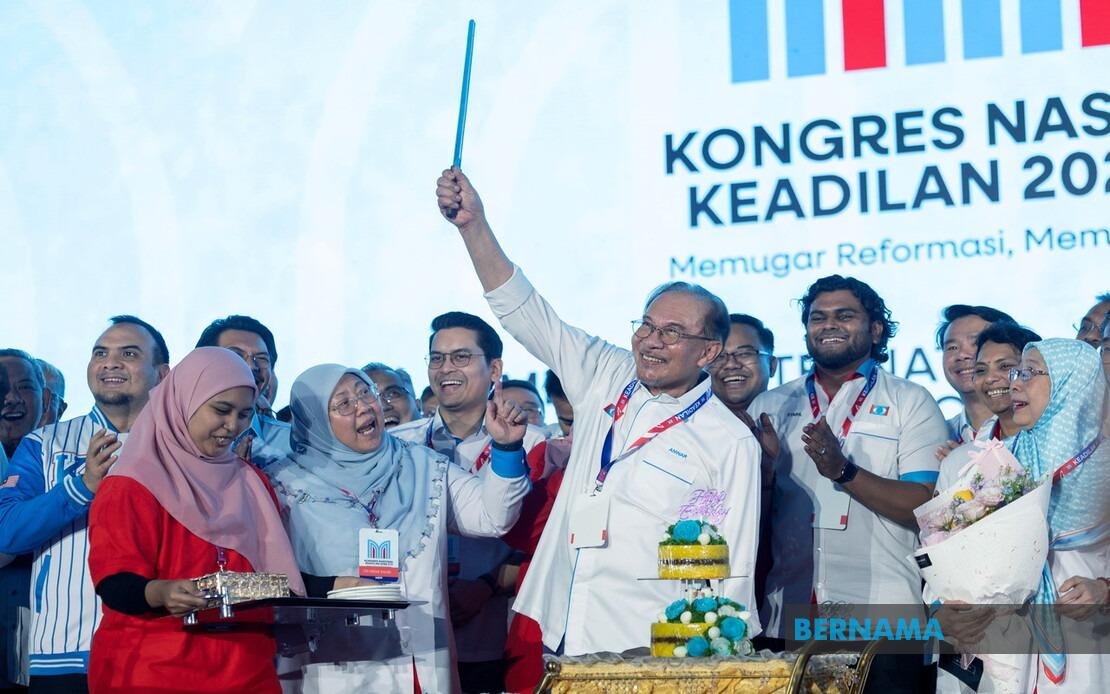
The PKR National Congress 2026, held in Melaka this month, painted a portrait of a party navigating the inherent tensions between wielding governmental power and maintaining its foundational reform credentials. In his closing remarks, President Datuk Seri Anwar Ibrahim sought to frame this balancing act as both feasible and necessary, stressing that the party would continue defending the Unity Government arrangement as the bedrock for both political stability and economic advancement benefiting ordinary Malaysians. However, his acknowledgment that the partnership's longevity depends fundamentally on decisions made by UMNO and Barisan Nasional underscores the delicate nature of the political settlement the coalition represents.
Anwar's dual emphasis on stability and reform reflects a strategic calculation about PKR's positioning. By defending the Unity Government, he signals pragmatism to potential investor communities and international observers concerned about Malaysian governance continuity. Yet simultaneously, the party leadership recognised that abandoning reform commitments entirely would alienate the urban, younger, and educated voter constituencies that form PKR's electoral backbone. This rhetorical tightrope walk has become central to understanding how PKR justifies its participation in a government that includes former adversaries, a choice that continues to generate internal debate within reformist circles across Southeast Asia's political landscape.
A notable flashpoint at the congress involved university autonomy and student activism. When Anwar pledged that the government would not replace the Universities and University Colleges Act (AUKU) 1971 with restrictive legislation, he directly addressed a long-standing PKR position. The party had campaigned against AUKU's constraints on campus organising during its opposition years. His framing—that existing criminal laws suffice to manage student misconduct—attempts to square the circle between maintaining order as a governing party and honouring commitments to civil liberties that defined PKR's identity. Whether this reassurance satisfies student activists remains an open question, particularly given generalised anxieties among Malaysian universities about constraints on free expression.
Deputy President Nurul Izzah Anwar articulated an intellectual justification for why reform need not cease upon entering government. By distinguishing between reforms within party structures, administrative processes, and legislative policy, she suggested multiple avenues through which PKR could advance change simultaneously. Her invocation of AUKU's repeal as a concrete achievement attempts to demonstrate that governmental participation need not mean abandoning ambitious objectives. For Malaysian observers of institutional reform, this represents an important claim: that change can flow through executive action and legislative sponsorship by sitting ministers, not merely through pressure exerted from opposition benches.
The congress placed particular emphasis on organisational readiness, suggesting PKR leadership anticipates potential political flux despite the surface stability the Unity Government projects. By encouraging members to prepare without awaiting parliamentary dissolution or candidate nomination cycles, party officials signal awareness that Malaysian coalition politics remains inherently unstable. This contingency planning reflects lessons from the country's recent history, where seemingly secure governmental arrangements have fractured with surprising speed. For regional observers, this organisational caution hints at structural vulnerabilities within Malaysia's political settlement that transcend the immediate Unity Government arrangement.
Gender representation emerged as a distinct theme through Education Minister Fadhlina Sidek's remarks as PKR Wanita chief. Her dual insistence on expanding women's roles in leadership and fostering openness to criticism among party and government figures suggests that PKR views inclusion as both a principle and a governance improvement mechanism. This framing appeals to demographic trends favouring women's participation in decision-making, particularly among younger cohorts that significantly influence Malaysian electoral outcomes. Her emphasis on receptiveness to criticism also implicitly critiques top-down governance models, positioning PKR as distinct from more hierarchical coalition partners.
Angkatan Muda Keadilan's (AMK) focus on youth engagement revealed PKR's recognition that younger voters increasingly concern themselves with technology-sector opportunities and economic security. By highlighting Bumiputera participation in artificial intelligence, semiconductors, and biotechnology, the youth wing attempted to reconcile traditionally redistributive Bumiputera frameworks with future-oriented sectors critical to economic competitiveness. This strategic positioning seeks to make inclusive development and technological advancement mutually reinforcing rather than contradictory—a crucial argument for a party dependent on urban middle-class support while remaining embedded in a coalition with significant rural and Bumiputera constituencies.
Generation Z issues received particular emphasis, with AMK raising gig economy recognition, enhanced social protection, mental health support, and professional development. These concerns reflect generational economic precarity distinct from earlier Malaysian cohorts, where formal sector employment and pension security proved more reliable. By foregrounding these issues, PKR signals attention to demographic anxieties that could reshape electoral patterns if left unaddressed. For regional analysts, Malaysia's grappling with gig economy formalisation and youth social protection mirrors challenges across Southeast Asia as traditional employment relationships fragment.
The congress documents reveal PKR grappling with fundamental questions about reform sustainability within governmental constraints. The party's framing suggests that stability need not preclude change, that working within the system can advance ambitious objectives, and that organisational coherence matters more than individual policy victories. Yet these claims remain contested terrain. Critics within Malaysia's civil society question whether participation in coalitions that include entrenched interests genuinely serves transformative agendas, or whether it inevitably compromises reformist missions through incremental dilution.
Anwar's reminder against excessive steps that could destabilise the Unity Government operated as both reassurance and warning—reassuring coalition partners that PKR prioritises continuity, while warning internal dissidents against pushing reform agendas that might alienate UMNO and trigger coalition rupture. This hierarchical framing, where governmental stability supersedes other considerations, inverts PKR's pre-2018 messaging about subordinating all else to systemic transformation. Whether party members ultimately accept this recalibration will shape PKR's electoral prospects and Malaysia's broader reform trajectory through the remainder of this governmental term.
Looking forward, the congress crystallised PKR's positioning as a stabilising force within an ideologically heterogeneous coalition. This role offers certain advantages—continued ministerial portfolios, influence over legislative agendas, and potential coalition durability. Yet it also risks institutional ossification if members perceive reform momentum stalling indefinitely. The party's ability to demonstrate tangible policy achievements beyond AUKU repeal will likely determine whether the balance articulated in Melaka proves durable or gradually unravels under pressure from both external coalition partners and internal constituencies viewing governmental participation as ultimately compromising original ideals.

