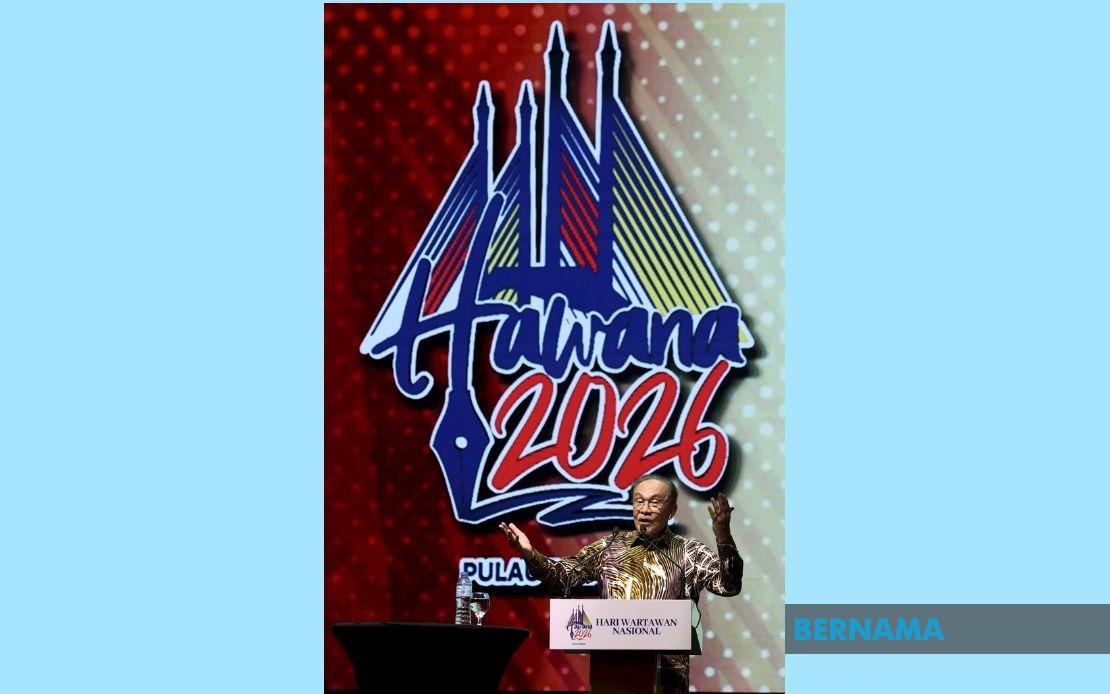
Prime Minister Datuk Seri Anwar Ibrahim pledged an additional RM1 million towards the Tabung Kasih@HAWANA welfare initiative during the opening ceremony of the National Journalists' Day 2026 gathering in Butterworth, underscoring the government's commitment to ensuring financial security for media professionals across the country.
The announcement was made while Anwar, who holds the dual portfolio of Prime Minister and Finance Minister, officially inaugurated the HAWANA 2026 main event at PICCA Convention Centre@Butterworth Arena. The funding allocation reflects a broader policy direction aimed at strengthening the welfare infrastructure for journalists and news professionals who form the backbone of the nation's information ecosystem.
Since its establishment during the HAWANA 2023 celebrations, the Tabung Kasih@HAWANA has emerged as a critical safety net for media practitioners facing financial hardship. The fund operates on a multi-faceted approach, extending support across medical expenses, family welfare assistance, and other pressing needs that arise within the journalism community. To date, the scheme has channelled assistance totalling RM2.26 million to 773 media professionals nationwide, indicating both the scale of demand and the real impact of targeted government intervention in this sector.
The government's decision to inject additional resources reflects recognition that media practitioners often operate in precarious employment situations, particularly freelancers and those in smaller news organisations lacking robust employee benefits. The welfare fund addresses gaps in the social safety net that conventional employment frameworks may not cover, acknowledging the contributions of journalists to democratic discourse and public accountability. For Southeast Asian context, Malaysia's approach contrasts with several neighbouring countries where media welfare remains largely dependent on individual organisations or industry associations.
The HAWANA 2026 celebration drew unprecedented participation, bringing together more than 1,000 media professionals from Malaysia alongside international delegates from Timor-Leste, Cambodia, and Laos. This regional gathering underscores the interconnected nature of media challenges and professional standards across Southeast Asia, where questions of press freedom, safety, and economic viability remain pressing concerns. The international attendance suggests growing recognition that media sustainability requires coordinated policy responses and cross-border dialogue.
Communications Minister Datuk Fahmi Fadzil and Penang Chief Minister Chow Kon Yeow joined Anwar in officiating the event, signalling whole-of-government support for media sector development. The presence of senior officials from the Communications Ministry, alongside leadership from Bernama and representatives from major local media organisations, demonstrated the centrality of this initiative to Malaysia's information policy agenda. Such high-level participation sends a signal that media welfare is not peripheral but integral to state priorities.
The theme selected for HAWANA 2026—Media Integrity Strengthens Credibility—carries particular relevance given the global erosion of trust in news institutions and the proliferation of misinformation. By coupling welfare support with explicit emphasis on journalistic standards and integrity, the government articulates a vision where professional sustainability and editorial excellence are mutually reinforcing. This framing acknowledges that without viable careers, the profession struggles to attract talent capable of delivering rigorous, ethical journalism.
The expansion of the welfare fund also addresses demographic shifts within Malaysian journalism. An ageing cohort of veteran journalists, combined with precarious conditions facing younger entrants to the profession, creates distinct welfare challenges. The flexible design of Tabung Kasih@HAWANA—encompassing medical expenses, family support, and general assistance—allows it to respond to diverse circumstances across the journalist population, from early-career freelancers to retirees navigating healthcare costs.
For Malaysian readers and the broader Southeast Asian media landscape, this initiative represents a governmental acknowledgement that market forces alone cannot ensure media sustainability. The fund operates as a targeted intervention that preserves professional journalism without necessarily imposing editorial control, attempting to thread a careful needle between supporting the sector and respecting editorial independence. Whether such support proves sufficient to reverse structural challenges facing news organisations—including revenue decline and audience fragmentation—remains an open question requiring continued monitoring and evaluation.
The RM1 million additional allocation for 2026, combined with the existing RM2.26 million already distributed, demonstrates incremental but meaningful expansion of welfare infrastructure. However, the scale of assistance relative to sector-wide challenges suggests the fund functions as a safety net for acute crises rather than a comprehensive solution to industry economics. Media organisations and professional associations may require complementary strategies addressing business model sustainability, training and development, and workplace protections to ensure long-term sector health.
Looking forward, the HAWANA platform itself—bringing together regional practitioners and policymakers—offers potential as an incubator for broader conversations about media viability across Southeast Asia. Whether future iterations of this initiative expand to encompass regional welfare frameworks, capacity-building programmes, or other collaborative mechanisms remains to be seen. For now, Malaysia's commitment to domestic journalist welfare sets a benchmark worth scrutiny and potentially emulation across the region.

