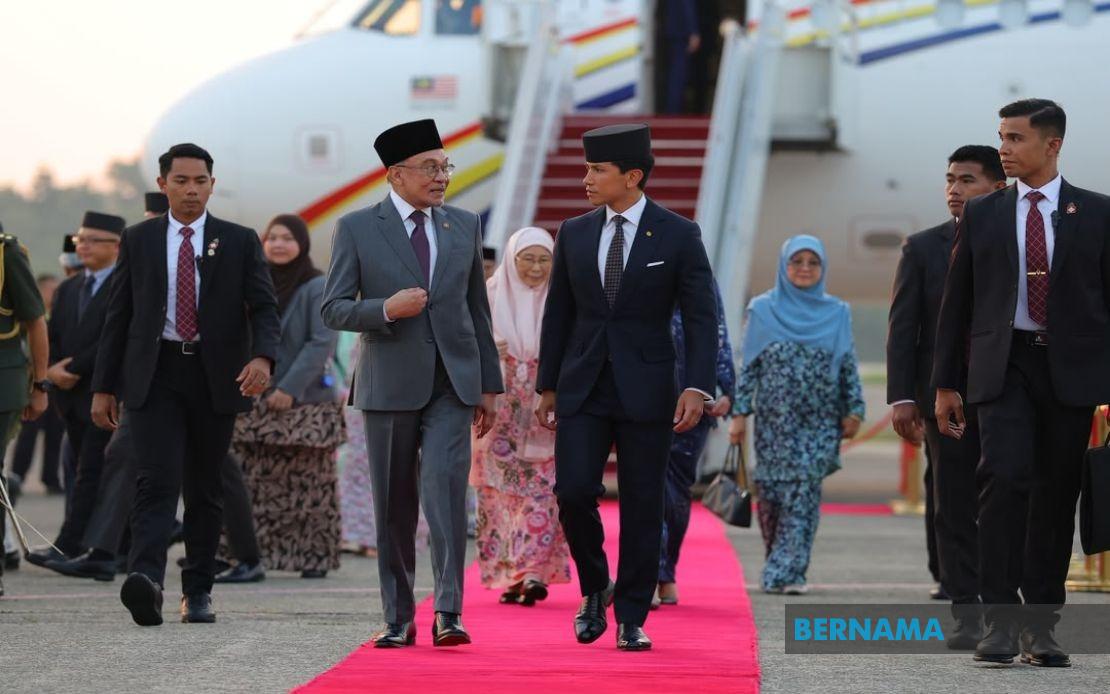
Prime Minister Datuk Seri Anwar Ibrahim touched down in Brunei on Wednesday evening to begin a two-day working visit centred on the 27th Annual Leaders' Consultation, the cornerstone diplomatic engagement between Malaysia and its smaller neighbour. The Prime Minister's aircraft arrived at Brunei International Airport at 6:10 pm, carrying Anwar alongside his wife, Datuk Seri Dr Wan Azizah Wan Ismail. The delegation was welcomed by Brunei's Minister of Foreign Affairs Prince Abdul Mateen Bolkiah, underscoring the significance both nations attach to this periodic summit.
The visit represents a continuation of Malaysia's strategic engagement with Brunei, a fellow ASEAN member with whom it shares deep historical and cultural ties. Anwar's journey comes at a moment when bilateral relations remain robust, though both nations navigate evolving regional dynamics and economic pressures. The presence of Foreign Minister Datuk Seri Mohamad Hasan and other senior diplomatic officials illustrates the comprehensive nature of the consultation, extending beyond ceremonial courtesy to substantive policy discussions.
Thursday's agenda includes a formal audience with Sultan Hassanal Bolkiah at the Nurul Iman Palace, one of the world's largest residential palaces and a symbol of Brunei's continued prosperity. Following protocol, Anwar will participate in a bilateral meeting with the Brunei monarch, providing an intimate forum for candid discussion on matters affecting both governments. These one-on-one sessions, often the most productive component of such visits, allow leaders to address sensitive issues and chart diplomatic direction away from the formality of larger delegations.
A significant outcome expected during the consultation is the signing of a Memorandum of Understanding on disaster management cooperation between the two countries. This agreement reflects recognition of shared vulnerabilities in Southeast Asia's increasingly volatile climate and natural disaster landscape. For Malaysia and Brunei, both vulnerable to monsoon patterns, flooding, and other regional environmental challenges, coordinated preparedness and response mechanisms carry practical importance beyond symbolic significance. The MoU signals commitment to pooling expertise and resources in emergency management, a domain where bilateral cooperation can yield tangible benefits for both populations.
The Annual Leaders' Consultation framework itself occupies a unique position in Malaysia's diplomatic architecture. As the highest-level bilateral mechanism between the nations, it serves purposes far broader than routine diplomatic correspondence. These consultations provide structured opportunity to comprehensively review all dimensions of bilateral cooperation, from trade and investment to security, cultural exchange, and people-to-people connectivity. The format allows leaders to step back from day-to-day governance pressures and consider longer-term strategic alignment.
Trade data illustrates the economic dimension underlying this political engagement. During 2025, bilateral commerce reached RM5.86 billion, with Malaysian exports to Brunei valued at RM4.20 billion against imports of RM1.66 billion. These figures reflect Malaysia's strong export position, driven largely by petroleum products, manufactured goods, and agricultural commodities that find ready markets in Brunei's import-dependent economy. The first half of 2026 recorded RM2.38 billion in trade, suggesting sustained commercial momentum despite global economic uncertainties affecting both nations.
For Malaysian policymakers, Brunei represents both opportunity and strategic interest. While small in population, Brunei commands significant resource wealth and serves as a gateway to broader engagement in Southeast Asia. Its stability, pro-regional stance, and alignment with Malaysian interests make it a valuable partner in pursuing ASEAN cohesion and addressing transnational challenges. Conversely, Malaysian expertise in manufacturing, services, and agricultural production aligns well with Brunei's development aspirations and import requirements.
The timing of this consultation carries subtle significance within Malaysia's broader regional diplomacy. As the nation navigates its relationship with larger powers and manages complex ASEAN dynamics, maintaining strong bonds with established partners like Brunei reinforces stability. The consultation provides opportunity to align positions on regional issues, from maritime security to economic integration initiatives, ensuring Malaysian interests receive sympathetic consideration within regional forums.
Beyond immediate bilateral concerns, this visit reflects how Southeast Asian nations continue prioritising personal relationships and structured engagement mechanisms despite the rise of digital communication. The choice to conduct high-level consultations through face-to-face meetings at regular intervals underscores belief that complex international relations still benefit from direct human interaction, where nuance, trust, and understanding cannot be fully conveyed through virtual channels or written correspondence.
The expected outcomes from this consultation—the disaster management MoU and whatever policy statements emerge—will likely emphasize shared commitment to ASEAN solidarity, regional peace and stability, and mutual prosperity. Malaysia and Brunei will probably reaffirm support for the ASEAN Regional Forum, East Asia Summit, and other multilateral mechanisms that provide regional security architecture. Discussion of economic cooperation, particularly expanding market access and encouraging Malaysian investment in Brunei's diversification efforts, will likely feature prominently.
Looking forward, the success of this consultation will be measured not merely by formal agreements signed but by whether consultation outcomes translate into concrete improvements in bilateral relations. Whether in enhanced trade facilitation, streamlined investment procedures, or coordinated regional diplomacy, the real test lies in implementation and tangible benefits reaching both populations. As Malaysia and Brunei continue navigating regional complexities and pursuing national development objectives, maintaining strong bilateral foundations through regular, high-level consultation remains essential to both nations' stability and prosperity.

