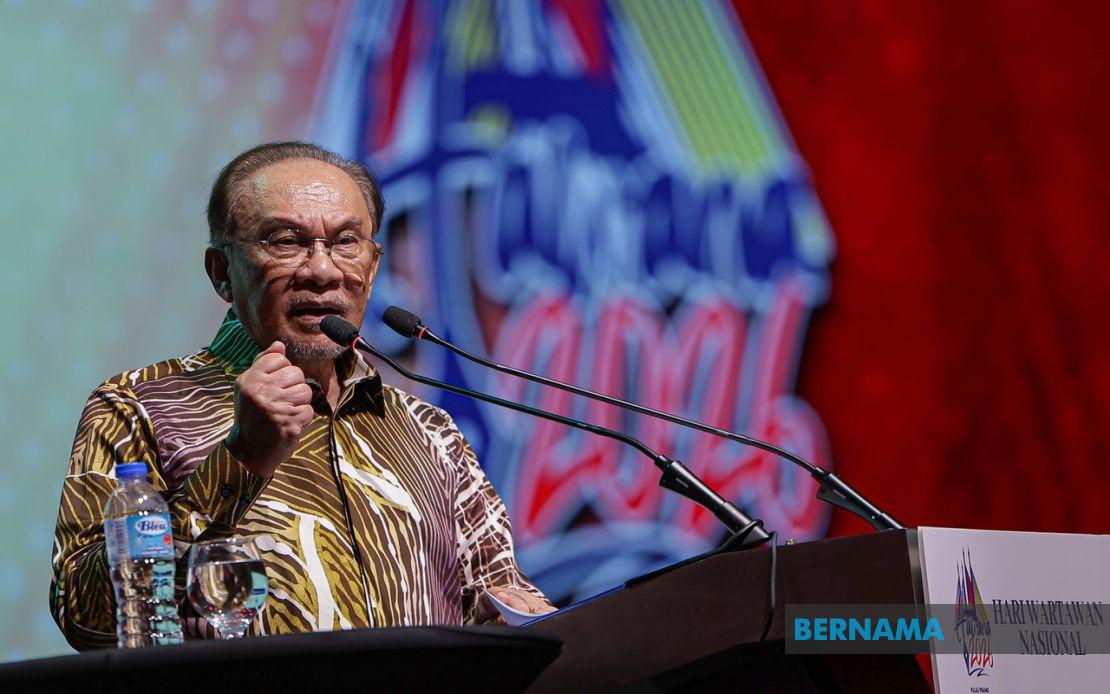
Prime Minister Datuk Seri Anwar Ibrahim has thrown his weight behind the appointment of former Federal Court judge Tan Sri Nallini Pathmanathan as chairman of the Malaysian Media Council, viewing the move as pivotal to rebuilding institutional credibility at a time when media oversight is increasingly scrutinised across Southeast Asia. Speaking at the National Journalists' Day (HAWANA) 2026 celebration in Butterworth on June 20, Anwar underscored that Nallini's extensive judicial experience and personal integrity would fundamentally reshape how the council is perceived by both the public and the industry itself, signalling the government's commitment to restoring confidence in media regulation after periods of contestation.
The appointment, which received unanimous endorsement from MMC board members during a May 26 meeting, represents a deliberate recalibration of the council's leadership structure. Anwar emphasised that the selection process was conducted with meticulous attention to professional qualifications and personal standing, recognising that effective media oversight requires individuals whose credibility transcends partisan divisions. In a media landscape increasingly fragmented by digital platforms and competing narratives, the choice of someone with Nallini's judicial pedigree signals an intent to anchor the council's work in established legal and ethical frameworks rather than perceived political expediency.
The Malaysian Media Council itself, formally established under the Malaysian Media Council Act 2025, represents a contemporary approach to media self-regulation that distinguishes it from traditional government censorship mechanisms. Rather than operating as a state enforcement tool, the MMC functions as an independent body tasked with maintaining journalistic standards, adjudicating public complaints, promoting ethical conduct, and—crucially—safeguarding media freedom as a foundational democratic principle. This functional mandate places it at the intersection of industry accountability and constitutional protection, a delicate balance that demands leadership possessing both judicial acumen and democratic sensibility.
Nallini's background as a Federal Court judge positions her uniquely to navigate this complex terrain. Her judicial experience equips her with methodological rigour in weighing competing interests and constructing reasoned determinations that withstand scrutiny. In the Malaysian context, where media regulation has historically been controversial—ranging from debates over the Printing Presses and Publications Act to more recent tensions around online speech—having a chair with unimpeachable judicial credentials provides institutional insulation and suggests decisions will rest on principled interpretation rather than political winds.
The timing of this appointment carries significance for the regional media environment. Southeast Asia faces mounting pressures on press freedom, from regulatory creep in several nations to the challenge of coordinating response to disinformation across borders. Malaysia's approach—establishing a professionalised, self-regulatory council led by an eminent jurist—may influence how other regional democracies consider their own media governance structures. The MMC's success under Nallini's leadership could become a model for balancing industry autonomy with public accountability without resorting to heavy-handed state control.
Communications Minister Datuk Fahmi Fadzil's presence at the event, alongside Penang Chief Minister Chow Kon Yeow, underscores the multi-level political backing for this institutional direction. Government endorsement of an independent regulator's leadership selection, when handled carefully, can enhance rather than compromise the regulator's independence—provided the appointee's credentials and mandate remain genuinely insulated from short-term political considerations. Nallini's judicial tenure affords her that protective distance.
The Malaysian National News Agency (Bernama), represented at the event by chairman Datuk Seri Wong Chun Wai and CEO Datin Paduka Nur-ul Afida Kamaludin, occupies a particular position within this ecosystem. As a state news agency, Bernama's relationship with the MMC touches on broader questions about how public-sector media institutions interface with independent regulators. Nallini's appointment carries implicit reassurance that the council will treat all media organisations—state-affiliated and independent alike—according to consistent professional standards.
For Malaysian journalists and news organisations, Nallini's leadership should clarify several ambiguities that have attended the MMC's early operations. The council's powers regarding complaint investigation, sanctions, and editorial guidance remain subjects of keen interest to the industry. A chair with judicial experience and demonstrated respect for due process may provide greater transparency around how these powers are exercised and constrained. The journalism profession's long-term relationship with institutional oversight depends substantially on perceptions of fairness and procedural integrity—qualities Nallini's appointment is designed to communicate.
The emphasis Anwar placed on Nallini's personal integrity reflects recognition that media regulation ultimately depends on the moral authority of those who exercise it. Technical competence without ethical grounding produces compliance but not genuine public confidence. Conversely, ethical commitment without professional expertise can result in well-intentioned but ineffective or inconsistent decision-making. Nallini's profile suggests an attempt to anchor the council in both dimensions—the rigour of judicial method combined with an established record of principled judgment.
Looking forward, the real test of this appointment will emerge through the MMC's concrete work: how it handles high-profile complaints, whether its determinations withstand legal and public scrutiny, and whether news organisations perceive the process as fair even when rulings go against their interests. Nallini's judicial background provides good cause for optimism on these fronts, yet institutional credibility remains fragile and must be earned through consistent performance rather than inherited from credentials alone.

