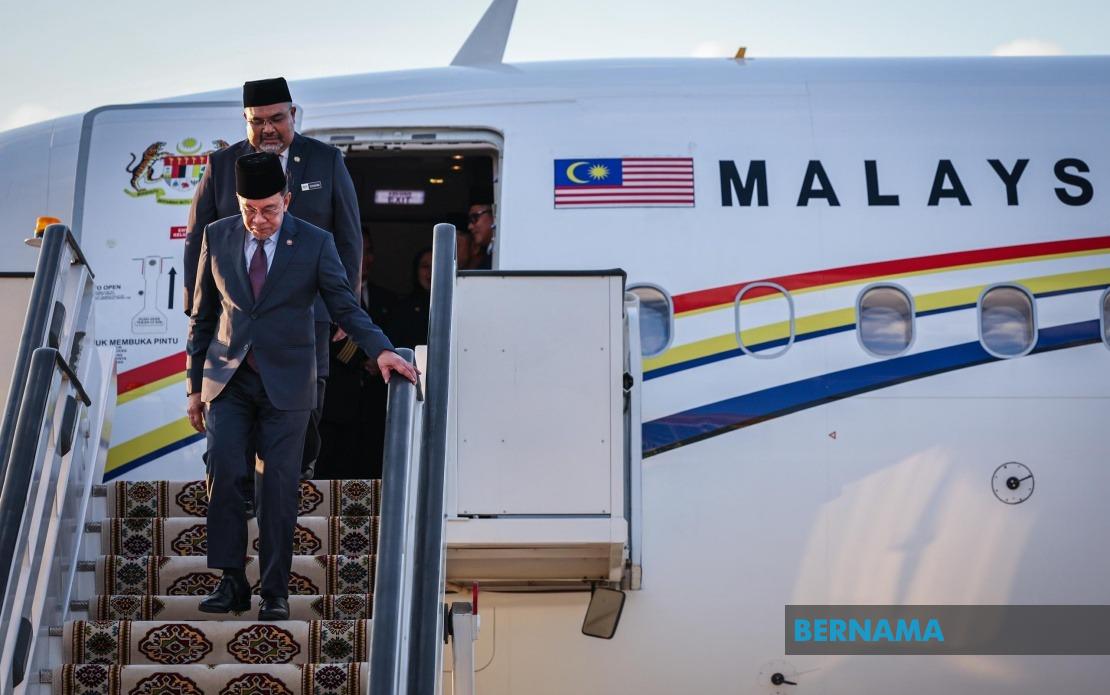
Prime Minister Datuk Seri Anwar Ibrahim touched down in Ashgabat on June 18 after completing a working visit to Russia's Tatarstan region, extending Malaysia's diplomatic engagement across Central Asia. His aircraft landed at Ashgabat International Airport at 8 pm local time, marking the beginning of a two-day official visit to Turkmenistan that will conclude on June 19. The journey represents a significant component of the government's broader strategy to deepen relationships with strategic partners beyond Southeast Asia, recognizing the economic and geopolitical importance of the Central Asian region.
Anwar travelled with a senior ministerial delegation that underscored the visit's economic dimensions. Minister of Investment, Trade and Industry Datuk Seri Johari Abdul Ghani and Minister of Economy Akmal Nasrullah Mohd Nasir accompanied the Prime Minister, alongside key officials from the Prime Minister's Office and Foreign Ministry. This composition signals Malaysia's intention to explore comprehensive cooperation spanning trade, investment, and institutional frameworks with Turkmenistan. The delegation's seniority reflects the visit's status as a high-level bilateral engagement rather than a routine diplomatic courtesy call.
Upon arrival, Anwar was received by Malaysia's Ambassador to Turkmenistan Mohd Suhaimi Ahmad Tajuddin, while Turkmenistan's representation came through Deputy Chairman of the Cabinet of Ministers for Oil and Gas Guvanch Agajanov, highlighting the host nation's prioritization of energy sector cooperation. This official reception protocol demonstrates mutual respect and anticipation of substantive discussions between both governments. The choice of interlocutors signals that discussions will extend beyond ceremonial matters into practical economic collaboration.
The visit itself was formally extended by Turkmenistan President Serdar Berdimuhamedov and represents a reciprocal gesture following the Turkmenistan leader's official visit to Malaysia in December 2024. This reciprocal dimension underscores the bilateral relationship's momentum and the mutual commitment both nations have demonstrated towards strengthening institutional ties. For Malaysia, the visit marks Anwar's first official trip to Turkmenistan, though it constitutes the fifth visit by a Malaysian prime minister to the Central Asian nation, indicating a pattern of consistent engagement across multiple administrations.
The formal schedule commences on June 19 with a welcoming ceremony at the Presidential Palace, followed by bilateral discussions and the signing of official documents. The agenda encompasses a one-on-one meeting between Anwar and Berdimuhamedov, a broader bilateral talks session, and the signing of a joint statement articulating shared positions and commitments. Additionally, the two governments plan to exchange agreements and memoranda of understanding that have already been negotiated, suggesting that substantive groundwork has preceded this visit. These multilayered discussions indicate that Malaysia and Turkmenistan have identified specific areas requiring formal cooperation frameworks.
Beyond formal state protocols, the itinerary includes cultural and religious observances reflecting Malaysia's diverse engagement approach. Anwar is scheduled to perform Friday prayers at the Turkmenbashi Ruhy Mosque, also known as the Gypjak Mosque, demonstrating respect for local customs and the significance of Muslim-majority nation relations. This religious observance carries symbolic weight in Muslim-world diplomacy, signalling shared Islamic heritage as a foundation for bilateral understanding. An official luncheon hosted by Berdimuhamedov will provide an informal setting for further discussion, while a dinner with the Malaysian diaspora earlier in the visit acknowledges the presence and contributions of Malaysian citizens in Turkmenistan.
The Malaysia-Turkmenistan Forum, to be jointly officiated by both leaders at the Chamber of Commerce and Industry of Turkmenistan, represents a crucial venue for private sector engagement and business-to-business networking. This forum format extends cooperation beyond government-to-government discussions, encouraging commercial entities from both nations to identify partnership opportunities. The structured forum approach reflects modern diplomatic practice that recognizes the centrality of business communities in sustaining long-term bilateral relationships. For Malaysian companies, Turkmenistan's Central Asian location offers strategic advantages in accessing regional markets.
Trade relations between Malaysia and Turkmenistan have demonstrated measurable growth, with 2025 data revealing Turkmenistan's position as Malaysia's fourth-largest trading partner among Central Asian nations. Total bilateral trade reached RM75.80 million, with Malaysian exports representing RM75.50 million of this figure—a substantial nine percent increase year-on-year. These figures, while modest relative to Malaysia's trade with major partners, reflect a trajectory of expanding commercial engagement. The export-heavy balance suggests Malaysian goods and services are gaining market acceptance in Turkmenistan, though bilateral trade remains underdeveloped relative to its potential given the economic complementarities between both nations.
Beyond trade statistics, Petronas represents Malaysia's most significant economic footprint in Turkmenistan, with the national oil company having accumulated RM52.73 billion in cumulative investments since establishing operations in 1996. This substantial presence reflects Turkmenistan's importance as a hydrocarbon-rich economy offering substantial opportunities for Malaysian energy companies. Petronas's long-term commitment to Turkmenistan demonstrates the strategic value both entities place on their partnership, with decades of operational history providing deep institutional knowledge and established relationships. For Malaysia, securing reliable energy partnerships in Central Asia supports national energy security objectives and diversifies Petronas's portfolio beyond Southeast Asian operations.
The broader context for this visit encompasses Malaysia's gradual but deliberate pivot toward cultivating diplomatic and economic relationships across Central Asia and beyond the immediate Southeast Asian region. This geographic diversification reflects recognition that long-term prosperity requires engagement with multiple regions and trading partners. Turkmenistan, positioned at the crossroads of energy corridors connecting Europe, Asia, and the Middle East, offers Malaysia strategic access to these networks. The visit demonstrates that Malaysian prime ministers recognize Central Asian nations not as peripheral actors but as essential components of a diversified international engagement strategy.
For regional observers, particularly in Southeast Asia, Anwar's Central Asian tour signals Malaysia's confidence in pursuing multi-directional foreign policy while maintaining ASEAN cohesion. The visit follows established diplomatic patterns of engagement with energy-rich nations that offer complementary economic interests. As Malaysian companies seek to expand beyond saturated regional markets, partnerships with Central Asian economies provide growth avenues. Simultaneously, Central Asian states recognize value in engaging Malaysia as a representative of ASEAN and a Muslim-majority nation with sophisticated financial and business services sectors.
The diplomatic mechanics of this visit—from ministerial composition to bilateral documentation—suggest serious intent toward institutionalizing Malaysia-Turkmenistan cooperation across multiple domains. While trade volumes remain modest, the consistent pattern of prime ministerial visits and the scale of Petronas's investments indicate a relationship with depth beyond headline statistics. Moving forward, the framework established during this visit may facilitate expanded collaboration in areas such as energy security, investment promotion, and cultural exchange, positioning both nations to benefit from Central Asia's growing importance in global geopolitical calculations.

