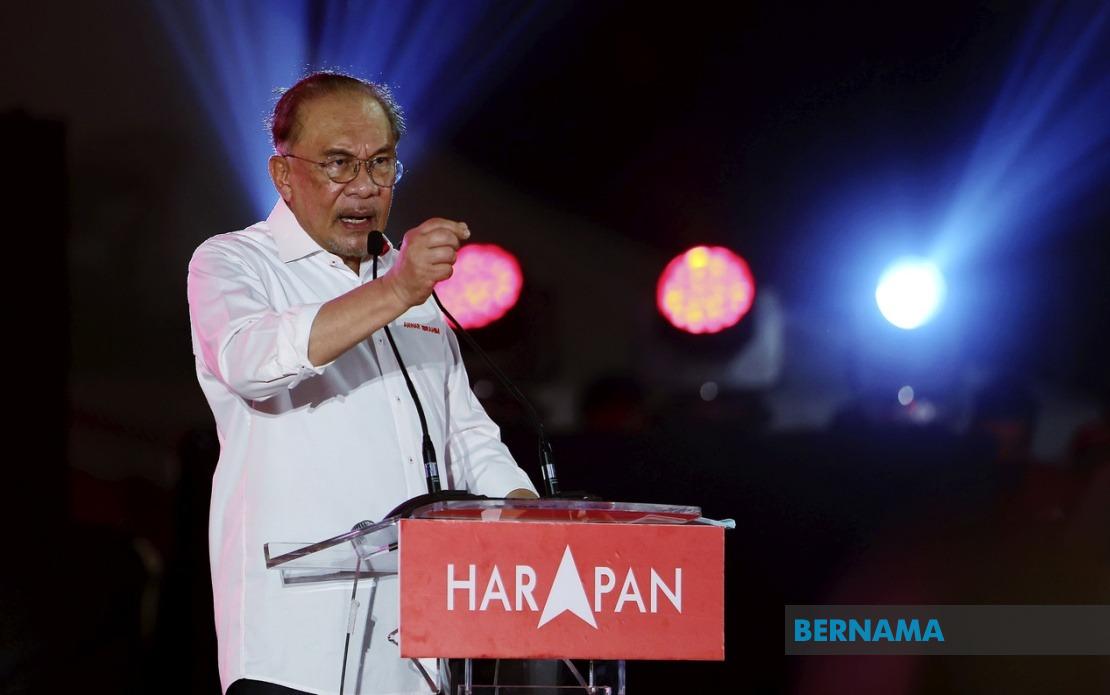
Prime Minister Anwar Ibrahim has issued a clear directive to all political contenders in the forthcoming Negeri Sembilan state election: steer clear of contentious matters surrounding royal institutions and the Federal Constitution. Speaking at a Pakatan Harapan candidate announcement ceremony in Kuala Pilah on Monday, the coalition chairman stressed that while electoral competition remains an essential component of democratic governance, it must be conducted with integrity and without resorting to inflammatory rhetoric that could fracture community cohesion.
Anwar's intervention reflects growing concerns about the tone and substance of campaign discourse in Malaysian elections. In recent years, state and federal contests have occasionally veered into sensitive constitutional and institutional territory, occasionally testing the boundaries of acceptable political debate. By explicitly cautioning against such approaches now, the Prime Minister is attempting to establish guardrails around what can legitimately become campaign fodder. His statement underscores the government's position that certain foundational elements of Malaysia's political architecture should remain above partisan contestation, regardless of short-term electoral advantage.
The Prime Minister articulated a nuanced position that acknowledges the legitimacy of political disagreement whilst simultaneously insisting on behavioural boundaries. He noted that parties can engage in vigorous policy debates and present contrasting visions for the state's future, but this freedom comes with corresponding responsibilities. Specifically, Anwar cautioned against slander and activities that might precipitate social divisions—a reference that likely encompasses both inflammatory rhetoric and the deliberate misrepresentation of opponents' positions on sensitive matters affecting Malaysia's constitutional framework and the institution of the monarchy.
Anwar's remarks gained additional weight through the assembly of prominent coalition figures at the event. DAP secretary-general Anthony Loke, Amanah president Datuk Seri Mohamad Sabu, and other senior Pakatan Harapan strategists stood alongside the Prime Minister, effectively signalling that this call for restraint represents a coalition-wide position rather than Anwar's personal preference. This unified messaging suggests that the leadership recognises potential vulnerabilities in the campaign landscape and has decided to pre-emptively establish norms that might work to their advantage against opposition parties that might otherwise seek to exploit institutional sensitivities.
The Negeri Sembilan contest assumes particular significance within Malaysia's broader political context. As a state traditionally associated with strong royal institutions and cultural conservatism, it represents terrain where opposition parties—particularly those with nationalist or Islam-focused agendas—might attempt to challenge Pakatan Harapan by raising questions about constitutional interpretation or royal prerogatives. Anwar's advance warning effectively signals that the government will not tolerate such tactics, and will likely respond forcefully if opponents transgress these newly articulated boundaries.
Beyond the cautionary message, Anwar used the platform to amplify positive themes for the coalition's campaign. He emphasised the need for leadership characterised by integrity and developmental competence, implicitly contrasting Pakatan Harapan's governance record with potential alternatives. His specific invocation of clean leadership and capability to drive progress speaks to the coalition's apparent strategy of framing the election as a choice between continued institutional stability under experienced stewardship versus the uncertainties that might accompany alternative configurations of state power.
The Prime Minister also employed the occasion to express confidence in the current Menteri Besar, Datuk Seri Aminuddin Harun, characterising him as collaborative and effective. This endorsement serves multiple purposes: it reinforces the coalition's emphasis on administrative continuity, suggests that working relationships between federal and state governments remain functional and productive, and personalises the government's developmental agenda through the figure of an experienced administrator. Anwar's willingness to spotlight Aminuddin as a cooperative partner also implicitly addresses potential concerns about federal-state tensions that might otherwise undermine Pakatan Harapan's electoral prospects.
The announcement of 36 candidates representing a deliberate blend of fresh and seasoned politicians across the coalition's three component parties—PKR, DAP, and Amanah—reflects careful calibration of the coalition's electoral strategy. The inclusion of established figures like Loke and Aminuddin in winnable constituencies signals confidence in retaining crucial strongholds, whilst the elevation of new candidates suggests an attempt to broaden the coalition's appeal and demonstrate renewal. This balanced approach attempts to address two potential vulnerabilities simultaneously: the risk that voters might perceive Pakatan Harapan as stale or reliant on recycled politicians, and the danger that untested candidates might alienate constituencies accustomed to experienced representation.
For Malaysian readers and regional observers, Anwar's intervention illuminates the careful negotiations required to maintain political stability within a constitutional framework that accords significant powers and symbolic importance to royal institutions. The Prime Minister's emphasis on respecting foundational institutions whilst enabling vigorous democratic competition reflects an understanding that Malaysia's democratic experiment depends upon maintaining consensus around certain structural elements, even as parties contest for temporary control of state machinery. His remarks also suggest that the government recognises the dangers inherent in campaigns that exploit institutional sensitivities for electoral gain, recognising that such tactics might generate backlash that ultimately damages social cohesion regardless of short-term electoral outcomes.
The Negeri Sembilan election thus becomes a test case for whether Malaysia's political parties can conduct competitive campaigns within mutually agreed-upon boundaries. If respected across party lines, Anwar's framework could establish a useful precedent for future contests. Conversely, if opposition parties ignore these cautionary signals and proceed with institutional or constitutional provocations, the government's response might establish important precedents regarding the acceptable scope of political speech in Malaysian electoral contests. Either outcome will carry implications for the character and tone of Malaysian democracy in the years ahead.

