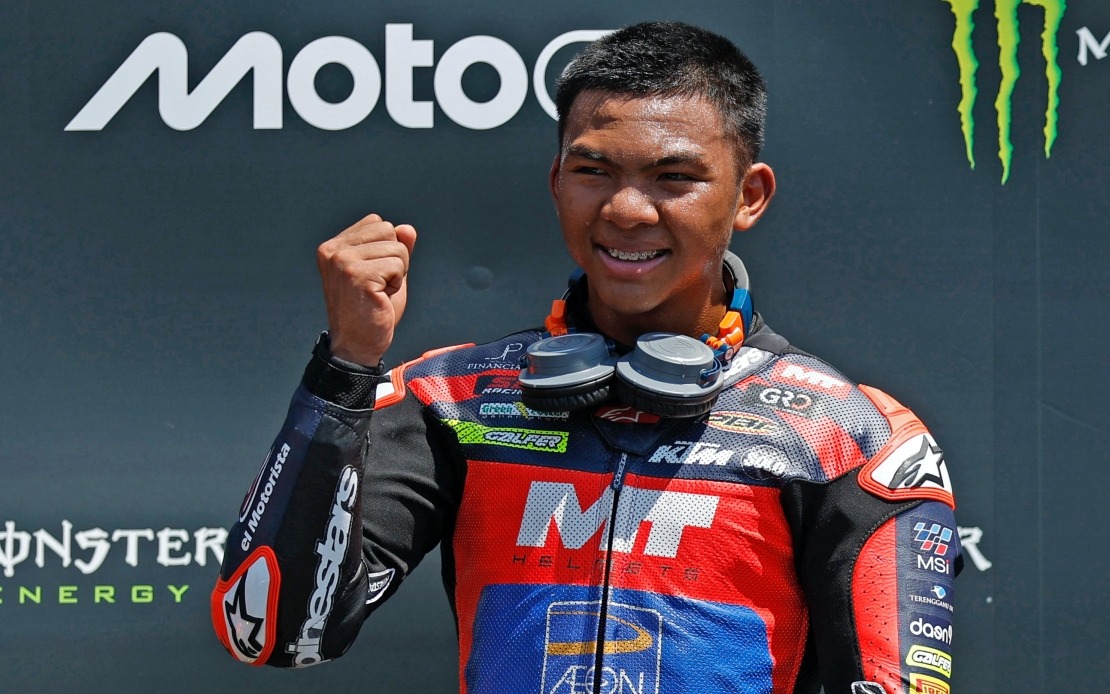
Prime Minister Datuk Seri Anwar Ibrahim has extended his felicitations to Moto3 competitor Hakim Danish Ramli following the teenager's triumph at the Czech Grand Prix held at Brno Circuit today. The Malaysian premier took to social media platform X to publicly acknowledge the accomplishment, urging the young rider to pursue additional victories as his career progresses. Anwar's swift recognition of the achievement underscores the significance attached to motor racing success within Malaysia's sporting landscape and governmental circles alike.
Hakim Danish's victory today represents only his second podium appearance throughout the current season, following a third-place finish at the Italian Grand Prix at Mugello in the preceding month. The AEON Credit-MT Helmets-MSi mounted rider has demonstrated steady progression through the competitive Moto3 field, building momentum as the season develops. His consistent performance in elite international racing illustrates the quality of talent emerging from Malaysia's motorsport development pipeline.
At merely 18 years old, Hakim Danish has etched his name into Malaysian sporting history by becoming the nation's first Moto3 race winner in a decade. The significance of this breakthrough cannot be overstated for a country that has long invested in producing world-class motorcycle racers. His victory arrives as a watershed moment following a prolonged period in which Malaysia failed to claim victories in this fiercely contested intermediate class of grand prix racing.
The last occasion on which a Malaysian pilot secured Moto3 honours stretched back to 2016, when Khairul Idham Pawi claimed consecutive victories at the Argentina Grand Prix and German Grand Prix during that campaign. Pawi's achievements in that season represented the pinnacle of Malaysian Moto3 success, and Hakim Danish's win today finally brings an end to the extended gap in medal returns at this level of international competition. The eight-year interval reflects both the demanding nature of progressing through professional motorcycle racing's ranks and the heightened competitiveness that characterises the sport's modern era.
Hakim Danish's performance at Brno carries profound implications for Malaysian motorsport recruitment and grassroots development programmes. When established riders achieve success on the world stage, they typically inspire younger cohorts to pursue careers in the sport, creating a virtuous cycle of talent emergence and institutional investment. National federations benefit from the motivational impact of homegrown success stories, which often translates into enhanced government backing, sponsor confidence, and media interest in domestic racing frameworks.
The teenager's breakthrough arrives during a transformative period for Malaysian motorsport, which continues to evolve its international presence across multiple racing disciplines. From circuit racing through to motorcycle competitions, the nation has cultivated a reputation for producing technically proficient riders capable of competing at the highest echelons of global motorsport. Hakim Danish's Czech Grand Prix victory reinforces this trajectory and provides tangible evidence that Malaysia remains a credible source of racing talent.
Hakim Danish's achievement also resonates within the broader Southeast Asian motorsport context, where Malaysia has historically maintained a leading position in developing competitive racers. The region's motorsport ecosystem benefits when national representatives advance their careers successfully at international level, elevating the profile of regional motorsport competitions and attracting enhanced international engagement. His success potentially opens doors for Malaysian teams and sponsors seeking to extend their involvement in grand prix racing categories.
The support extended by Prime Minister Anwar Ibrahim reflects governmental appreciation for athletes who represent Malaysia internationally. High-level political acknowledgement of sporting achievement serves practical purposes beyond ceremonial gratification, as it frequently correlates with increased resource allocation, improved support infrastructure, and enhanced career opportunities for successful competitors. For young racers like Hakim Danish, such recognition from national leadership can facilitate sponsorship arrangements and private sector backing that sustains career advancement.
Looking forward, Hakim Danish faces the considerable challenge of consolidating this breakthrough into sustained competitive performance throughout the remainder of the season and beyond. Moto3 competition remains intensely contested, with multiple manufacturers and rider combinations battling for supremacy across the calendar. Translating a single victory into a consistent pattern of podium finishes and further wins will require sustained focus, technical development, and psychological resilience as rivals inevitably intensify their efforts to counter his newly demonstrated capability.
The Brno triumph serves as confirmation that Malaysian motorsport development efforts have yielded tangible international returns after several seasons of relative underperformance in the Moto3 category. Investment in rider education, technical expertise, and competitive machinery appears to be generating results that justify continued commitment to these programmes. Hakim Danish's victory today may well inspire renewed policy attention toward motorcycle racing support within Malaysia's broader sports administration framework.

