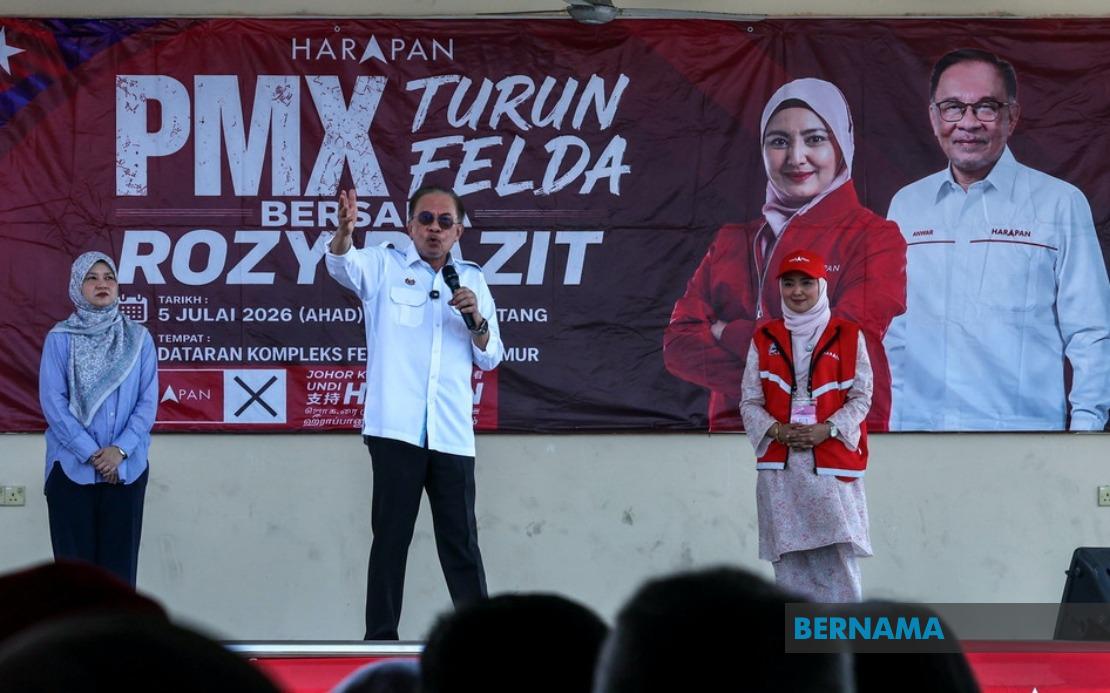
Prime Minister Datuk Seri Anwar Ibrahim has made a formal commitment to address the housing crisis that has plagued the second generation of FELDA settlers for decades, declaring during a constituency visit in Segamat that resolving this issue ranks among his administration's priorities. Speaking at a public engagement programme at Dataran Putra FELDA Palong Timur in the Buloh Kasap state constituency, Anwar underscored the urgency of providing housing sites and security guarantees for the descendants of original settlement scheme participants, many of whom have been denied the land benefits their parents received.
The Prime Minister's pronouncement represents a formal acknowledgment of a structural inequity within Malaysia's agricultural settlement framework that has festered since the early years of FELDA's expansion. The Federal Land Development Authority, a cornerstone institution for rural development and poverty alleviation since its establishment in 1956, initially allocated land holdings to pioneer settlers but failed to establish a systematic mechanism for transferring or securing equivalent benefits to their children. This omission has created a significant generational disparity, with second-generation settlers lacking the land ownership or housing security that underpinned their parents' economic stability and social standing within FELDA communities.
Anwar's remarks carry particular weight given his positioning of the issue as a matter requiring resolution during his tenure as Prime Minister, effectively setting a personal timeline for action. He articulated a clear policy direction aimed at protecting second-generation settlers' housing rights and ensuring guaranteed access to residential sites, framing the commitment as both a matter of equity and governmental responsibility. This framing suggests recognition that the housing deficit represents not merely a logistics problem but a failure of intergenerational justice within a state-sponsored development scheme.
The political practicality of implementation, however, presents considerable complexity. Anwar explicitly acknowledged that resolving the crisis demands cooperation from state governments, as constitutional arrangements in Malaysia vest land administration and basic infrastructure provision—electricity, water, roads—under state jurisdiction rather than federal control. This federal-state coordination requirement introduces multiple layers of bureaucratic negotiation and resource allocation, particularly given that FELDA schemes operate across numerous states with varying administrative capacity, fiscal constraints, and political priorities. States such as Selangor, where the Segamat event occurred, face competing land development demands and budget pressures that may complicate housing provision efforts.
The delegation accompanying Anwar underscored the multi-dimensional nature of the challenge. Selangor Menteri Besar and PKR vice-president Datuk Seri Amirudin Shari's presence signalled state-level engagement with the initiative, while the inclusion of Education Minister Fadhlina Sidek and Deputy National Unity Minister R. Yuneswaran, who also serves as Segamat's Member of Parliament, reflected the interconnected social, educational, and community dimensions of the FELDA housing crisis. The participation of multiple cabinet-level officials suggested that addressing second-generation settler grievances forms part of a broader government strategy to stabilise rural constituencies and rebuild confidence in state-led development institutions.
For FELDA communities scattered across peninsular Malaysia, the announcement carries significant implications regarding asset security and intergenerational wealth transfer. Many second-generation settlers, now in their forties and fifties, have remained economically precarious precisely because they lack the property ownership security that their parents possessed. Without guaranteed housing sites or land allocation mechanisms, these individuals cannot leverage property as collateral for business expansion, cannot secure their children's inheritance prospects, and lack the tangible economic foundation that characterized their parents' experience within the settlement scheme.
The timing of Anwar's commitment reflects broader political calculations within the ruling coalition. FELDA settlers and their descendants constitute a significant voting bloc across multiple constituencies, and rural satisfaction with federal governance directly influences electoral outcomes in seats that often determine overall parliamentary composition. By addressing a long-neglected grievance, the government seeks to reinforce coalition support in these demographically important communities, particularly given that FELDA constituencies have occasionally tilted towards opposition parties when rural constituencies perceived government neglect.
The decades-long delay in addressing second-generation housing needs also reflects institutional challenges within FELDA itself. The authority's original mandate focused on pioneer settlement and land development, with administrative structures designed around managing original settler populations and their immediate support requirements. Extending FELDA's operational logic to encompass generational land transfer mechanisms requires reconceptualizing the organization's role and potentially restructuring its financial and administrative frameworks. Any comprehensive solution will likely demand legislative amendments, budget allocation, and coordination across multiple government tiers.
Implementing Anwar's commitment will require negotiating between competing policy objectives. FELDA has long functioned as a mechanism for poverty alleviation and rural development, but expanded housing provision for second-generation settlers could strain the authority's fiscal capacity and redirect resources from other development initiatives. States may require federal fiscal support or incentive structures to make housing provision financially viable, potentially creating tensions over cost allocation between federal and state governments.
The resolution of this issue carries implications beyond FELDA communities themselves. Success in addressing second-generation settler housing needs could establish a precedent for government intervention in other intergenerational equity questions affecting rural Malaysia, potentially reshaping expectations regarding state responsibility for sustaining development scheme participants' descendants. Conversely, failure or prolonged delays would reinforce perceptions of governmental indifference to rural grievances and institutional incapacity to implement complex, multi-stakeholder policy solutions.
Regional observers from other Southeast Asian nations with analogous agricultural settlement schemes may scrutinize Malaysia's approach, as similar generational housing crises affect rural development programmes across Indonesia, Thailand, and the Philippines. How Malaysia resolves this challenge could inform policy discussions across the region regarding sustainable land distribution and intergenerational benefit mechanisms within state-directed rural development frameworks. The issue thus transcends domestic Malaysian politics, touching on fundamental questions regarding development equity and institutional sustainability across Southeast Asia's rural landscape.

