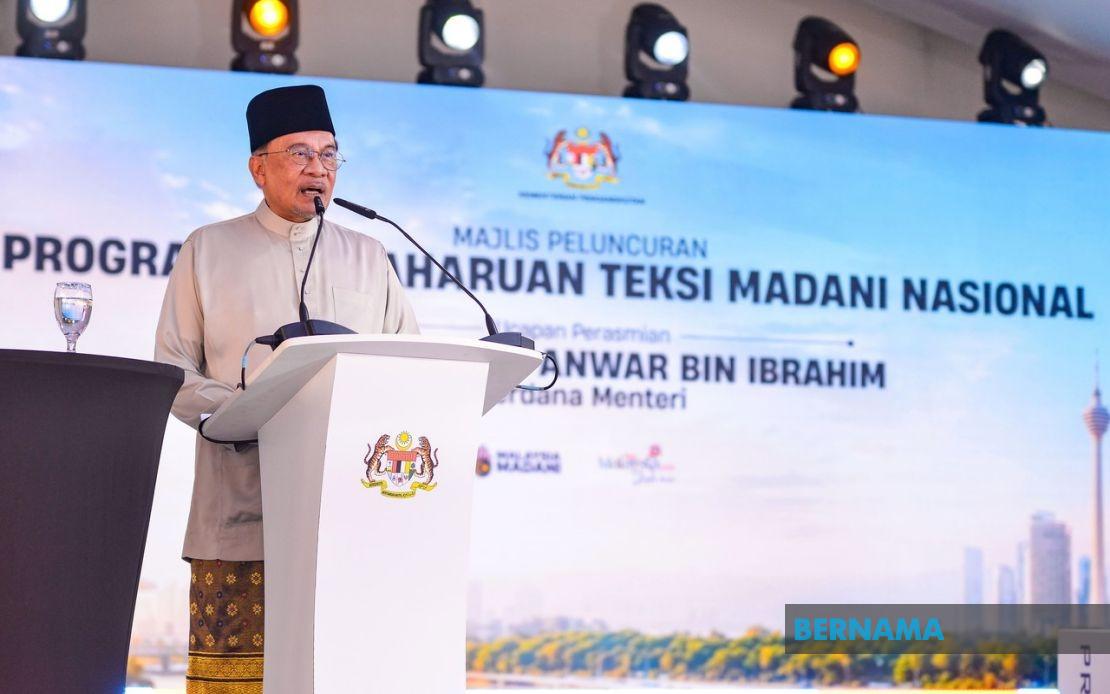
Prime Minister Datuk Seri Anwar Ibrahim has committed an additional RM10 million to accelerate the modernisation of Malaysia's taxi fleet, responding to overwhelming uptake of the initial funding tranche from Budget 2026. Speaking at the launch of the National MADANI Taxi Reform Programme at Dataran Merdeka on July 3, Anwar, who also holds the Finance Ministry portfolio, characterised the taxi sector's response as sufficiently compelling to warrant immediate supplementary investment. The fresh allocation brings total government support for vehicle replacement to RM20 million, signalling the administration's determination to revitalise an industry that remains crucial to urban mobility across the country.
The decision reflects a shift in government priorities towards the informal transport sector, which has long struggled with ageing vehicle fleets and associated safety and environmental concerns. Taxi drivers in major cities like Kuala Lumpur, Selangor and Penang operate vehicles that frequently exceed 15 years, creating maintenance burdens and reliability issues that disadvantage both operators and passengers. By channelling funds directly into replacement incentives, the government addresses a structural problem that market forces alone have failed to resolve, particularly given the competitive pressure from ride-hailing applications and the substantial capital investment required for fleet renewal.
Crucially, the government has negotiated a dedicated financing arrangement with Malaysian automaker Proton and the Transport Ministry to enable taxi drivers to purchase the Proton S70 sedan under preferential terms. This partnership represents a convergence of industrial policy and transport reform, allowing Proton to secure a predictable customer base while providing drivers with access to locally manufactured vehicles at competitive rates. The S70, a mid-range sedan with reasonable fuel efficiency and passenger comfort, represents a practical solution for the taxi market, though details on the specific financing terms, interest rates, and payment periods have not yet been disclosed.
Transport Minister Anthony Loke attended the programme launch alongside Minister in the Prime Minister's Department (Federal Territories) Hannah Yeoh and Chief Secretary to the Government Tan Sri Shamsul Azri Abu Bakar, underlining the cross-agency coordination required for successful implementation. The multi-ministerial involvement suggests that government expects the taxi reform initiative to address not only vehicle replacement but potentially broader issues including driver training, passenger safety standards, and integration with the wider public transport ecosystem. Hannah Yeoh's presence, given her portfolio's oversight of Kuala Lumpur's municipal affairs, indicates that capital city taxi services remain a priority area where government visibility and public perception are particularly acute.
The National MADANI Taxi Reform Programme extends beyond simple financial grants to encompass a more holistic reimagining of the sector. MADANI, the government's framework for inclusive development, prioritises enhanced service quality and environmental sustainability—both critical concerns for urban taxi operations. Drivers who access replacement grants will theoretically operate newer, more reliable vehicles with improved fuel economy and lower emissions, benefiting both their operational costs and broader air quality objectives in congested city centres. The programme also implicitly encourages standardisation and professionalisation of the taxi fleet, potentially paving the way for future regulatory improvements in driver conduct and passenger safety protocols.
The enthusiastic initial response to the Budget 2026 allocation, which justified rapid approval of supplementary funding, demonstrates pent-up demand within the taxi sector for vehicle modernisation assistance. Many drivers have deferred replacement due to capital constraints and uncertainty about the transport industry's future viability amid competition from digital ride-sharing platforms. The government's willingness to inject additional capital signals confidence in the sector's continued relevance and creates a window for drivers to act on modernisation before any future economic downturns might constrain further support. This window-of-opportunity approach is familiar from previous government programmes but carries particular urgency given the accelerating technological disruption of transportation markets.
For Malaysian passengers, the implications are substantial though not immediate. A younger, better-maintained taxi fleet would deliver improved reliability, reduced mechanical breakdowns during journeys, and enhanced passenger comfort through more modern vehicle interiors and air conditioning systems. Safety outcomes may also improve, as newer vehicles typically incorporate superior crash protection features and braking systems compared to ageing models currently on roads. However, these benefits materialise only as drivers actually access financing and complete vehicle purchases—a process that typically unfolds over 18–36 months depending on the scheme's operational efficiency and the speed at which drivers navigate the application and approval procedures.
The Proton partnership warrants closer examination in the context of Malaysia's automotive industry strategy. The government has consistently sought to support domestic carmakers through procurement and financing support, yet Proton's market share among consumers has faced sustained pressure from foreign competitors. By creating a captive market segment—professional taxi drivers with government-backed financing—the government effectively underwriting Proton's commercial performance in a specific niche. Critics might question whether this represents optimal allocation of public funds, while supporters argue that maintaining a viable domestic automotive ecosystem provides long-term industrial and employment benefits that justify short-term subsidisation.
Implementation challenges should not be underestimated. Previous government programmes targeting informal sector workers have frequently encountered obstacles including bureaucratic delays, inadequate communication of application procedures, and disparities between official programme terms and ground-level reality. Taxi drivers, who typically operate with modest profit margins and limited spare capital, cannot afford lengthy waiting periods for fund disbursement or unexpected additional costs. The government must ensure that Proton and partner financial institutions streamline the application process, provide transparent communication in accessible formats, and deliver financing decisions within timeframes that align with drivers' operational needs. Regional differences—including variations in taxi industry structure between federal territories, Selangor, and other states—may also complicate uniform programme implementation.
The timing of this announcement, occurring mid-year after initial Budget allocations have been partially absorbed, suggests fiscal discipline alongside political responsiveness. The Prime Minister's authority to approve supplementary allocations demonstrates the concentration of budgetary control within the Finance Minister's office, a characteristic feature of Malaysia's executive-dominated fiscal system. Opposition politicians may question whether such mid-year adjustments should require parliamentary scrutiny, though the government's framing as a tactical response to demonstrated demand provides a rationale for executive action. This approach establishes a precedent that successful programmes can attract additional funding, potentially incentivising other sectors to demonstrate enthusiasm for their respective government schemes.
Looking forward, this taxi reform initiative represents a test case for the government's broader commitment to sectoral modernisation and informal economy support. The success or failure of vehicle replacement uptake, the actual delivery of Proton S70 financing, and measurable improvements in taxi service quality will shape public and parliamentary expectations for future programmes targeting other informal transport operators—including motorcycle taxi and van services that serve suburban and rural communities. If implementation proceeds smoothly and drivers successfully modernise their fleets, the programme could establish a replicable model for targeted industrial policy that combines direct financial support with domestic enterprise partnership. Conversely, implementation delays or low uptake would raise questions about the government's capacity to execute complex sectoral reforms and appropriately calibrate support to market realities.

