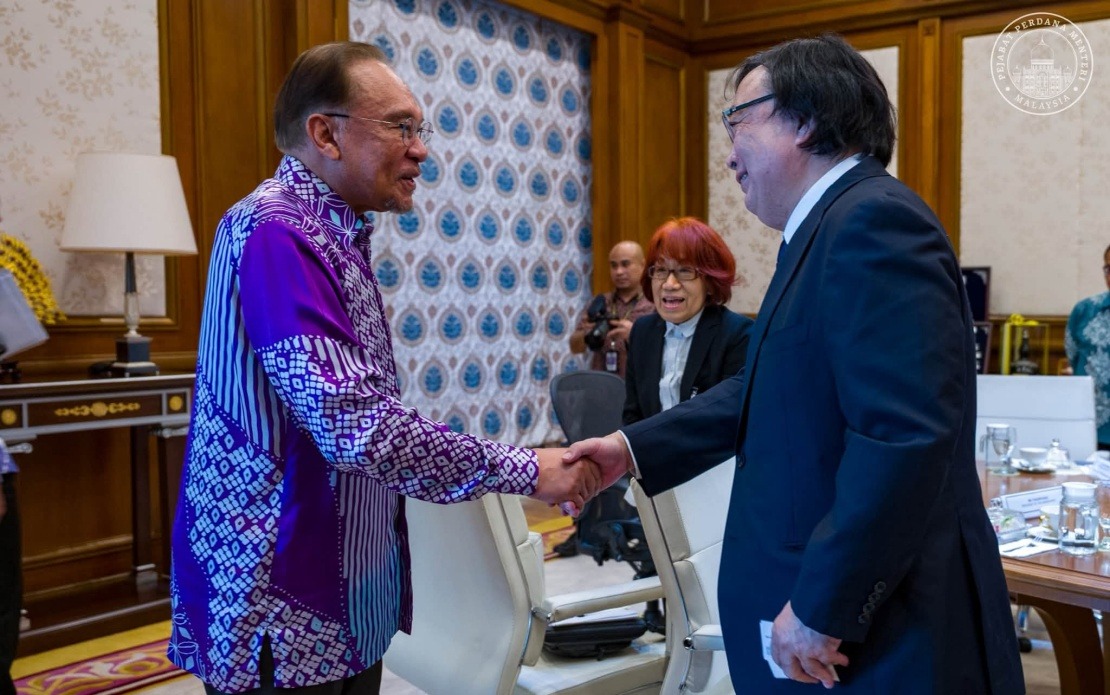
Prime Minister Datuk Seri Anwar Ibrahim received a courtesy visit from Genron NPO President Yasushi Kudo on July 23, marking a continued dialogue between Malaysia's leadership and a prominent independent think tank based in Japan. The meeting underscored the ongoing commitment both parties share in leveraging the Asia Leaders Roundtable as a meaningful platform for strategic engagement across the region. Through this forum, policymakers and thought leaders aim to collectively address pressing regional and global issues that affect stability and prosperity throughout Asia.
The Genron NPO, officially registered as a non-profit and independent research institution, has emerged as an influential voice in Japanese policy circles and broader Asian discourse. The organization works to facilitate high-level dialogue among Asian leaders, creating spaces where candid discussions on geopolitical, economic, and security matters can take place outside formal governmental channels. By inviting Malaysia's Prime Minister to engage with this platform, the Genron NPO demonstrates recognition of Malaysia's evolving regional influence and its role as a moderating force within Southeast Asia's complex political landscape.
Anwar took to Facebook to share details of the engagement, highlighting that the discussion also served to reinforce the bilateral relationship between Malaysia and Japan. The Prime Minister seized the occasion to express his gratitude for the reception and hospitality he received during his official visit to Japan in June, signalling that the journey had achieved its diplomatic objectives and left a positive impression. Such courtesy acknowledgements reflect the customary but substantive practice of maintaining warm bilateral relations, particularly with countries that Malaysia considers among its most important partnerships in the broader Indo-Pacific region.
Malaysia's relationship with Japan occupies a distinctive position within the nation's foreign policy architecture. Designated as a Comprehensive Strategic Partnership, the bilateral ties span multiple domains including defence, trade, investment, technology transfer, and cultural exchange. For Malaysia, Japan represents not merely a developed economic power but a stable, predictable partner that shares commitment to regional stability and the rules-based international order. This partnership has weathered various regional tensions and shifts in great power dynamics, remaining a cornerstone of Malaysian strategic calculations.
The economic dimensions of Malaysia-Japan relations cannot be understated. Japan consistently ranks among Malaysia's top trading partners and sources of foreign direct investment, particularly in manufacturing sectors such as semiconductors, automotive components, and electronics. Japanese companies have established deep supply chain networks throughout Malaysia, making the relationship mutually beneficial. Beyond commerce, Japan's technical expertise and educational programs have contributed substantially to Malaysia's human capital development, with numerous Malaysian professionals having undergone training in Japanese institutions.
Anwar's remarks concerning the Comprehensive Strategic Partnership reflect an intentional message to both Japanese policymakers and Malaysia's domestic audience. By emphasizing the significance of this relationship, the Prime Minister signals that his government prioritizes deep engagement with developed democracies that share similar values on governance and regional security. This positioning becomes particularly relevant amid broader geopolitical competition, where Southeast Asian nations must carefully calibrate their relationships with multiple external powers.
The invitation to attend the Tokyo Conference 2027 represents a concrete manifestation of Malaysia's valued position within these regional dialogue mechanisms. By conferring such invitations on the Prime Minister, the Genron NPO acknowledges Malaysia's diplomatic weight and the potential contribution Malaysian perspectives can bring to pan-Asian discussions. Anwar's acceptance of an earlier invitation to deliver a video message at the 2026 conference demonstrates consistent engagement with these intellectual forums, suggesting that Malaysia intends to remain a visible participant in regional strategic conversations.
These dialogue platforms serve a crucial function in contemporary Asia, where formal multilateral institutions sometimes lack flexibility or face constraints from geopolitical tensions. The Asia Leaders Roundtable and similar forums create informal settings where leaders can explore ideas, build personal relationships, and occasionally signal policy shifts without the rigidity of official statements. For Malaysia, participation in such mechanisms allows the nation to influence regional narratives and contribute to consensus-building on critical issues, from maritime security to economic integration.
The meeting also reflects broader patterns in Southeast Asian diplomacy, where engagement with Japan has intensified as regional states seek to balance relationships with larger powers. Japan's own pivot towards more active regional engagement, manifested through initiatives like the Quad framework and enhanced security partnerships with ASEAN nations, has created new opportunities for countries like Malaysia to deepen cooperation. Anwar's administration has demonstrated willingness to engage with these initiatives while maintaining prudent distance from being perceived as taking sides in great power competition.
Looking forward, the continued strengthening of Malaysia-Japan ties through both governmental and non-governmental channels suggests enduring commitment to partnership. The emphasis on shared pursuit of peace, stability, and prosperity encapsulates the mutual interests that bind the two nations. For Malaysia, maintaining robust relationships with stable, technologically advanced democracies like Japan remains strategically prudent as the nation navigates complex regional dynamics and seeks to position itself as a credible, forward-thinking player in Asian affairs.

