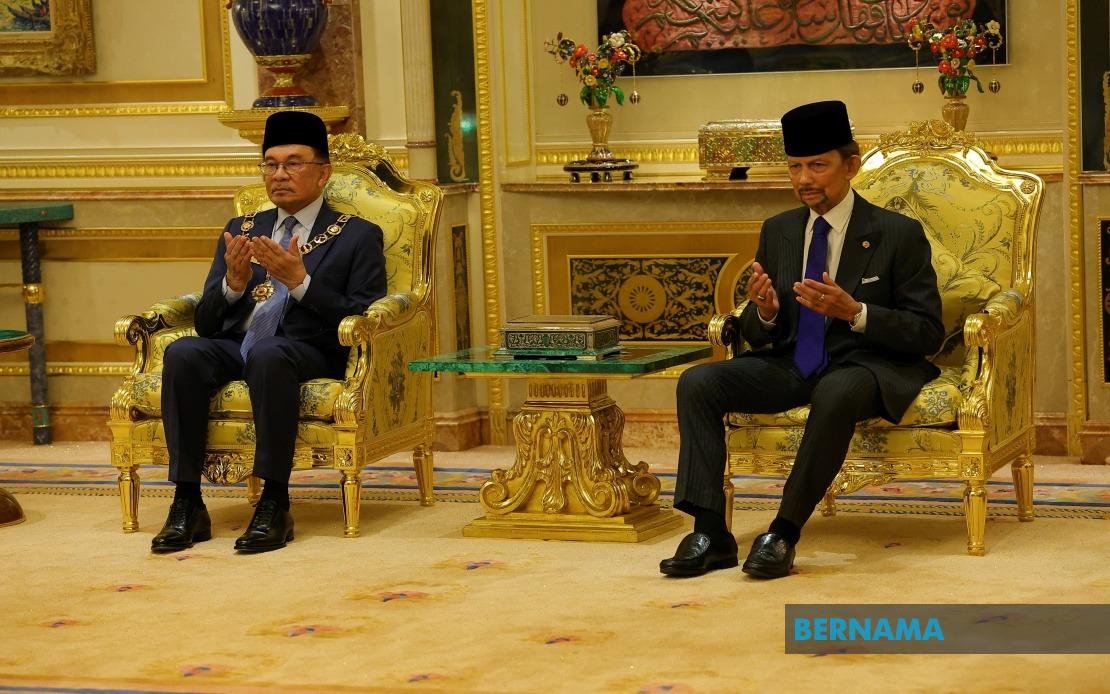
Prime Minister Datuk Seri Anwar Ibrahim was conferred the Darjah Kerabat Laila Utama Yang Amat Dihormati (D.K.) by Sultan Hassanal Bolkiah in a formal investiture ceremony at Cheradi Laila Kenchana, Istana Nurul Iman, in Bandar Seri Begawan on August 22. The award, Brunei's highest honour, recognises Anwar's contributions to regional relations and bilateral cooperation. The ceremony drew witness from Brunei's Crown Prince Pengiran Muda Mahkota Al-Muhtadee Billah, underscoring the significance of the occasion within Brunei's royal protocols.
Anwar's delegation included several senior Malaysian officials whose presence reflected the breadth of bilateral engagement. Foreign Minister Datuk Seri Mohamad Hasan and Investment, Trade and Industry Minister Datuk Seri Johari Abdul Ghani joined the Prime Minister, while state leaders Sarawak Premier Tan Sri Abang Johari Tun Openg and Sabah Chief Minister Datuk Seri Hajiji Noor demonstrated the role of East Malaysian governments in deepening regional ties. This multi-level representation highlighted Malaysia's comprehensive approach to strengthening ties with its southern neighbour.
The ceremony formed part of Anwar's two-day working visit to Brunei, a destination that remains strategically important for Malaysia despite its smaller size and population. The visit's timing and composition signal Malaysia's commitment to maintaining robust relations with all Association of Southeast Asian Nations members, particularly those with shared maritime boundaries and mutual security interests. Brunei's position as the wealthiest nation per capita in Southeast Asia and a significant energy producer underscores the economic dimension of bilateral engagement.
Beyond ceremonial elements, the visit carried substantive policy outcomes. Sultan Hassanal Bolkiah and Anwar were scheduled to witness the signing of a Memorandum of Understanding on disaster management cooperation, a development reflecting shared vulnerabilities in a region prone to tropical storms, flooding, and transboundary environmental hazards. Such frameworks enable coordinated response mechanisms and knowledge-sharing on early warning systems and emergency preparedness—matters of practical importance to both nations' populations.
The Darjah Kerabat Laila Utama represents one of Brunei's most distinguished honours, typically conferred upon foreign leaders and dignitaries who have demonstrated exceptional commitment to deepening ties with the sultanate. The award carries symbolic weight within the region's diplomatic community, elevating the recipient's status and affirming bilateral respect. For Anwar, the honour comes at a time when Malaysia navigates complex regional dynamics and seeks to reinforce its position as a trusted partner across ASEAN.
The formal investiture occurred during a bilateral meeting between the two leaders, suggesting that substantive discussions on regional and bilateral matters accompanied the ceremonial proceedings. Such high-level exchanges typically address issues ranging from trade relations and tourism to maritime cooperation and educational collaboration. Given the presence of trade and investment ministers, negotiations likely encompassed opportunities for Malaysian businesses in Brunei's economy, particularly in the energy and financial services sectors.
Anwar's presence at the 27th Annual Leaders' Consultation between Malaysia and Brunei underscores the institutional depth of bilateral relations. These annual consultations provide structured forums for addressing ongoing challenges and exploring new areas of cooperation. The gathering brings together the highest levels of political leadership, creating opportunities for frank dialogue on regional security, economic integration within ASEAN, and responses to shared external pressures.
The composition of Malaysia's delegation carried particular significance for East Malaysian politics. The inclusion of Sarawak's and Sabah's chief ministers acknowledged these states' roles in Malaysia's broader diplomatic strategy, particularly regarding maritime affairs and border cooperation with Brunei. Both states share maritime boundaries with Brunei and have direct interests in regional stability, resource management, and people-to-people exchange.
From a regional perspective, Malaysia's engagement with Brunei reflects broader patterns of Southeast Asian diplomacy in an era of geopolitical complexity. Small nations like Brunei maintain strategic importance despite limited size, serving as crucial nodal points in regional trade networks and security arrangements. Malaysia's cultivation of these relationships demonstrates sophisticated understanding of ASEAN's principle of non-interference combined with pragmatic cooperation on matters of mutual concern.
The disaster management cooperation accord represents a forward-looking dimension of bilateral relations. Climate change and environmental degradation increasingly threaten both nations' populations and economic interests, making coordinated approaches essential. Such frameworks often lead to joint training exercises, exchange programmes for disaster management personnel, and integrated preparedness planning—tangible benefits that extend beyond ceremonial interactions.
Anwar's diplomatic visit occurs within Malaysia's broader engagement strategy under his administration, characterised by renewed emphasis on regional multilateralism and bilateral relationships. The honour conferred by Sultan Hassanal Bolkiah validates this approach and potentially opens pathways for deeper economic and security cooperation. For Malaysian observers, the visit demonstrates sustained commitment to ASEAN cohesion and the smaller member states that form crucial anchors of regional architecture.
The working visit concludes Malaysia's efforts to strengthen the sultanate relationship and institutionalise cooperation across multiple sectors. Looking forward, the disaster management accord and other collaborative frameworks established during such visits create operational infrastructure supporting long-term partnership. For both nations, such sustained engagement represents investment in regional stability and prosperity, recognising that challenges ranging from transnational crime to environmental degradation require coordinated responses beyond individual state capacity.

