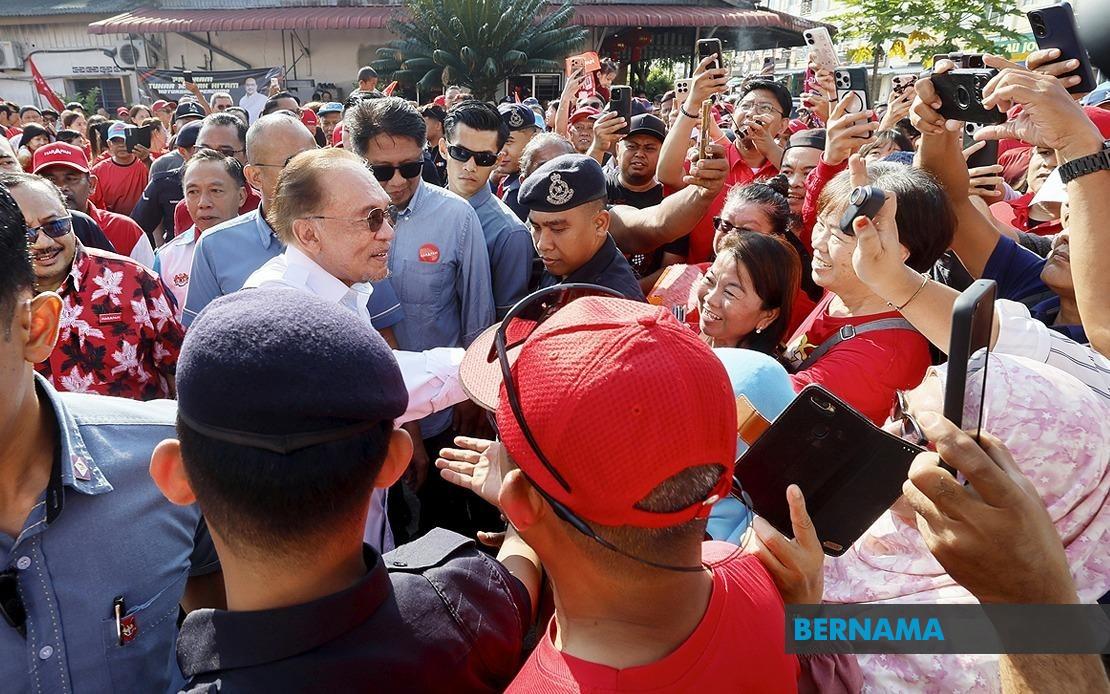
Prime Minister Datuk Seri Anwar Ibrahim took time out of his campaign schedule in Batu Pahat to reconnect with an elderly couple whose determination to meet him had captured public attention. Abdul Razak Pelangga, 86, and his wife Jamilah Samsudin, 64, became the focus of widespread social media attention after undertaking a humble journey by trishaw to greet the Prime Minister during his breakfast visit to Senggarang the previous Sunday. The reunion took place as Anwar attended the "Yok! Meriahkan Johor! Undi Harapan" programme in the same locality, bringing together supporters ahead of the closely watched state election.
The encounter was marked by genuine warmth and humour as the Prime Minister engaged with Abdul Razak, whose physical vitality at 86 years old became a talking point. Anwar playfully acknowledged the octogenarian's impressive feat of pedalling the trishaw himself, drawing laughter from the assembled crowd. Beyond the light-hearted banter, the Prime Minister expressed his appreciation for the couple's unwavering support, recognizing that their gesture represented a deeper commitment from ordinary Malaysians to the political process.
The visibility of this moment underscores how grassroots engagement has become central to Malaysian electoral campaigns. The story of Abdul Razak pedalling nearly a kilometre by trishaw to fulfil his wife's wish of meeting the national leader embodies a narrative of civic participation that resonates with voters across generations. In an era where political engagement often feels distant or mediated through digital platforms, the image of an elderly couple making a physical journey to connect with their leader carries symbolic weight.
Several senior figures from the ruling coalition were present to witness the interaction, including Pakatan Harapan Communications director Datuk Fahmi Fadzil, who also serves as Minister of Communications. The programme further featured candidates contesting in the upcoming state election, including Onn Abu Bakar for Senggarang, Mohd Khuzzan Abu Bakar for Semerah, and Felicia Poh Rui Ling for Penggaram. This gathering of party leadership and local candidates reflected the strategic importance of Johor in the broader political landscape, where maintaining strong community connections can translate into electoral success.
The timing of this reunion held particular significance as Johor prepared for its state election scheduled for Saturday of that same week. Early voting had already occurred the previous Tuesday, setting the stage for what many analysts viewed as a critical test of voter sentiment. The Johor state election carries implications beyond the state itself, serving as a barometer for federal political dynamics and the continued viability of Pakatan Harapan's governing coalition.
The trishaw journey by Abdul Razak and Jamilah represented more than a personal milestone. It illustrated how traditional modes of transport and old-fashioned civic commitment still hold meaning in contemporary Malaysia. The couple's story, amplified through social media coverage, provided positive messaging for the coalition without requiring manufactured spectacle. This authentic grassroots narrative offered a counterpoint to more formal political communications.
For Anwar Ibrahim, such interactions form part of a broader strategy to maintain direct connection with voters beyond metropolitan centres. Senggarang and the surrounding Batu Pahat region represent areas where personal engagement by senior leadership can reinforce party presence and demonstrate accessibility. The Prime Minister's willingness to step away from his itinerary to acknowledge the couple's effort sends a subtle but important message about valuing ordinary citizens' participation in the democratic process.
The accessibility factor embedded in this encounter also relates to broader questions about how Malaysian political leadership connects with communities. While digital communication increasingly dominates campaign strategies, these face-to-face moments carry disproportionate impact in building trust and demonstrating genuine interest in constituents' lives. The couple's story had already circulated widely among Johor voters by the time of the reunion, meaning Anwar's decision to meet them again reinforced the narrative rather than introducing it.
As Malaysia's political landscape continues to evolve following various transitions and coalition shifts, moments of authentic human connection remain powerful tools for building electoral coalitions. The Johor state election represented one of several contests through which voters could signal their assessment of national government performance. Stories like that of Abdul Razak and Jamilah, rather than policy documents or campaign speeches, often lodge in voters' memories and influence their decision-making at the ballot box.
The broader context of Johor state politics adds another dimension to this meeting. The state has historically been a stronghold for various political forces, and its election results carry weight in discussions about peninsular Malaysia's political trajectory. Pakatan Harapan's performance in this election would contribute to assessments of the coalition's viability as a governing force, particularly in states where it faced significant opposition challenges. Grassroots support demonstrated through stories like Abdul Razak's trishaw journey provided anecdotal evidence of voter engagement beyond polling projections.

