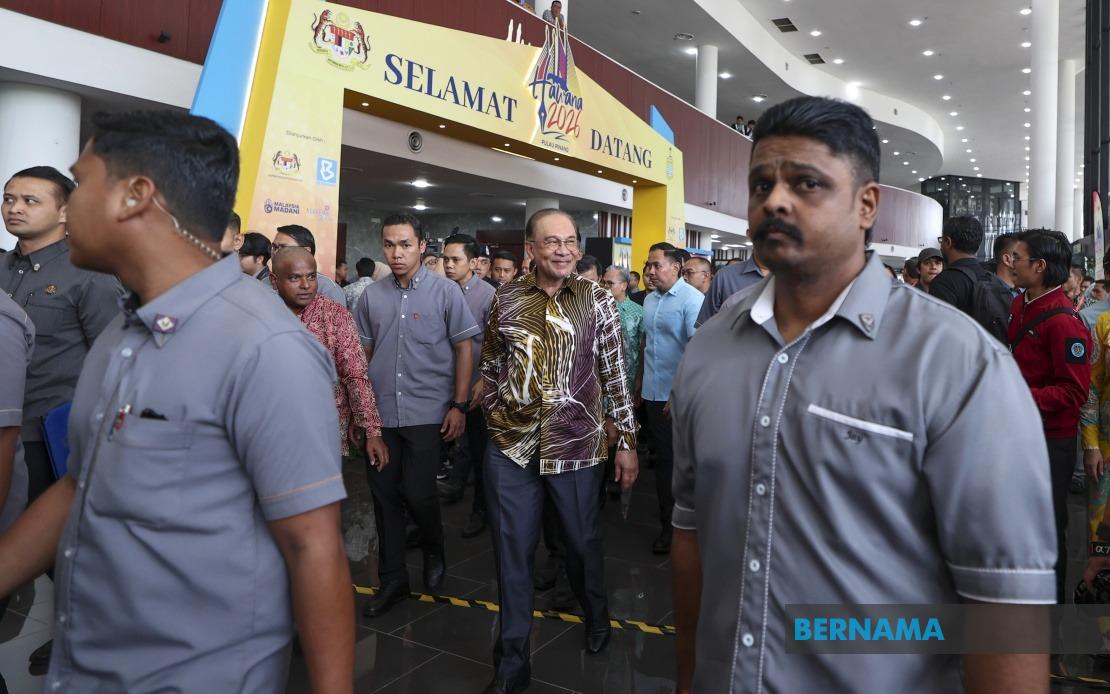
Prime Minister Datuk Seri Anwar Ibrahim officiated the main celebration of HAWANA 2026, Malaysia's National Journalists' Day, at the PICCA Convention Centre @ Butterworth Arena on June 20, arriving at 2.40 pm to a formal reception. Penang Chief Minister Chow Kon Yeow, Communications Minister Datuk Fahmi Fadzil and Communications Ministry secretary-general Datuk Abdul Halim Hamzah welcomed the Prime Minister, underscoring the significance of the occasion as a high-level government event honouring the journalism profession across the region.
Before engaging with the formal proceedings, Anwar took time to engage with the exhibition space and a dedicated HAWANA 2026 Photo Gallery positioned in the venue's foyer, a gesture demonstrating the government's broader commitment to celebrating media contributions to public discourse. This walkthrough allowed him to interact with displays reflecting the evolution and current state of journalism in Malaysia and beyond, setting the tone for what organisers billed as a strategic platform for the media industry.
The event drew significant institutional representation from Malaysia's own media apparatus. Bernama, the Malaysian National News Agency, brought together its chairman Datuk Seri Wong Chun Wai, chief executive officer and HAWANA 2026 Working Committee chairman Datin Paduka Nur-ul Afida Kamaludin, editor-in-chief and deputy committee chairman Arul Rajoo Durar Raj, and deputy editor-in-chief and project director Mohd Shukri Ishak. Their collective presence highlighted the event's status as a milestone for Malaysia's state news infrastructure and the broader journalism ecosystem.
What distinguished HAWANA 2026 from previous iterations was its decidedly international and regional character. ASEAN delegates occupied prominent positions, reflecting the event's positioning as a platform for cross-border media dialogue. These included Timor-Leste Secretary of State for Social Communication Expedito Loro Dias Ximenes and Cambodia's Undersecretary of State at the Ministry of Information Prak Thaveak Amida. Laos' Permanent Secretary of the Cabinet Office of the Ministry of Technology and Communications, Phuangpasert Keosouvanh, also attended, signalling the event's pull across Southeast Asia's diplomatic and communications networks.
Representatives from regional news agencies underscored HAWANA's role as a convening space for journalism practitioners across the region. The president of Timor-Leste's news agency TATOLI, Noemio Mateus Soares Falcao, and deputy president Madalena DE JCP Carlos brought perspectives from the region's island democracies, while delegates from Indonesia's Antara News Agency, Vietnam News Agency (VNA) and China's Xinhua News Agency demonstrated the event's reach beyond ASEAN proper. The Indonesian Journalists Association (PWI) and the Malaysia-Indonesia journalists network (ISWAMI) further reinforced the cross-border professional dimensions of modern journalism.
The centrepiece of the Prime Minister's role involved presenting accolades recognising sustained contributions to journalism and public thought. The HAWANA Award and Special HAWANA Award ceremonies stood as the formal mechanism through which Malaysia's government acknowledges excellence within the profession, a practice that carries symbolic weight in affirming journalism's place within the nation's democratic infrastructure. Alongside these honours, Anwar distributed contributions from the Kasih@HAWANA Fund, a charitable mechanism aimed at supporting media veterans facing financial hardship—an initiative reflecting broader conversations about journalist welfare across Southeast Asia.
The gathering assembled approximately 1,000 media practitioners domestically and internationally, a scale suggesting HAWANA has matured into one of the region's major journalism conferences. The official theme, 'Media Integrity Strengthens Credibility', encapsulates contemporary concerns about journalism's epistemic role in an era of information abundance and competing narratives. This framing indicates that Malaysian policymakers view media integrity not merely as a professional virtue but as foundational to public trust and, by extension, democratic legitimacy.
Organisationally, HAWANA 2026 represents a collaboration between Malaysia's Ministry of Communications and Bernama as implementing agency, embedding the event within government structures whilst maintaining editorial distance through Bernama's nominal independence. This arrangement reflects the Malaysian state's traditional relationship with media infrastructure—one of close partnership and strategic oversight rather than formal control. For regional observers, the event signals how Southeast Asian governments conceptualise journalism's role: as a sector worthy of recognition and investment, yet one whose freedoms remain contextualised within state interests.
For Malaysian readers and regional observers, HAWANA 2026's scale and composition carry implications. The event demonstrates Malaysia's aspirations to position itself as a regional thought leader on media standards and journalism ethics, particularly at a moment when information warfare and disinformation campaigns challenge professional norms across Southeast Asia. By convening ASEAN colleagues and international news agencies, Malaysia projects itself as invested in collective solutions to journalism's contemporary challenges—a positioning that carries soft power dimensions amid regional geopolitical competition for influence over information flows and narrative frameworks.

