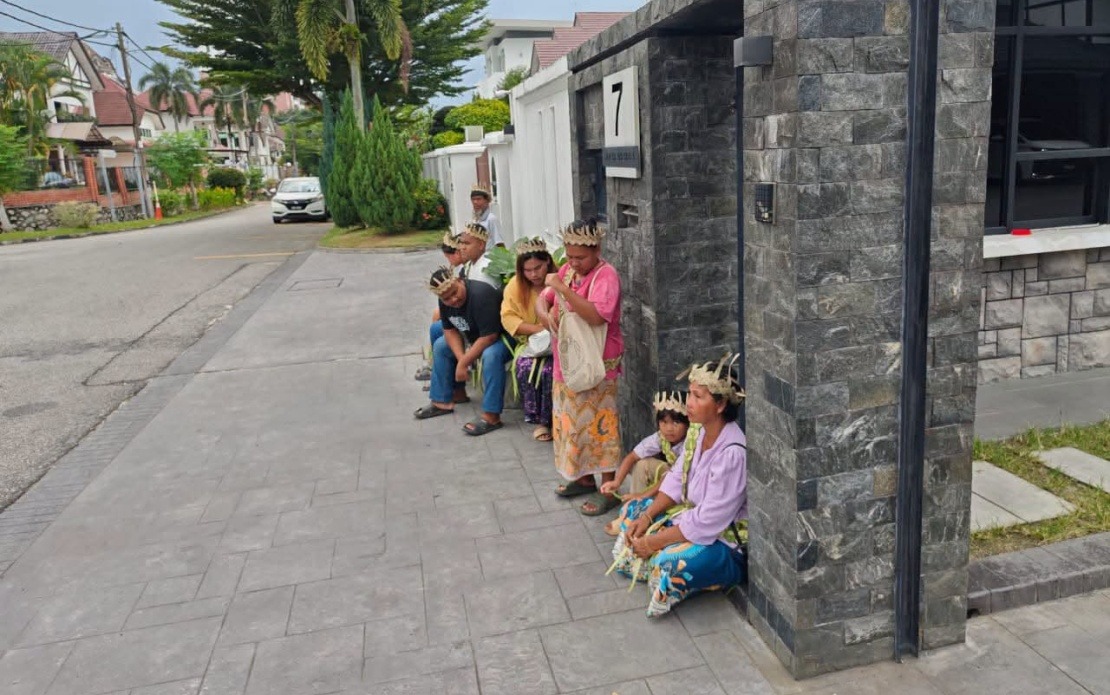
Prime Minister Datuk Seri Anwar Ibrahim has pledged to escalate the longstanding land dispute affecting the Orang Asli community of Kampung Sungai Cot in Maran, Pahang, directly to the state administration. The commitment came following a visit by community representatives to his official residence in Kuala Lumpur, where Anwar engaged in detailed discussions about the grievances facing the indigenous settlement.
The land dispute represents one of several indigenous rights issues that have gained heightened visibility in recent months across Malaysia. Kampung Sungai Cot, located in the Maran district of Pahang, has experienced protracted uncertainty regarding land ownership and usage rights, a situation that has created considerable hardship for the Orang Asli residents who have inhabited the area for generations. The community's struggle exemplifies broader challenges facing indigenous populations across Peninsular Malaysia, where competing land claims and development pressures frequently collide with customary land rights.
During his conversation with the delegation, Anwar heard firsthand accounts of the difficulties confronting the community. Beyond the underlying land dispute itself, the situation has been complicated by the detention of three Orang Asli residents from Kampung Sungai Cot. However, Anwar noted with satisfaction that those detained have since been released by police, suggesting some de-escalation in what had appeared to be an increasingly tense situation. The release of detainees indicates potential receptiveness to dialogue, though questions remain about what prompted the original arrests and detention.
The Prime Minister's involvement signals that the matter has risen to the highest levels of government attention. By committing to raise the issue with Pahang's state administration, Anwar is positioning the federal government as an intermediary and potential facilitator in resolving disputes that technically fall under state jurisdiction. This approach reflects the constitutional framework in which land matters remain primarily a state responsibility, yet federal intervention can apply pressure and provide resources for negotiated settlements.
Anwar emphasized the necessity of responsible discourse surrounding the dispute, cautioning all stakeholders against exploiting the issue for political purposes. His call for parties to refrain from manipulation suggests awareness that land disputes involving indigenous communities can easily become flashpoints for political point-scoring, with various groups using the Orang Asli struggle to advance unrelated agendas. This concern is particularly pertinent in Malaysian politics, where indigenous rights issues occasionally become vehicles for broader political narratives rather than genuine advocacy for affected communities.
The Prime Minister's advocacy for a solution that is fair, prudent, and legally compliant reflects the complexity inherent in Orang Asli land disputes. Such cases frequently involve competing legal frameworks, including colonial-era land records, customary rights recognized under the Aboriginal Peoples Act 1954, and modern property law. Finding resolutions that satisfy all these dimensions requires careful legal analysis and genuine commitment to indigenous welfare rather than bureaucratic convenience.
The Orang Asli population, comprising approximately 178,000 individuals distributed across various ethnic subgroups, has long faced systemic challenges in land rights recognition. Historical marginalization, insufficient government resources for land demarcation, and competing development interests have created a cumulative disadvantage. Kampung Sungai Cot's situation mirrors similar disputes in locations throughout Pahang, Perak, and other states, suggesting this represents not an isolated grievance but rather a symptom of deeper institutional failures in protecting indigenous land rights.
For Malaysian readers and policymakers, the Prime Minister's statement carries significance beyond the specific dispute at hand. It reflects an apparent willingness to engage directly with Orang Asli concerns and to leverage federal authority to address state-level issues. Whether this commitment translates into substantive policy changes or meaningful redress for affected communities will depend on subsequent actions and the willingness of Pahang's state government to cooperate in finding comprehensive solutions.
The timing of this intervention also occurs within a broader context of renewed global attention to indigenous rights and land justice. International organizations and civil society groups have increasingly scrutinized Malaysia's treatment of its Orang Asli population, particularly regarding land dispossession and inadequate consultation on development projects. Federal government engagement on specific cases like Kampung Sungai Cot can serve to demonstrate commitment to international standards while addressing legitimate community grievances.
Moving forward, the success of Anwar's commitment will be measured by concrete outcomes. These might include formal recognition of Orang Asli land claims, provision of alternative land compensation, or establishment of formal mechanisms for community participation in land use decisions affecting their territories. The involvement of the Prime Minister's office also suggests that resources and political capital may be mobilized to resolve what might otherwise languish in bureaucratic channels.
The incident underscores the continuing importance of direct representation and access to senior government officials for marginalized communities. The fact that Kampung Sungai Cot residents were able to present their case personally to the Prime Minister reflects Malaysia's democratic institutions functioning as intended, though it also highlights how dependent indigenous communities remain on individual goodwill rather than systematic protections. Addressing root causes would require institutional reforms extending beyond individual cases to create permanent safeguards for indigenous land rights across the country.

