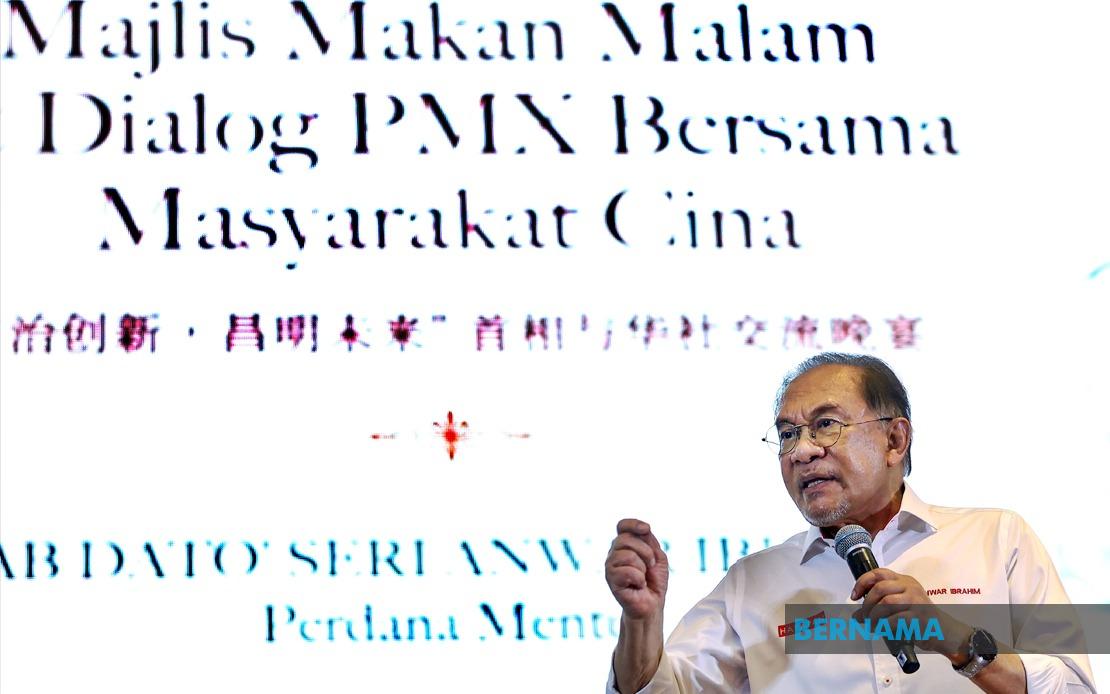
Prime Minister Datuk Seri Anwar Ibrahim has underscored his resolve to guide Malaysia towards becoming a thriving nation built on foundations of integrity and inclusivity. Speaking during an engagement with the Chinese community in Johor Bahru on July 4, the premier articulated a vision centred on bridging societal divides and ensuring that governance reflects the aspirations of every Malaysian, irrespective of ethnicity or background.
At this stage of his political journey, Anwar emphasised that his overarching mission transcends partisan interests or narrow communal concerns. Instead, he has oriented his leadership around the principle that every citizen merits equal consideration and attention from the highest levels of government. This perspective reflects a deliberate attempt to position himself as a national leader rather than a factional one, particularly as Malaysia navigates complex questions around social cohesion and communal relations in an increasingly pluralistic society.
The Prime Minister articulated a deeply personal dimension to his political philosophy during the evening gathering, suggesting that his approach to leadership is informed by temporal consciousness. Acknowledging his advancing years, Anwar framed his remaining tenure not as an opportunity for accumulating power or cementing dynastic influence, but rather as a window to establish institutional and moral foundations that will endure beyond his own political career. This temporal framing—the awareness of mortality and legacy—adds philosophical weight to his stated commitments around clean governance and inclusive policymaking.
Anwar's emphasis on being remembered as a leader who genuinely cherishes his people carries particular resonance within Malaysian political discourse, where questions of authenticity and leader-citizen relationships remain deeply contested. His assertion that he wants Malaysians to recall his tenure with affection, rather than mere grudging respect, suggests an understanding that political sustainability depends partly on emotional connection and perceived sincerity. This approach represents a departure from transactional politics, at least in rhetorical terms, towards a vision grounded in genuine care for national welfare.
The gathering itself—held with the Chinese community in Johor Bahru—signals strategic attention to maintaining multiethnic support networks. The presence of Parti Keadilan Rakyat vice president and Selangor Menteri Besar Datuk Seri Amirudin Shari reinforces the coordinated nature of these outreach efforts, suggesting that messages around inclusive governance are being amplified across different levels of government and party structures. Such synchronized communication strategies are essential for reinforcing policy narratives and maintaining political coherence in Malaysia's complex federal system.
For Malaysian policymakers and analysts, Anwar's stated commitment to serving all communities warrants scrutiny against implementation realities. The gap between rhetorical commitment and actual resource allocation, legislative priorities, and enforcement patterns often determines whether leadership ideals translate into tangible benefits for marginalized or minority groups. Malaysia's historical experience demonstrates that inclusive governance requires more than aspirational messaging—it demands institutional mechanisms, budgetary commitments, and sustained political will across multiple administrations.
The emphasis on fairness and cleanliness in governance also addresses long-standing public concerns around corruption and patronage networks that have historically plagued Malaysian institutions. By positioning these principles as central to his intended legacy, Anwar acknowledges that Malaysians increasingly demand accountability and transparency from their leaders. This represents a partial response to years of systemic corruption allegations and institutional erosion that undermined public confidence in government.
The regional dimension merits consideration as well. Malaysia's capacity to maintain social stability and economic dynamism depends partly on how effectively its leadership navigates intercommunal relations and demonstrates equitable governance. In a regional context where several neighboring nations face significant communal tensions, Malaysia's ability to sustain multiethnic cooperation becomes a distinctive competitive advantage. Anwar's framing of inclusive leadership thus carries implications beyond domestic politics, potentially affecting Malaysia's regional standing and soft power.
However, translating such aspirational visions into durable institutional practices requires more than individual commitment from the head of government. It demands sustained engagement with bureaucratic structures, political parties with entrenched interests, and diverse constituencies with competing demands. The challenge for Anwar will be ensuring that his stated philosophy becomes embedded in policy frameworks, budgetary allocations, and institutional cultures throughout the civil service and government apparatus, rather than remaining confined to high-profile public pronouncements.

