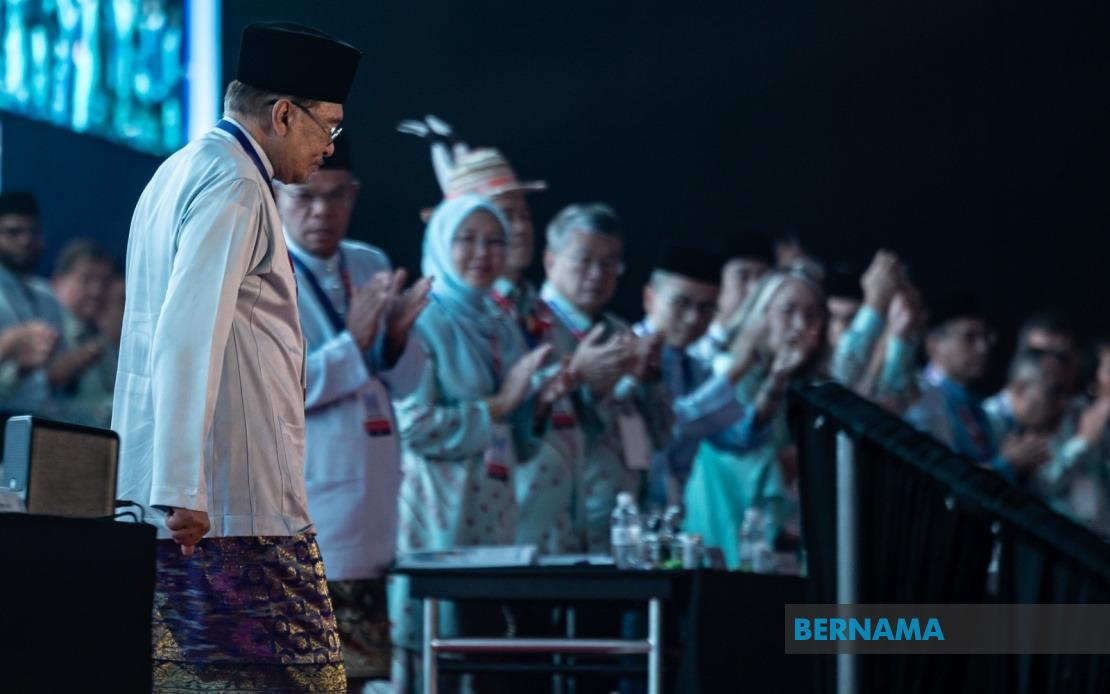
Prime Minister Datuk Seri Anwar Ibrahim has firmly rejected suggestions that his administration is sidelining particular states, countering the narrative with figures demonstrating increased budget allocations across multiple regions. Speaking at the 2026 PKR National Congress held at the Melaka International Trade Centre in Ayer Keroh on August 15, Anwar emphasised that variations in state funding reflect differing developmental priorities rather than any deliberate policy of regional marginalisation, and that overall spending trends show consistent growth since the MADANI Government took office.
The Prime Minister's remarks come at a critical juncture when questions about equitable resource distribution across Malaysia's 13 states and three federal territories have become increasingly vocal in political discourse. Such concerns touch on fundamental issues of federal-state relations and resource equity that resonate deeply across the Malaysian electorate. By presenting concrete budgetary evidence, Anwar sought to reframe the conversation from qualitative allegations to quantifiable outcomes, a strategy designed to demonstrate administrative competence and neutrality in governance.
Central to Anwar's defence were substantial figures showing federal expenditure trajectories for Sabah, one of the states reportedly subject to criticism. Federal allocations to Sabah have expanded from RM13 billion in 2022 to RM17.6 billion in 2026, representing a 35 per cent increase over the four-year period. For perspective, this growth rate exceeds typical inflation and population growth figures, suggesting deliberate budgetary prioritisation. Anwar implicitly challenged state opposition leaders by questioning whether similar grievances had been raised during preceding administrations, a rhetorical move that seeks to position his government as more responsive to state-level concerns than its predecessors.
Sarawak's budgetary trajectory painted an even more dramatic picture of resource commitment. Federal allocations to the East Malaysian state increased from RM10.2 billion in 2022 to RM15.1 billion in 2026, translating to a 48 per cent expansion. This represents one of the highest growth rates among Malaysia's states and underscores the federal government's substantial investment in infrastructure, services, and development initiatives across Sarawak. The figure assumes particular significance given Sarawak's geographical expanse, population distribution challenges, and historical positioning within federal fiscal negotiations.
On Peninsular Malaysia, Anwar provided additional examples demonstrating broad-based allocation increases. Terengganu's federal budget climbed from RM6 billion in 2022 to RM8.1 billion in the current year, while Johor experienced expansion from RM10.2 billion in 2022 to RM14.6 billion in 2026, representing a 43 per cent increase. Kedah, Kelantan, and Perlis similarly benefited from enhanced allocations, though the Prime Minister did not specify exact figures for these states. This selective presentation of data suggests a conscious effort to highlight multiple regions benefiting from federal largesse, thereby neutralising claims of systematic neglect.
The policy approach Anwar articulated reflects a modern governance philosophy that distinguishes between equality of funding and equity of outcomes. Rather than maintaining identical allocations across all jurisdictions, the MADANI Government allocates resources according to identified development needs and strategic priorities. This methodology acknowledges that different states face distinct challenges—whether infrastructure deficits, demographic pressures, or geographic constraints—and therefore warrant differentiated investment strategies. Explaining this principle publicly helps build understanding of why certain states may receive proportionally larger allocations without implying prejudicial treatment of others.
For Malaysian observers and regional analysts, Anwar's intervention carries implications beyond the immediate political theatre of party congresses. The demonstrated willingness to quantify achievements with specific budgetary data represents a departure from more rhetorical forms of political communication. It reflects confidence that administrative performance can be objectively measured and compared, a confidence that may resonate with voters increasingly demanding evidence-based governance. Whether such metrics ultimately satisfy critics depends partly on how effectively state governments convert federal allocations into visible development outcomes that benefit ordinary citizens.
The timing of these remarks at the PKR National Congress also warrants consideration. Party congresses function as internal political events where leaders communicate directly with party stalwarts and grassroots activists. By addressing state allocation concerns at this forum, Anwar signals to PKR members that concerns about regional equity matter within party circles and deserve substantive responses backed by evidence. This preemptive positioning may suppress internal party discord and present a unified frontline to political opposition.
For states governed by opposition parties, Anwar's figures pose an interesting challenge. They suggest that federal funding decisions remain largely independent of partisan considerations, distributed according to administrative formulas rather than political alignment. This potentially weakens narratives of federal discrimination based on state government political colour. However, opposition-controlled states may counter that allocations, while nominally increased, fail to match actual developmental needs or that disbursement timelines favour certain states for practical reasons related to project implementation readiness.
The broader context of Malaysian fiscal federalism also illuminates Anwar's position. State governments depend significantly on federal transfers for revenue, making transparent allocation criteria essential to political stability. Accusations of unfair distribution can generate centrifugal pressures threatening national cohesion, particularly in geographically and culturally distinct regions like Sabah and Sarawak. By robustly defending his allocation decisions with data, Anwar addresses not merely partisan opponents but fundamental questions about federal-state trust and the legitimacy of distribution mechanisms.
Moving forward, the credibility of Anwar's claims will be tested through implementation. Budget allocations mean little without effective spending that translates into tangible improvements in healthcare, education, infrastructure, and livelihood opportunities. State governments and civil society organisations will likely scrutinise how these increased allocations manifest in project completion rates, service quality improvements, and economic returns. The Prime Minister's willingness to publicly anchor his position in specific figures therefore creates both opportunity and vulnerability, as future assessments of implementation outcomes will either validate or undermine these claims.
The statement ultimately reflects a government confident enough in its administrative record to invite scrutiny through data-driven discourse. Whether this confidence proves justified will shape not only the political fortunes of the MADANI Government but also broader public expectations regarding transparency and accountability in resource allocation across Malaysia's federal system.

