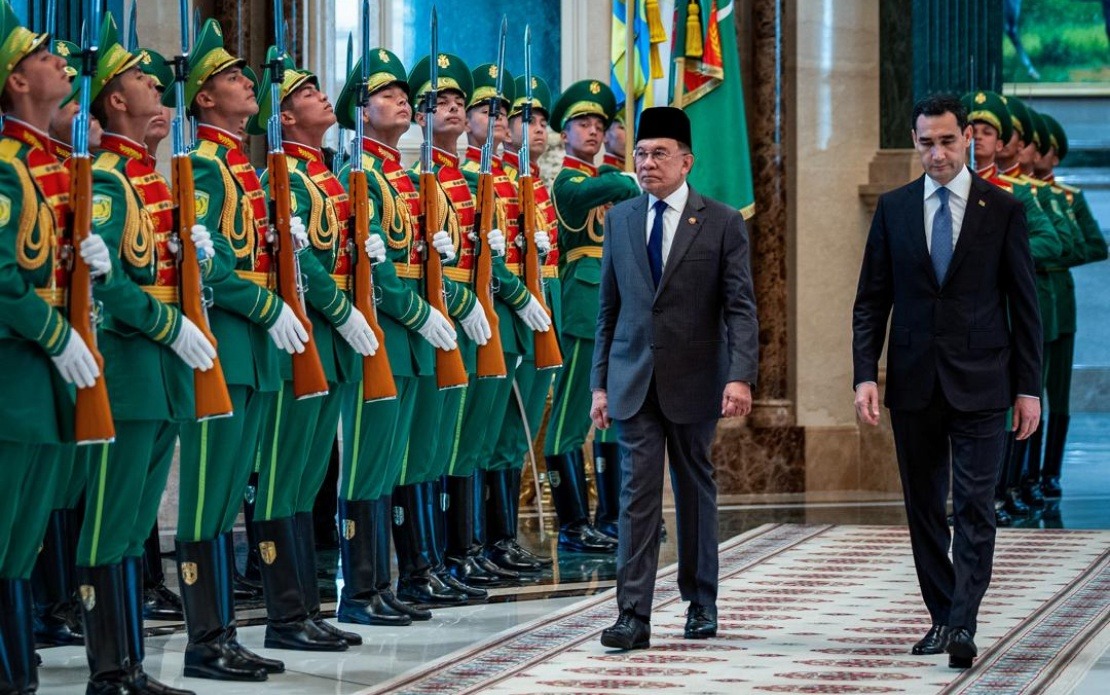
Prime Minister Datuk Seri Anwar Ibrahim was formally received at the Turkmenistan Presidential Palace in Ashgabat on June 19, signalling the commencement of Malaysia's diplomatic engagement with the oil-rich Central Asian nation under his premiership. The ceremonial reception, complete with a full guard of honour and the playing of both national anthems, underscored the significance Turkmenistan's government places on strengthening ties with Malaysia at the highest level.
The official welcome was conducted by Turkmenistan President Serdar Berdimuhamedov, who personally greeted the Malaysian prime minister upon his arrival. This direct engagement from the host nation's president reflects the importance attributed to bilateral relations and the visit's ceremonial stature. The protocol-laden reception, involving the presentation of the Malaysian delegation to Turkmenistan's Cabinet ministers and senior government officials, established a formal foundation for substantive diplomatic discussions.
Anwar's two-day visit, which began on June 18, represents his first official journey to Turkmenistan since his appointment as Malaysia's 10th Prime Minister in November 2022. The invitation from President Berdimuhamedov demonstrates Turkmenistan's intention to develop stronger bilateral relations with Malaysia, a fellow Muslim-majority country seeking to expand its footprint across diverse geographical regions. This visit carries particular significance as it expands Malaysia's diplomatic outreach beyond traditional Southeast Asian partnerships into Central Asia, a region of growing strategic and economic importance.
Central Asia has become increasingly relevant to Malaysian foreign policy as the country seeks to diversify its international partnerships and economic opportunities. Turkmenistan, in particular, possesses substantial natural gas reserves and serves as a crucial energy supplier to global markets. For Malaysia, establishing stronger governmental links with Turkmenistan opens avenues for potential cooperation in energy, trade, and technology sectors, areas where both nations could identify complementary interests.
Following the ceremonial welcome, Anwar engaged in a series of diplomatic discussions with President Berdimuhamedov, beginning with a four-eyed meeting that allowed the two leaders to converse privately on matters of mutual concern. This private consultation typically addresses sensitive diplomatic issues and establishes personal rapport between heads of government. The subsequent bilateral meeting, which included broader delegations from both nations, provided a platform for exploring concrete areas of cooperation and addressing bilateral opportunities.
The agenda for discussions between the two governments likely encompassed trade relations, cultural exchanges, and regional security matters affecting both nations. Malaysia's growing interest in Central Asian affairs aligns with broader Southeast Asian recognition that stability and economic development in Central Asia have direct implications for regional connectivity and the Belt and Road Initiative. Turkmenistan's geographic location along crucial energy corridors serving Asia makes it a valuable partner for Malaysia's long-term strategic planning.
Anwar's direct engagement with the Turkmenistan Cabinet ministers and senior officials demonstrates Malaysia's commitment to building comprehensive governmental relationships rather than conducting business solely through diplomatic channels. This multi-level approach facilitates knowledge transfer and establishes working relationships that will support future cooperation across various sectors and ministries. Such connections often prove instrumental in translating high-level political goodwill into tangible economic and cultural outcomes.
The timing of this inaugural official visit under Anwar's premiership reflects Malaysia's strategic reassessment of its global engagement priorities. While Malaysia traditionally maintains strong connections with Middle Eastern nations and European partners, the expansion toward Central Asia signals recognition that emerging opportunities lie beyond conventional diplomatic spheres. Central Asia's developing economies and resource wealth present untapped potential for Malaysian businesses and investors seeking diversification away from more saturated markets.
Turkmenistan's significance extends beyond bilateral considerations; the nation serves as a bridge between Europe and Asia, hosting critical energy infrastructure and transportation networks. Malaysia's engagement with Turkmenistan positions the country more favourably within broader Eurasian connectivity initiatives. This visit, therefore, represents not merely a courtesy call but a deliberate strategic move to integrate Malaysia into emerging continental networks that will shape economic and geopolitical dynamics in the coming decades.

