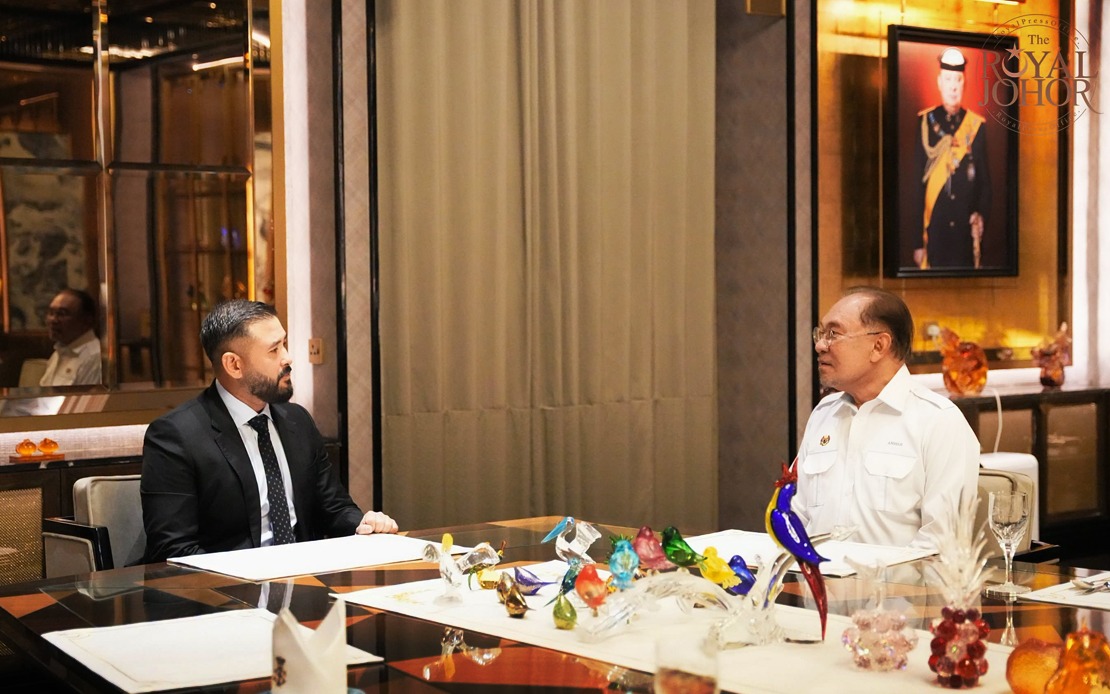
Prime Minister Datuk Seri Anwar Ibrahim on Saturday night seized upon a recent courtesy meeting with Johor's Regent, Tunku Mahkota Ismail, as an opportunity to deliver a pointed message about the proper boundaries between Malaysia's monarchy and electoral politics. Speaking at an event in Tangkak where the Pakatan Harapan coalition unveiled its slate of candidates for the 16th Johor state election, Anwar expressed warm appreciation for the Regent's willingness to receive him in Kuala Lumpur, framing the encounter as a meaningful gesture of goodwill.
The Prime Minister's remarks carried unmistakable political significance. By publicly acknowledging the audience and characterising it as evidence of the royal household's non-partisan stance, Anwar appeared to be responding to critics who have questioned whether the monarchy maintains appropriate distance from electoral contests. His comments suggested that some political opponents had been inappropriately invoking the names and authority of royal figures during campaign activities, a practice he clearly views as improper and counterproductive.
During his time with the Regent, Anwar explained, he had made a deliberate effort to brief the royal official on infrastructure and development initiatives that the federal government under his leadership has undertaken specifically to benefit Johor's residents. This conversational approach reflects a broader governing philosophy that Anwar has consistently articulated: maintaining open channels of communication and consultation with Malaysia's sultanate system rather than operating in isolation or adversarial posture towards the monarchy.
Anwar's public positioning on royal relations carries particular weight given the constitutional complexities of Malaysia's system of governance. The country's Rulers wield significant constitutional powers, and their relationship with the federal executive can substantially influence the political climate. By demonstrating deference towards the Johor Regent and emphasizing his commitment to seeking royal audiences and receiving counsel, Anwar signals to both the palace and the broader electorate that his government respects traditional hierarchies and constitutional protocols.
The Prime Minister articulated a philosophy of engagement with the Malay Rulers that acknowledges inevitable disagreements without allowing them to fester into confrontation. He noted that his consultations with various sultans sometimes result in agreement and sometimes in differing viewpoints, but that he approaches all royal guidance and advice in good faith. This framework extends to his relationship with Yang di-Pertuan Agong Sultan Ibrahim, King of Malaysia, with whom Anwar indicated he maintains a comparable pattern of dialogue and mutual respect even when policy perspectives diverge.
Anwar's emphasis on consultation, audience-seeking, and explanation suggests an administrative approach that prioritizes harmony with institutional forces beyond the executive branch. Rather than attempting to minimize or circumvent the influence of the monarchy, he appears to have chosen a strategy of continuous engagement and transparent communication. This approach may reflect recognition that Malaysia's sultans command deep respect among significant portions of the population, particularly in their respective states, and that securing their cooperation or at least their neutrality in electoral contests offers tangible political advantages.
The gathering at Padang Bukit Gambir Extreme Park brought together the major components of the Pakatan Harapan coalition, including DAP secretary-general Anthony Loke Siew Fook and Amanah president Datuk Seri Mohamad Sabu, alongside numerous other party leaders. The presence of this unified coalition leadership at a candidate announcement in Johor—a state that has historically presented electoral challenges for PH—underscores the coalition's determination to make significant gains in the 16th state election.
For Malaysian readers and particularly those in Johor, Anwar's remarks highlight ongoing tensions in how political actors navigate the country's constitutional monarchy. The implicit criticism of opponents who invoke royal names and authority during campaigns reflects anxieties about the politicization of institutions that many Malaysians view as standing above the partisan fray. Whether Anwar's own consultation-focused approach will effectively inoculate the monarchy from electoral controversy remains an open question as the campaign progresses.
The framing of the Regent's willingness to receive Anwar as a repudiation of "petty political campaigns" suggests that the government believes it can leverage the appearance of royal approval or at least royal neutrality. However, opposition parties may interpret such high-profile audiences with royal figures as precisely the kind of politicization that Anwar claims to oppose, potentially intensifying accusations of royal partiality from multiple directions.
The Johor state election carries heightened significance within Malaysia's broader political landscape. As the second-largest state by population and historically a significant source of federal parliamentary seats, Johor results will substantially influence calculations about whether Anwar's coalition government can consolidate power or faces erosion of its support base. The Prime Minister's courting of royal favour and his public emphasis on respectful relations with the institution may prove strategically important, particularly if Johor voters view the monarchy's apparent approval as a meaningful signal about governmental legitimacy and stability.

