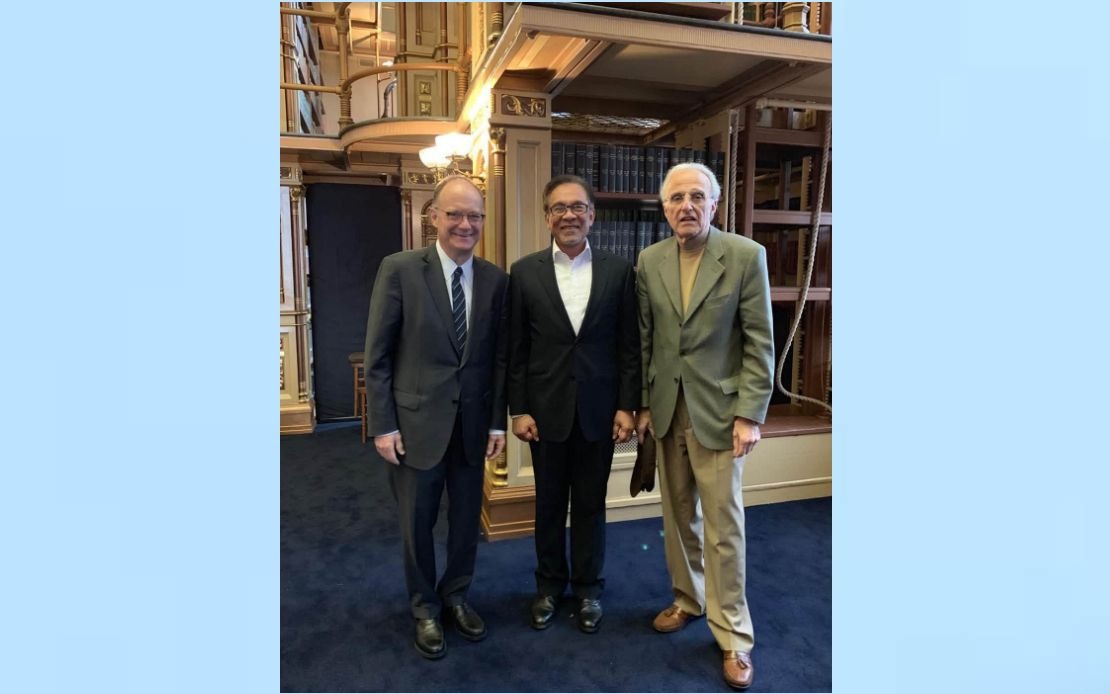
Prime Minister Datuk Seri Anwar Ibrahim has mourned the passing of Professor John L. Esposito, one of the world's most prominent figures in Islamic scholarship, offering his condolences through a Facebook statement. The loss marks the end of an era for interfaith dialogue in academia, removing from the global stage one of the most articulate voices in bridging cultural divides during a period of heightened tensions between Muslim and Western societies.
Anwar's relationship with Esposito extended across more than five decades, beginning in the early 1970s when the two first encountered one another. This extraordinarily long professional friendship underscores the esteem in which Malaysia's Premier held the American academic, and reveals the personal dimensions of their bond that transcended intellectual exchange. Throughout their years of association, the Prime Minister relied upon Esposito's insights and counsel, valuing his perspectives on matters concerning Islam's place in contemporary global affairs.
Esposito built an academic legacy centred on demystifying Islam for Western audiences and fostering genuine understanding between faith communities. Rather than accepting the prevailing divisive narratives that often characterised discourse about Islam and the West, he dedicated his career to constructing intellectual frameworks that allowed for nuanced, respectful engagement. Anwar characterised this approach as one where Esposito "built bridges where others were content to build civilisational barriers," capturing the essence of a scholar who prioritised dialogue over confrontation.
As the founding director of Georgetown University's Centre for Muslim-Christian Understanding, Esposito institutionalised interfaith scholarship and created spaces where rigorous academic inquiry could coexist with mutual respect. This institutional foundation proved crucial for establishing credibility and legitimacy in promoting Muslim-Christian dialogue within American academia. Through this centre, he mentored generations of scholars and practitioners committed to dismantling stereotypes and fostering genuine cross-cultural comprehension.
Esposito's scholarly output extended beyond academic journals and specialist publications. He authored numerous works designed to make Islamic studies accessible to general readers, including "What Everyone Needs to Know About Islam" and "Who Speaks for Islam?", both of which brought scholarly precision to popular discourse. These contributions proved particularly valuable in the aftermath of September 11, 2001, when public understanding of Islam became clouded by fear and misinformation. During this critical period, Esposito's measured, evidence-based commentary provided counterweight to simplistic narratives, offering American and global audiences the intellectual tools necessary for more sophisticated engagement with Islam and Muslim societies.
As co-author of "Makers of Contemporary Islam", Esposito contributed to documenting and analysing the intellectual currents shaping modern Islamic thought. This collaborative work demonstrated his commitment to capturing the diversity and complexity of Islamic intellectual traditions, resisting monolithic characterisations that reduced Islam to a single ideological expression.
Anwar emphasised the duality of Esposito's character, noting that he proved "as generous in private conversation as he was rigorous on the page." This observation speaks to a scholar who maintained intellectual integrity without sacrificing human warmth, combining academic excellence with genuine care for those around him. The Prime Minister recalled how Esposito remained steadfast through challenging circumstances, demonstrating loyalty that transcended professional networks.
For Malaysia specifically, Esposito's scholarly contributions held relevance for how the nation articulates its own multicultural and multireligious identity. As a Muslim-majority nation navigating complex relationships with Western powers and maintaining internal religious plurality, Malaysia has benefited from the intellectual frameworks that scholars like Esposito developed. His work legitimised serious academic inquiry into Islam without requiring defensive apologism, providing models for how Muslim-majority societies could engage with global intellectual discourse from positions of confidence rather than insecurity.
The significance of Esposito's passing extends beyond the personal loss felt by those who knew him, affecting the broader trajectory of interfaith studies at a moment when such scholarship faces renewed challenges. Rising polarisation in international relations, resurgent identity politics, and the fragmentation of shared epistemic spaces make the kind of bridge-building work that defined Esposito's career increasingly difficult. His death removes an authoritative voice capable of speaking credibly to multiple audiences simultaneously.
Anwar's tribute reflected not merely ceremonial acknowledgement but genuine appreciation for a scholar whose lifetime of work complemented Malaysia's own aspirations toward interfaith harmony and cross-cultural understanding. The Prime Minister specifically extended formal condolences to Esposito's wife Jean, his family, colleagues, and students, recognising the ripple effects of his absence across multiple communities.
Looking forward, the challenge facing the Islamic studies community and interfaith practitioners involves sustaining the intellectual and institutional infrastructure that Esposito helped construct. His legacy of rigorous scholarship combined with genuine commitment to dialogue offers a model for future generations navigating an increasingly fractured world. The hope expressed by Anwar that "his scholarship and the dialogue he spent his life building continue to bear fruit" captures the imperative for others to carry forward this crucial work, ensuring that the bridges built by thinkers like Esposito remain standing against forces working toward separation and misunderstanding.

