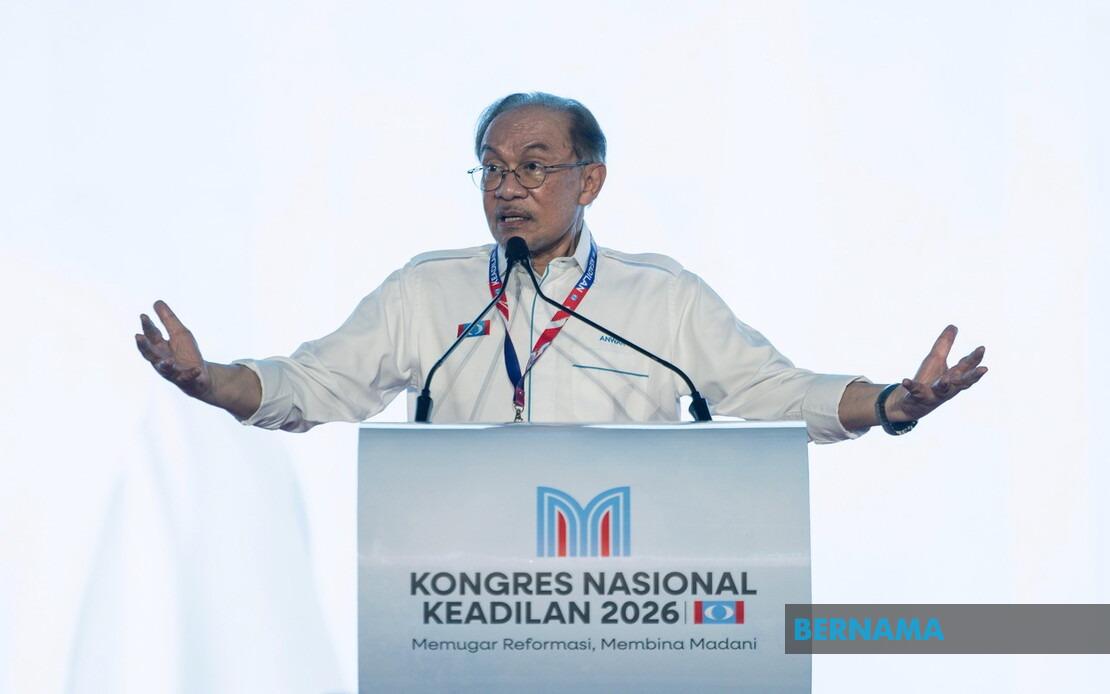
Prime Minister Datuk Seri Anwar Ibrahim has unveiled a fresh RM1 million injection for each of Malaysia's parliamentary constituencies, a move designed to fast-track the resolution of community needs without getting entangled in bureaucratic delays. The announcement, made during his closing address at the PKR National Congress in Melaka, signals a deliberate shift towards empowering constituency-level leaders to deploy funds directly for welfare, infrastructure, and immediate social assistance initiatives affecting ordinary citizens. This direct-to-constituency mechanism represents the government's determination to bridge the gap between national policy decisions and tangible improvements felt at the neighbourhood level.
Anwar, who holds the dual portfolio of Prime Minister and Finance Minister, positioned the additional funds as a complement to the MADANI Government's existing safety-net architecture. The announcement underscores the administration's conviction that macroeconomic growth must translate into visible relief for households grappling with cost pressures. By removing intermediary approval stages that typically accompany centralised allocations, the government aims to enable rapid deployment of resources towards housing repairs, community centres, or emergency welfare top-ups without prolonged administrative processing.
The timing of this announcement carries particular significance given Malaysia's ongoing transition towards ensuring that economic gains reach all strata of society. The allocation supplements existing cash transfer programmes—specifically the Sumbangan Tunai Rahmah and Sumbangan Asas Rahmah schemes—which together command a RM16 billion commitment. This layered approach suggests the government recognises that no single mechanism adequately addresses the diverse and context-specific vulnerabilities facing different communities across the nation. Rural constituencies face infrastructure challenges distinct from urban centres, whilst semi-urban areas confront their own peculiar service gaps.
Under the MADANI framework, the government has prioritised poverty reduction with measurable outcomes. The hardcore poverty rate now stands at 0.09 per cent, reflecting targeted interventions since the administration's inception. However, the introduction of this RM1 million per-constituency allocation indicates awareness that poverty metrics, whilst encouraging, do not capture the full spectrum of financial stress experienced by middle and lower-income households. Rising rents, education costs, healthcare expenses, and transport fees continue to squeeze household budgets even when formal poverty measures improve.
The Prime Minister's emphasis on accessibility and awareness represents a strategic acknowledgment of implementation challenges that plague many government initiatives. He explicitly urged party machinery at branch and grassroots levels to actively communicate available assistance programmes to residents, recognising that many entitled individuals remain unaware of support mechanisms or find application procedures prohibitively complex. This visibility challenge has historically undermined programme effectiveness; funds allocated but unclaimed effectively waste resources and fail to deliver intended welfare outcomes. By mobilising political party structures as information intermediaries, the government leverages existing community networks.
For Malaysian constituencies, particularly those in lower-income regions, the RM1 million allocation provides meaningful flexibility in addressing locally-identified priorities. A rural constituency facing deteriorating community water infrastructure can now allocate funds accordingly without waiting for central approval of a specific water development project. An urban constituency struggling with youth unemployment might direct resources towards skills training initiatives or small enterprise grants. This subsidiarity approach aligns with international best practice in development programming, where decentralised decision-making often yields superior outcomes compared to centralised, one-size-fits-all interventions.
The announcement also contains implicit messaging regarding political accountability and performance measurement. Constituency leaders now possess both the authority and responsibility to deploy these funds effectively. Poor allocation decisions or misuse become readily apparent to constituents, creating electoral pressure for judicious spending. This mechanism thus creates internal accountability structures without requiring onerous auditing apparatus, as voters themselves become natural monitors of how funds benefit their communities. The political cost of misallocation provides a powerful incentive for legitimate, community-responsive utilisation.
From a comparative Southeast Asian perspective, Malaysia's approach mirrors patterns observed in countries like Indonesia and Thailand, where decentralised allocation mechanisms have gained traction as governments seek to improve service delivery and political satisfaction simultaneously. The innovation lies not merely in fund provision but in the removal of bureaucratic gatekeeping—the deliberate choice to trust elected representatives with discretionary authority reflects confidence in local political institutions and recognition that communities, when empowered with resources, generally allocate them reasonably according to their specific circumstances.
The broader economic context for this announcement involves Malaysia's balancing act between fiscal sustainability and social support expansion. With RM16 billion already committed to cash transfer schemes, the additional constituency allocations represent incremental investment in what the government terms "comprehensive" welfare coverage spanning B40 and M40 income brackets. This inclusive framing suggests policy intent to prevent the middle class from feeling excluded from government largesse, potentially addressing electoral perceptions that assistance concentrates exclusively on bottom-income populations whilst middle-income households, facing genuine pressures from dual income earners and dependents, receive insufficient acknowledgment.
Implementation success will ultimately determine whether this initiative translates political commitment into substantive improvements. Monitoring mechanisms must ensure funds actually reach intended beneficiaries rather than disappearing into administrative overhead or becoming tools for patronage politics. Clear guidelines governing eligible expenditure categories, transparent reporting requirements, and periodic public accounting of how each constituency deployed its allocation will be essential for maintaining programme credibility and public trust. The coming months will reveal whether this represents genuine structural reform in how the government delivers services or whether it constitutes primarily electoral positioning heading toward major political cycles.

