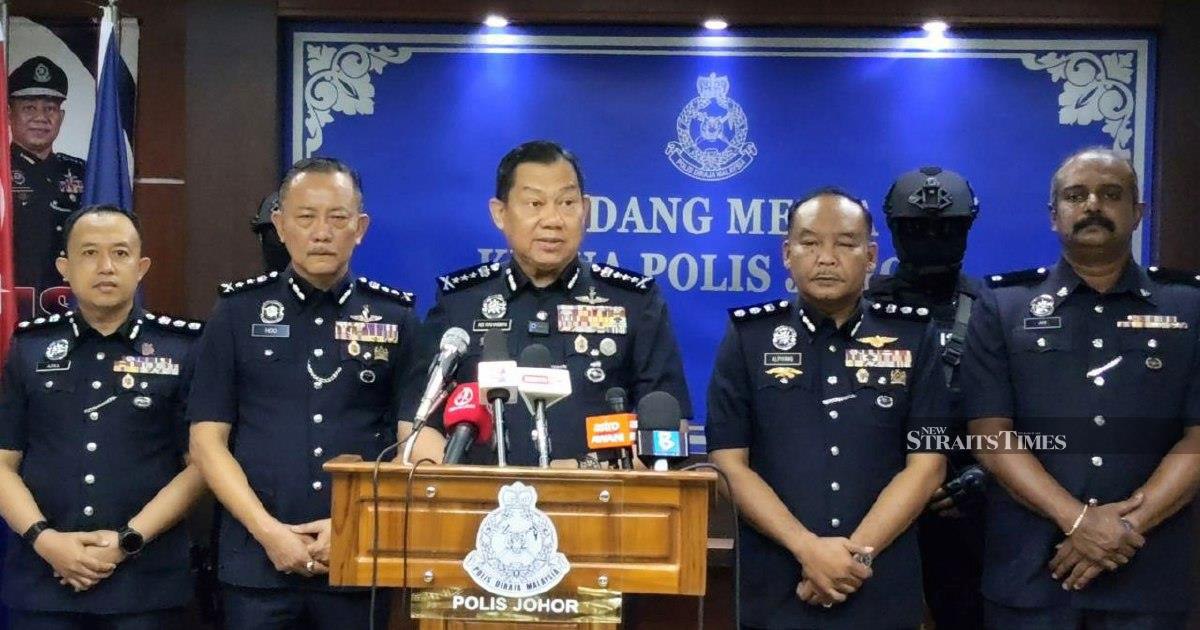
Authorities in Johor Baru have struck a major blow against organised drug trafficking, with police conducting simultaneous raids on Saturday that netted 60.78kg of methamphetamine valued at RM3.04 million and leading to the arrests of eight individuals suspected of involvement in large-scale narcotics distribution. Among those detained was a school dropout enlisted to transport the illicit substances, highlighting how trafficking networks frequently exploit vulnerable and economically disadvantaged young people to move drugs across state lines and between distribution points.
The operation, which unfolded across multiple locations in the state capital, demonstrates the ongoing sophistication of drug rings operating in Malaysia's southern corridor. These networks typically employ hierarchical structures where low-level couriers bear disproportionate legal risk while higher-level operatives remain insulated from direct law enforcement contact. The arrest of a teenage transporter underscores this dynamic and raises concerns about the recruitment patterns used by criminal enterprises to expand their operations without significantly increasing their operational exposure.
Methamphetamine, commonly known as crystal meth or ice, remains one of Southeast Asia's most pressing drug challenges. The stimulant has become increasingly prevalent across Malaysia, particularly in urban centres and industrial hubs where demand from construction workers, long-distance drivers, and factory employees sustains a lucrative black market. The purity and potency of methamphetamine seized in recent years has climbed sharply, suggesting supply chains are becoming more established and manufacturing processes more refined, likely pointing to increased production capacity in clandestine laboratories across the region.
The monetary valuation of RM3.04 million attached to this seizure reflects street-level market pricing rather than wholesale rates, indicating authorities are calculating the street value of the drug if distributed through retail networks. This pricing approach helps communicate the scale of drug availability that would have reached end-users, though the actual financial loss to traffickers would be considerably lower at wholesale rates—a distinction that underscores the profit margins embedded in drug distribution networks. Such margins fuel intense competition between trafficking organisations and create incentives for violent disputes over territory and supply sources.
From an enforcement perspective, the multi-location raid strategy employed by Johor police reflects lessons learned about disrupting trafficking operations. Rather than conducting isolated arrests, coordinated simultaneous raids across multiple sites prevent suspects from destroying evidence or alerting associates further up or down the supply chain. This approach has proven particularly effective in fragmenting networks temporarily, though the inherent economics of drug markets typically ensure that disrupted operations are quickly reconstituted through redundant distribution channels and replacement personnel.
The involvement of a young school dropout in this operation illustrates a broader social problem affecting Malaysia. Economic marginalisation, limited educational opportunities, and peer influence create vulnerability to recruitment by criminal organisations offering immediate financial returns. The allure of relatively quick earnings through drug courier work can prove irresistible to teenagers from disadvantaged backgrounds, yet the legal consequences of conviction typically include extended imprisonment, creating long-term disruption to individual life trajectories and contributing to recidivism cycles that burden the criminal justice system.
For Malaysian law enforcement agencies, this seizure represents meaningful progress within the constraints of resource allocation and border control challenges. The southern Johor-Singapore boundary, long a corridor for transnational trafficking, requires constant vigilance and intelligence gathering. Cooperation between Malaysian and Singaporean authorities has improved over recent years, though the permeability of land borders and the sophistication of smuggling methods—including concealment in vehicle compartments, cargo containers, and body carries—continue to complicate interdiction efforts.
The methamphetamine market in Malaysia operates within a complex regional ecosystem connected to major production facilities in Myanmar and synthetic drug manufacturing operations in Thailand. Supply reduction efforts targeting producers, refiners, and trafficking organisations in these source countries remain limited due to weak governance, corruption, and the vast profitability of the trade. Consequently, Malaysian authorities operate largely in a demand-management and disruption capacity, attempting to intercept mid-level trafficking operations and retail distribution networks rather than addressing root production causes.
Looking forward, the eight arrests and substantial seizure will likely result in extended court proceedings and potential prison sentences for those convicted. The case will be monitored closely by regional drug enforcement agencies as intelligence gleaned from interrogations—regarding supply sources, distribution networks, customer bases, and logistics methods—may illuminate broader trafficking patterns affecting other Malaysian states and Southeast Asian countries. Information sharing through bodies like the ASEAN Secretariat's drug enforcement coordination mechanisms can amplify the impact of individual enforcement actions.
The identification and arrest of individuals at different levels of the distribution hierarchy, from couriers to organisers, also provides law enforcement agencies with opportunities to map trafficking network structures and identify higher-level targets. Successful prosecution of mid-level operatives sometimes yields cooperative testimony that enables authorities to prosecute more significant figures, gradually working toward network leaders—though such progression often requires years of sustained investigation and international collaboration that stretches agency resources.

