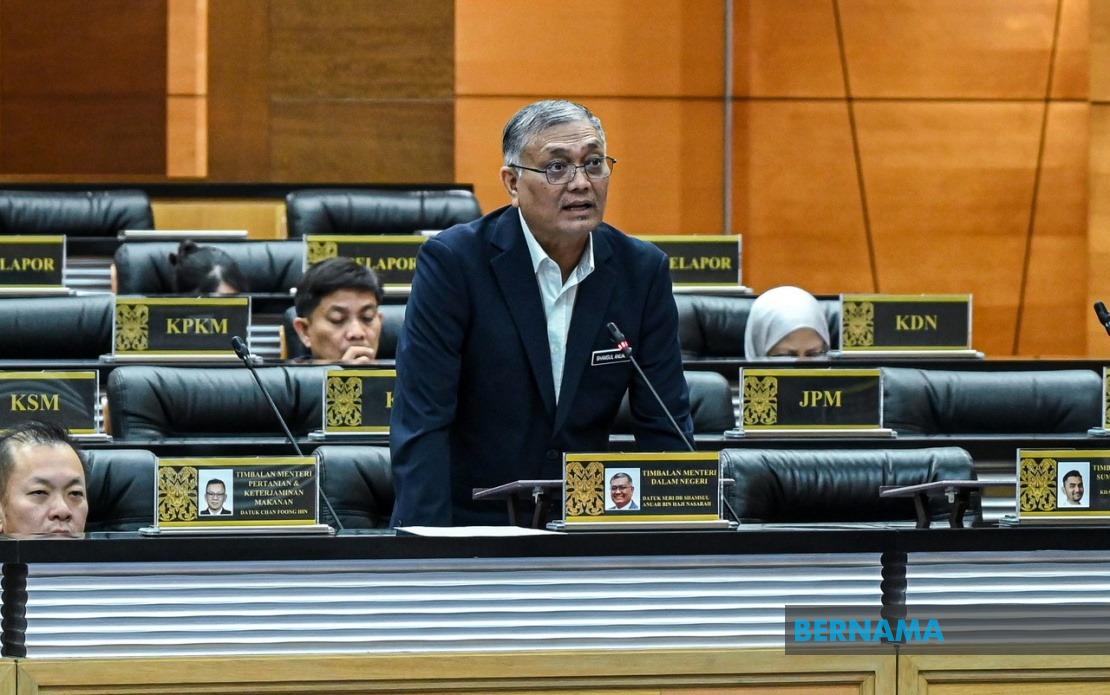
In a firm statement to Parliament, Deputy Home Minister Datuk Seri Dr Shamsul Anuar Nasarah has made clear that the Royal Malaysian Police will extend no special protection to prominent figures under investigation, regardless of their political standing or past positions. The assurance came during debate in the Dewan Rakyat Special Chamber, where Shamsul Anuar responded to concerns about how police handle sensitive cases involving well-connected individuals.
The Deputy Home Minister's remarks were prompted by questions from Datuk Wan Saifulruddin Wan Jan, the Tasek Gelugor MP representing Perikatan Nasional, who sought an update on several investigations capturing public attention, most notably the case involving an intimate video that surfaced online in 2019 and was allegedly connected to a former government minister. Shamsul Anuar's response underscores the government's effort to signal that investigative agencies operate free from political interference, a concern that has periodically surfaced in Malaysian public discourse where cases involving senior figures have drawn scrutiny.
Regarding the intimate video case, investigators continue their pursuit of the original recording and any devices or equipment involved in its creation and distribution. The investigation operates under multiple legal frameworks, including Section 292, Section 377B and Section 504 of the Penal Code, alongside Section 233 of the Communications and Multimedia Act 1998. These provisions address offences ranging from obscene publications to criminal intimidation, reflecting the broad legal arsenal available to authorities investigating such matters. The multi-layered legal approach demonstrates that cases with digital components typically intersect several statutes, complicating both investigation and prosecution.
Shamsul Anuar's statement that the police conduct their work "professionally, transparently and fairly without considering the position or political affiliation of any party" carries particular weight given Malaysia's history of public concern regarding selective law enforcement. The phrase explicitly addresses a lingering anxiety in Malaysian civil society: that access, connections and former government roles might influence investigative priorities or vigour. By making this declaration in Parliament, where statements carry formal weight and are recorded in official proceedings, the Deputy Home Minister placed the government on record regarding its investigative standards.
Separately, Shamsul Anuar addressed another prominent case involving the son-in-law of former Prime Minister Tan Sri Muhyiddin Yassin, noting that the Malaysian Anti-Corruption Commission has assumed investigative responsibility and issued an arrest warrant. The Deputy Home Minister declined to elaborate further, citing the ongoing nature of the MACC inquiry. This division of labour between the PDRM and MACC illustrates Malaysia's institutional framework, where different agencies hold jurisdiction over distinct categories of alleged wrongdoing, with anti-corruption matters falling squarely within the MACC's purview.
The emergence of such cases involving relatives and associates of senior political figures reflects broader governance challenges that Malaysia shares with many developing democracies. When family members of prominent politicians face investigation, the cases inevitably attract public interest and speculation about whether authorities will pursue them vigorously or allow political connections to provide shelter. The explicit public commitment by a Deputy Home Minister that no such immunity exists represents an attempt to counter such speculation and reinforce institutional independence.
Beyond domestic investigations, Shamsul Anuar touched on Malaysia's extradition capabilities and international cooperation. The country currently maintains extradition treaties with eleven nations and has signed the ASEAN Extradition Treaty, establishing frameworks for pursuing suspects who flee across borders. The Deputy Home Minister indicated Malaysia's readiness to negotiate additional extradition arrangements with foreign governments, reflecting a recognition that transnational crime and fugitives increasingly require regional and international coordination. For Southeast Asian readers, this signals Malaysia's commitment to tightening cooperative frameworks that might affect individuals fleeing the region.
The extradition landscape has grown increasingly complex, particularly as digital crimes and financial offences frequently involve multiple jurisdictions. Malaysia's engagement with international law enforcement mechanisms mirrors trends across Southeast Asia, where countries seek to strengthen their capacity to pursue criminals who exploit jurisdictional boundaries. The ASEAN Extradition Treaty, in particular, represents a significant regional framework that Malaysian courts and authorities increasingly invoke in handling cross-border cases.
The parliamentary exchange also serves a broader political function in Malaysian governance. When opposition and government legislators jointly examine investigative conduct during special chamber sessions, such scrutiny theoretically reinforces institutional accountability. Datuk Wan Saifulruddin Wan Jan's questions, posed by a Perikatan Nasional representative, suggest that concerns about investigative fairness transcend the usual government-opposition divide, reflecting broader societal anxieties that span the political spectrum.
For Malaysian observers and regional analysts, the Deputy Home Minister's statements offer both reassurance and a test case. The commitment to impartial investigation of high-profile figures is formally stated, but public confidence ultimately depends on how investigations actually proceed, how vigorously authorities pursue leads, and whether outcomes demonstrate genuine independence from political considerations. The cases under discussion—particularly the intimate video matter and the alleged corruption case involving the former Prime Minister's son-in-law—will provide empirical evidence against which the Deputy Home Minister's assurances can be measured.
The timing of these clarifications matters as well. Malaysia's political landscape has experienced considerable turbulence in recent years, with transitions of power, coalition changes and accusations of selective prosecution occasionally surfacing in public discourse. Reaffirming that investigative agencies operate without political bias serves to stabilise confidence in institutions during periods of political flux. For Southeast Asia more broadly, Malaysia's approach to handling sensitive cases involving prominent figures offers lessons and precedents as other nations grapple with similar governance challenges.

