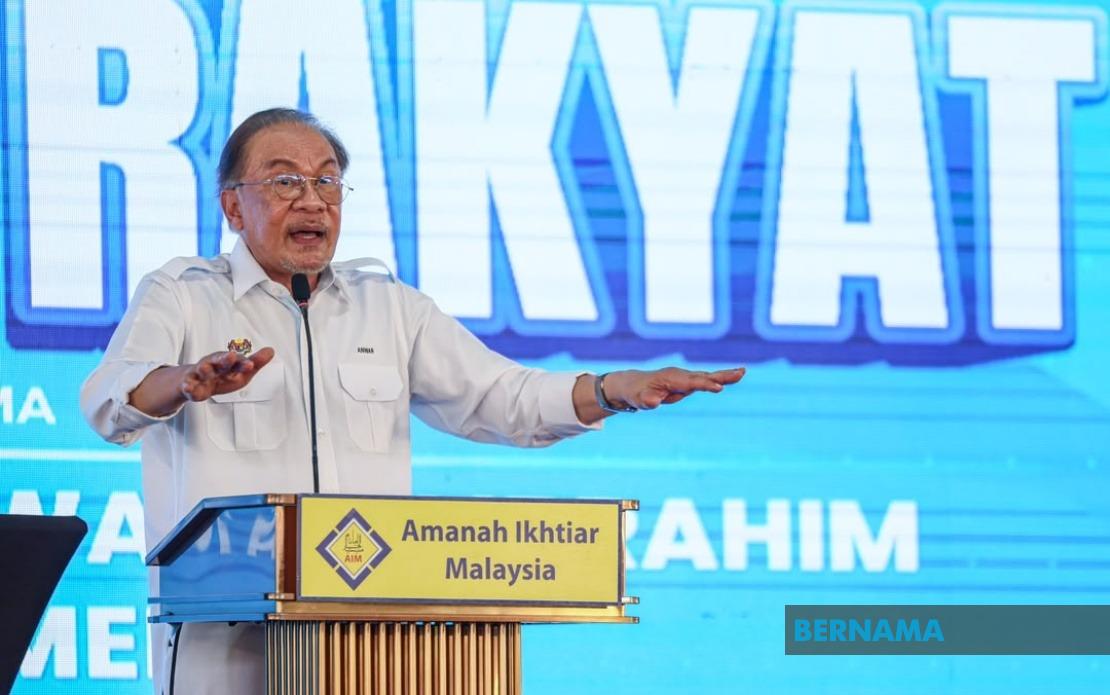
Prime Minister Datuk Seri Anwar Ibrahim has attributed mounting political opposition to his government's resolute battle against corruption and the misuse of public authority. Speaking at a Pakatan Harapan campaign event in Batu Pahat ahead of the Johor state election, Anwar characterised the coalition of rival parties now arrayed against him as a direct response to the MADANI Government's zero-tolerance stance on those who plunder state resources or exploit their positions for personal enrichment. The accusation reflects deepening political tensions as the electoral contest in Johor intensifies, with multiple factions coalescing in apparent opposition to the federal administration's governance agenda.
Anwar, who chairs the Pakatan Harapan coalition, framed the government's anti-corruption philosophy as the primary source of discomfort among his adversaries. He asserted that the administration's unwavering commitment to preventing leaders from accumulating land, securing lucrative projects, obtaining shareholdings, or amassing private wealth through public office had provoked considerable anxiety within rival political camps. This interpretation suggests that the Prime Minister views the consolidation of opposition forces not as a policy disagreement but as a defensive manoeuvre by politicians whose interests may be threatened by heightened scrutiny of financial dealings and resource allocation. The framing carries significant implications for how governance and institutional accountability have become polarised in Malaysian politics.
Demonstrating personal adherence to these principles, Anwar pointed to his own conduct during repeated visits to Johor as Prime Minister, claiming he had never accepted land, projects, or shareholdings in the state. He presented this record as exemplary of the standard he expects from elected representatives across the country. By establishing himself as a benchmark for integrity, the Prime Minister attempted to contrast his administration's approach with what he characterised as the historical practices of rival coalitions. This strategy of personal virtue-signalling is designed to resonate with voters concerned about governance standards, though critics may question whether individual rectitude addresses systemic institutional weaknesses that enable corruption.
The Prime Minister's remarks occurred during a meet-and-greet session for the Senggarang state constituency, part of the broader Pakatan Harapan campaign machinery mobilising support ahead of the Johor state election scheduled for July 11. The Johor contest, involving 172 candidates competing for 56 state seats, represents a critical battleground for the coalition's efforts to consolidate control across Malaysia's second-largest state by economic output. Early voting commenced on July 7, with the main polling day set for July 11. The alignment between federal and state governments has become a central campaign theme, with Anwar arguing that voters should elect a PH-led state administration to facilitate coordinated implementation of development programmes and welfare initiatives.
Anwar pressed the case for institutional alignment, contending that a state government aligned with the federal administration would enable more efficient delivery of public goods and services. Despite Johor receiving development funding worth billions of ringgit, he noted that fundamental service gaps persisted, particularly in affordable housing, road infrastructure, places of worship including mosques and surau, and social assistance programmes. This framing positions state-level governance as inadequate despite substantial capital investment, suggesting that administrative coordination and political coherence are necessary complements to financial resources. The argument carries weight in Malaysian politics, where federal-state tensions have historically complicated policy implementation and created opportunities for blame-shifting between levels of government.
The Prime Minister articulated a vision of inclusive prosperity, criticising what he described as the concentration of wealth among narrow elites within Johor. He acknowledged the state's significant economic capacity while arguing that the benefits of development had not been equitably distributed among ordinary residents. This populist critique seeks to distinguish Pakatan Harapan's governance model from what he implicitly characterised as previous administrations' patterns of elite capture. Such rhetoric resonates particularly in Johor, where economic disparities and perceptions of unequal development outcomes have featured prominently in political discourse, though translating campaign promises into tangible wealth redistribution remains a persistent challenge for Malaysian governments across ideological spectrums.
Anwar also addressed long-standing concerns within Malay-Muslim constituencies regarding Pakatan Harapan's partnership with the Democratic Action Party, which draws significant support from non-Muslim communities. He asserted that throughout his three-and-a-half years as Prime Minister, DAP cabinet ministers had never opposed programmes benefiting Malays or Islam, inviting voters to verify this claim against the administrative record. This defence acknowledges the salience of ethno-religious concerns within Malaysian electoral politics while attempting to neutralise perceptions that PH's multiethnic composition threatens Malay-Muslim interests. The assertion implicitly frames concerns about DAP influence as unfounded political rhetoric rather than substantive policy disagreement, though such reassurances have historically encountered scepticism among constituencies wedded to more ethnically or religiously nationalist political movements.
During the campaign event, Anwar remarked on the remarkable enthusiasm displayed by Pakatan Harapan supporters in Senggarang, noting that attendees had endured intense heat to participate in the gathering. He characterised the turnout as extraordinary compared to typical campaign appearances, using the observation to suggest genuine grassroots momentum for the coalition's message. Such observations, while common in campaign discourse, serve the rhetorical function of implying superior organisational capacity and popular endorsement. The emphasis on supporter commitment despite adverse weather conditions appealed to audience sense of collective purpose and distinguished the PH movement from what he implicitly portrayed as more mechanistic opposition campaigns.
The Prime Minister appealed directly to voters in the Senggarang, Rengit, and Penggaram constituencies to deliver their support to Pakatan Harapan candidates, framing the choice as consequential for Johor's developmental trajectory and governance quality. This direct electoral appeal encapsulates the broader campaign strategy: positioning Anwar's administration as committed to integrity, effectiveness, and equitable development, whilst characterising opposition forces as reactive, self-interested, and potentially predatory toward public resources. The Johor state election thus transcends a regional political contest, functioning as a referendum on the MADANI Government's governance model and the credibility of its anti-corruption agenda amid persistent political polarisation.
The campaign messaging reflects deeper anxieties within Malaysian politics regarding institutional integrity and the distribution of state resources. By attributing opposition consolidation to fear of anti-corruption enforcement, Anwar attempts to reframe political conflict not as ideological competition but as confrontation between reformist governance and entrenched interests seeking to preserve corrupt practices. Whether this narrative persuades Johor voters to grant Pakatan Harapan control of the state government will significantly influence the federation's political trajectory. The outcome will also test whether commitments to anti-corruption governance and institutional transparency can sustain political support when implemented through partisan structures potentially susceptible to their own forms of preferential allocation and factional advantage.

