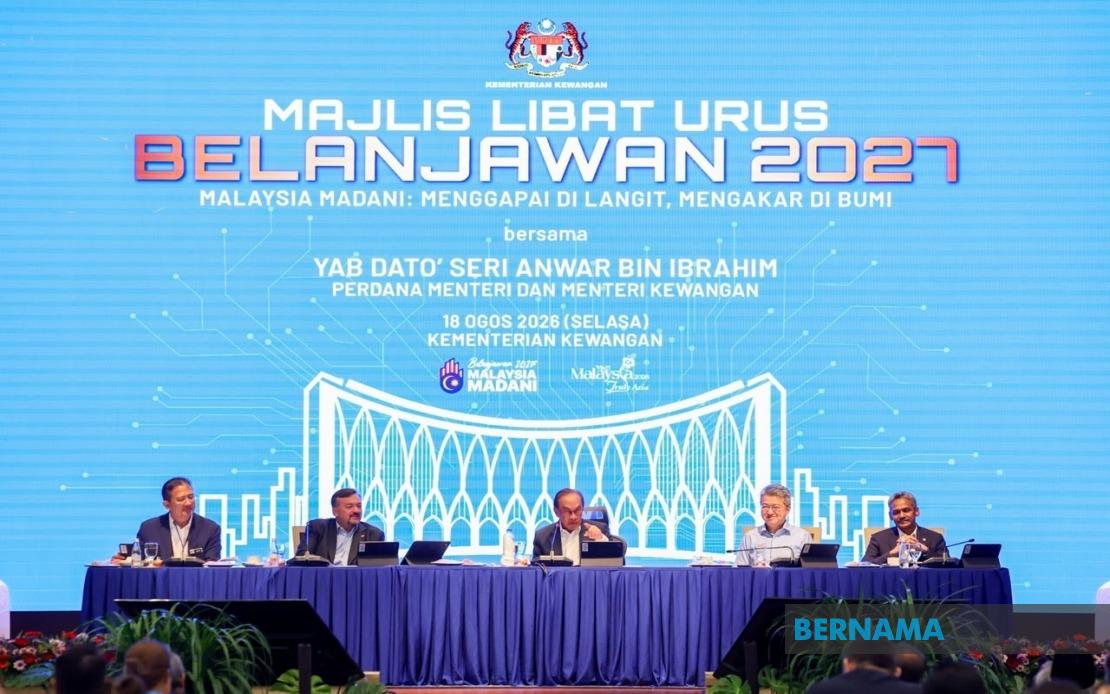
Political stability remains the bedrock upon which Malaysia must build its appeal to international investors, Prime Minister Datuk Seri Anwar Ibrahim declared at the conclusion of the Budget 2027 engagement session in Putrajaya. Speaking in his dual capacity as Finance Minister, Anwar underscored that the confidence of global capital markets hinges not only on economic indicators and growth prospects, but critically on the perceived predictability and durability of a nation's political environment. Without this fundamental assurance, even countries with sound fundamentals struggle to attract the sustained investment flows necessary to fuel development.
The Prime Minister's emphasis reflects a reality that Malaysian policymakers have long grappled with—investor appetite is shaped as much by political perceptions as by balance sheet indicators. Companies considering major capital commitments in Malaysia weigh the stability of the operating environment alongside interest rates, exchange rates, and sectoral opportunities. A country perceived as politically fragile, regardless of its economic strength, finds itself at a disadvantage when competing for multinational investments against neighbours offering similar returns but greater institutional predictability. Anwar's articulation of this principle suggests a deliberate prioritisation within the government's strategic calculus.
Acknowledging the inherent tensions within governance, Anwar candidly addressed the compromises his administration has accepted to preserve political cohesion. He framed the dilemma facing policymakers in stark terms: pursue aggressive policy implementation and risk destabilising the political coalition, thereby deterring investment; or maintain the delicate balance of political consensus and accept constraints on the scope of fiscal and regulatory action. This formulation exposes a central challenge confronting Malaysia's coalition-based government structure, where broader agreement often comes at the cost of bold, unilateral decision-making. The Prime Minister's choice to prioritise stability over maximalist policy goals reflects both pragmatism and an implicit acceptance that incremental progress under stable conditions outweighs more dramatic reforms conducted amid political turbulence.
Criticism directed at Anwar for making compromises stems partly from his government's predecessor track record and partly from expectations that a reformist administration would pursue more transformative agendas. Yet his articulation of the choice confronting leadership suggests he views such criticism as reflecting a misunderstanding of governance constraints. In Anwar's analysis, the trade-off is not between compromise and purity, but between compromise and economic decline. By this logic, those who advocate for more aggressive policy stances must confront the counterfactual: would the pursuit of such measures genuinely serve public interest if the political upheaval they triggered resulted in capital flight and reduced growth?
The connection Anwar draws between political stability and enhanced economic capacity demonstrates sophisticated understanding of the multiplier effects at play. A growing economy generates additional tax revenues and fiscal space without requiring politically contentious increases in tax rates or cuts to popular programmes. Conversely, a contracting or stagnant economy forces zero-sum political calculations where every budgetary decision represents a reduction elsewhere. By prioritising the conditions for sustained growth, the government creates the fiscal flexibility to address demands from various constituencies—whether in infrastructure, education, healthcare, or welfare—that might otherwise generate political friction.
In this framework, Malaysia's current economic trajectory becomes a political asset. The government benefits from moderately improving fundamentals that validate the stability strategy and create room for incremental improvements in public spending and allocations. However, this approach also contains an implicit vulnerability: should growth falter or external shocks materialise, the government's political capital may erode if constituencies perceive that austerity or reduced allocations follow from policy failures rather than external necessity. The Prime Minister's statement thus carries a subtle message to investors and political actors alike: the government's ability to deliver on economic expectations depends on the continued forbearance of stakeholders accepting gradualism over transformation.
The Budget 2027 engagement process itself reflects the coalition government's consultation-heavy approach to policymaking. By drawing input from business associations, banking institutions, and sectoral representatives before finalising budget allocations, the government signals that stability derives partly from inclusive decision-making rather than top-down imposition. This consultative model, while sometimes slow and accommodation-heavy, builds broader stakeholder buy-in for fiscal priorities. The involvement of chambers of commerce and financial institutions serves a dual purpose: it provides government with ground-level insights into economic conditions whilst simultaneously enlisting these influential actors as stakeholders in the stability project.
Anwar's reference to persisting challenges facing small and medium-sized enterprises and less technologically advanced sectors reveals the asymmetries within Malaysia's economy. Whilst cutting-edge fields such as artificial intelligence and digital technology advance, large segments of the domestic economy—particularly SMEs that employ substantial portions of the workforce—remain vulnerable to disruption and technological displacement. The government's budget allocation decisions must navigate between supporting these struggling constituencies and investing in the high-potential sectors that drive innovation and export competitiveness. This tension mirrors broader questions about inclusive growth: whether economic expansion that benefits dynamic, technology-driven sectors can generate sufficient spillovers to support livelihoods across the broader economy.
For Malaysian investors and business leaders, Anwar's statements offer reassurance about the government's commitment to maintaining the policy environment within which they operate. The explicit connection between political stability and investment climate suggests that maintaining coalition unity and avoiding institutional crises remains a top governing priority. This reassurance may prove particularly valuable given Malaysia's experience with rapid political changes in recent years. The investor community has come to value predictability over specific policy outcomes, and Anwar's articulation prioritises precisely that variable.
Regionally, Malaysia's emphasis on stability as an investment attractor carries implications for how the country positions itself within Southeast Asia. Competing for foreign direct investment against Thailand, Vietnam, and Indonesia requires demonstrating advantages beyond labour costs or natural resources. Political reliability and institutional predictability emerge as increasingly important differentiators. Anwar's public commitment to prioritising stability serves as a signal to international capital markets that Malaysia offers a governance environment distinct from neighbours experiencing greater political turbulence or institutional uncertainty.
The underlying tension in Anwar's framework merits further scrutiny: whether prioritising stability ultimately constrains the transformative reforms that might elevate Malaysia's long-term competitiveness. Critics argue that gradualism and compromise, whilst preserving short-term stability, may sacrifice the structural reforms necessary to compete effectively as global supply chains reorganise and emerging economies climb the value-added ladder. Yet Anwar's logic suggests that such reforms, however desirable, prove counterproductive if pursued amid political instability that scares away the investment necessary to finance them. This represents a genuinely difficult governance question rather than a choice between obvious right and wrong answers.

