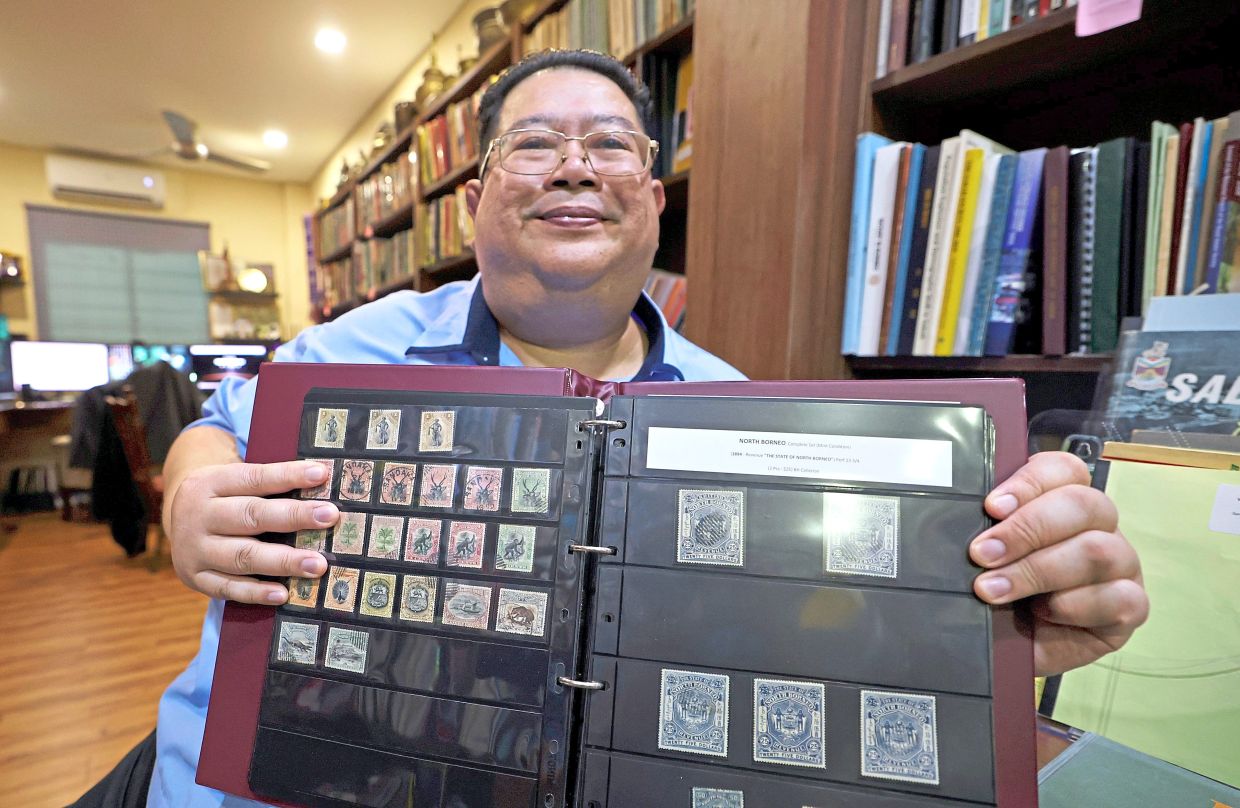
The fading passion for stamp collecting threatens to erase an important chapter of Sabah's documented history. North Borneo stamps, some now exceeding a century in age, represent more than postal memorabilia—they constitute a tangible record of the territory's evolution under British administration, from the initial 1883 issue through to independence. As these rare artefacts become increasingly difficult to locate and younger generations show diminishing interest in philately, preservationists are sounding the alarm about the potential loss of this irreplaceable cultural heritage.
Dr Shari Jeffri, 56, a leading voice in this preservation movement as founder and president of the Borneo History Association, conceptualises these stamps as a "living archive" that demands careful stewardship and intergenerational transmission. His perspective carries the weight of nearly four decades spent as an active philatelist, during which he has accumulated considerable knowledge about the stamps' historical context and significance. Jeffri observes a troubling generational shift: contemporary audiences have far less exposure to stamp collecting than their predecessors, with only a dedicated minority maintaining active interest in the hobby. This demographic contraction within the collector community creates an urgent imperative to document and preserve existing collections before knowledge and artefacts scatter irretrievably.
A systematic survey of antique dealers operating throughout Kota Kinabalu reveals the scarcity now characterising the North Borneo stamp market. Dealers report that original issues from the territory's British Chartered Company period command premium prices determined by multiple factors: chronological age, physical condition, and relative rarity within surviving populations. Among notable specimens discovered were exemplars featuring imagery central to Sabah's identity—a six-cent denomination portraying Queen Elizabeth II alongside a Dusun woman, and a ten-cent issue documenting logging operations. Both emerged from the 1954-1961 period, representing the maturation of design principles that evolved throughout the territory's postal history.
Jeffri's personal connection to these stamps runs deeper than professional interest, rooted in familial inheritance and childhood exposure. His late grandfather, employed at the Recreation Club Jesselton during the 1920s, accumulated a collection inspired by observing British colonial officers pursuing philately as an intellectual leisure activity. Rather than hoarding this assemblage, the grandfather deliberately cultivated an intention to spark similar enthusiasm among descendants, bequeathing both artefacts and passion. Young Shari encountered his first stamps at age seven but only developed systematic collecting practices during secondary school years, ultimately inheriting and meticulously preserving the family's accumulated holdings—a process that deepened his scholarly interest in understanding the historical narratives embedded within the stamps' designs and chronological development.
Central to Jeffri's personal collection are two exceptional two-cent specimens from the inaugural 1883 issue, each bearing the iconic brown sailing boat motif and complete postmark cancellations. For serious stamp collectors, the omission of this foundational 1883 series represents a fundamental gap in their collections, since these stamps function simultaneously as evidence of a specific historical transaction and as documentary artifacts of their era. Each specimen communicates details about postal logistics, administrative structures, and the territory's presentation of itself to the international community. The 1883 issuance marked the British North Borneo Chartered Company's decision to establish formal postal infrastructure, initiating an unbroken sequence of stamp releases spanning fifty-two years until the territory's postal administration transitioned during the approach to independence.
The visual evolution of North Borneo stamps tracks the gradual transformation of how the territory presented itself to external observers. Initial denominations from the 1880s employed symbolic imagery—lions, tigers, and stylised sailing vessels—integrated with the Latin motto Pergo et Perago, loosely translated as "I undertake and I achieve." These heraldic and allegorical choices represented deliberate efforts to project an image of organised administration and civilisational development to Victorian and Edwardian audiences. The design philosophy shifted markedly from 1894 onwards, transitioning toward authentic representations of Borneo's biodiversity and landscape features. The 1935 series achieved particular sophistication in reflecting Sabah's distinct identity, appearing across denominations ranging from two cents through one dollar and incorporating increasingly specific imagery of indigenous flora, fauna, and natural characteristics. This progression demonstrates how postal aesthetics functioned as a mechanism for territorial branding during the imperial era.
Preserving these materials presents conservation challenges distinct from those confronting other historical artefacts. The paper composition and adhesive formulations employed in late nineteenth and early twentieth-century stamp production require specialised storage conditions. Acidic materials constitute the primary preservation threat, capable of chemically degrading paper over time and causing the photographic pigments to fade or discolour. Jeffri emphasises the necessity of maintaining collections within acid-free albums specifically engineered to prevent such chemical deterioration. Beyond environmental controls, the analytical assessment of stamp authenticity and valuation depends upon understanding the technical characteristics of paper types and adhesive compositions employed across different production periods, knowledge that distinguishes genuine period issues from later imitations or reprints.
Stamps bearing complete postal cancellations occupy a distinct category within serious philatelic evaluation, valued for providing extraordinarily detailed information about historical mail systems. Complete postmarks preserve the precise date of posting, the identity of the originating post office, temporal information indicating the hour of dispatch, and sometimes the destination post office's receiving mark. Assembled collectively, cancelled stamps create a three-dimensional database documenting postal traffic patterns, communication networks, and administrative boundaries within historical territories. For Sabah, such evidence provides reconstruction of nineteenth and early twentieth-century communication infrastructure and social connectivity, data largely absent from conventional historical documentation.
Jeffri's expertise reflects sustained engagement with both physical collections and specialised scholarly apparatus. He studied under recognised Singaporean philatelic authorities Voon Kyam Foh and Tan Chun Lim, establishing scholarly credentials within a rigorous international community of specialists. His research methodology incorporates consultation of comprehensive reference works including the Commonwealth & British Empire Stamps catalogue, ensuring that assessments rest upon established taxonomic frameworks and documented provenance evidence. This scholarly approach elevates North Borneo stamp study beyond casual hobby status, positioning it as a legitimate historical research methodology capable of illuminating aspects of colonial administration, cultural representation, and territorial identity.
The transition from handwritten correspondence to digital communication has rendered stamps functionally obsolete within contemporary postal systems, yet this transformation actually amplifies their historical significance. Stamps no longer serve utilitarian purposes within living communication networks; instead, surviving examples constitute material evidence from vanished social practices. Their scarcity and the declining familiarity of younger populations with stamp collecting create dual imperatives: first, immediately documenting and preserving existing collections before they disperse into private hands or disappear; second, developing educational frameworks that communicate the historical richness embedded within these designs to audiences lacking direct personal experience with letter-writing cultures. North Borneo stamps function as portable archives of Sabah's transformation across multiple centuries—windows into how the territory imagined and represented itself during crucial developmental epochs.

