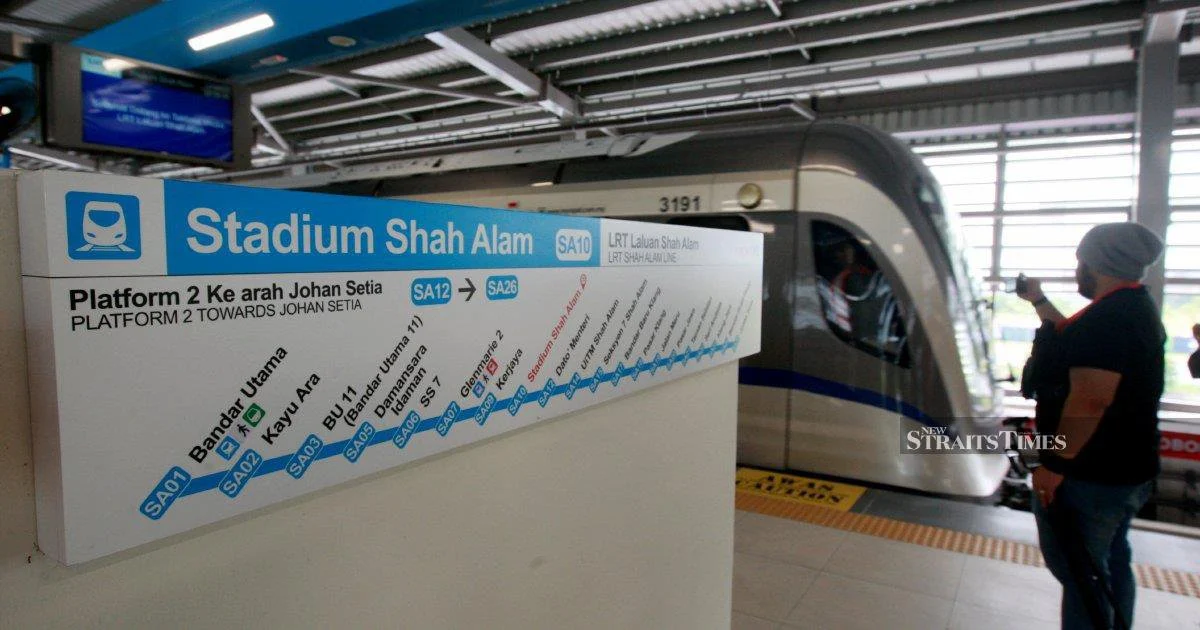
Prime Minister Datuk Seri Anwar Ibrahim will officially open the Light Rail Transit Line 3 (LRT3) Shah Alam line on Sunday, marking a significant milestone in Malaysia's ongoing effort to expand rapid transit infrastructure around the Klang Valley. The ceremonial launch precedes the line's commercial debut on Monday, when regular passenger services begin their scheduled operations across the newly extended corridor.
The LRT3 Shah Alam extension represents a crucial addition to the nation's public transport network, designed to enhance connectivity for residents and workers across the western suburbs of Selangor. The project reflects the government's broader commitment to reducing traffic congestion and promoting sustainable urban mobility throughout the greater Kuala Lumpur region. This infrastructure investment aligns with Malaysia's Vision 2050 framework and the government's push to modernise transportation networks ahead of rapidly growing urban populations.
The timing of this inauguration underscores the administration's focus on delivering completed infrastructure projects that directly benefit commuters. Public transport expansion has emerged as a central pillar of economic policy under the current government, with rail network improvements seen as essential to supporting long-term growth in the Klang Valley corridor. The Shah Alam extension joins several other transit initiatives undertaken across the peninsula in recent years, collectively aimed at shifting travel patterns away from private vehicle dependency.
LRT3, which already serves multiple stations across Klang and central Selangor, will now extend its reach to Shah Alam, a major commercial and industrial hub hosting numerous multinational corporations and manufacturing facilities. This expansion enables tens of thousands of additional commuters to access rapid transit alternatives for their daily journeys, potentially reducing congestion on major arterial roads and highways that already experience considerable strain during peak hours. The Shah Alam connection proves particularly significant given the city's designation as a major economic centre within the Klang Valley region.
The operational launch on Monday will mark the realisation of years of planning, construction, and testing across the extended alignment. Transport authorities have implemented comprehensive safety protocols and staff training programmes to ensure smooth service delivery from day one. Commuters can expect regular scheduling modelled on existing LRT3 operations, with frequency and coverage designed to accommodate morning and evening peak periods alongside midday and weekend traffic patterns.
For Malaysian readers, the expanded LRT3 network carries implications extending beyond mere commuting convenience. Improved public transport access typically stimulates property development patterns, potentially reshaping investment flows across secondary and tertiary business districts. Companies and workers previously reliant on automotive transport or longer commute times may now reconsider relocation decisions, particularly regarding office spaces and residential locations within Shah Alam and adjacent areas.
The project's completion also reflects broader Southeast Asian trends toward enhanced urban transit infrastructure. As regional economies grow increasingly integrated and metropolitan areas expand geographically, reliable rapid transit becomes increasingly competitive as a factor attracting international investment and multinational operations. Malaysia's continued investment in rail infrastructure positions the nation favourably within the region's evolving transportation landscape.
From an environmental perspective, the expanded LRT3 network contributes to Malaysia's greenhouse gas reduction commitments under international climate frameworks. Every passenger transported via rail rather than private vehicle represents a marginal reduction in carbon emissions, cumulative benefits that become substantial across millions of annual journeys. The Shah Alam extension thus serves dual purposes of economic convenience and environmental stewardship.
The formal inauguration by Prime Minister Anwar Ibrahim carries political significance as well, demonstrating tangible progress on infrastructure delivery promises made to constituents across the Klang Valley. Transportation project completions generate visible public goodwill, particularly when announced through ceremonial inaugurations that attract media coverage and public awareness. Such events reinforce narratives of effective governance and economic progress heading into political cycles.
For businesses already operating in Shah Alam or considering expansion there, the enhanced transit access potentially reduces employee recruitment challenges and improves customer accessibility. Manufacturing operations, logistics facilities, and office-based enterprises all benefit from worker mobility improvements. The economic stimulus generated by infrastructure completion often extends across multiple sectors as employees spend time and money in surrounding commercial areas near transit nodes.
The Shah Alam extension also provides downstream benefits for future transport planning. Completed rail networks generate usage data, passenger flow patterns, and operational metrics that inform subsequent transport infrastructure development across Malaysian cities. This empirical information proves invaluable for transport planners designing future expansions or considering alternative transit technologies.
Looking ahead, the LRT3 Shah Alam line's successful launch may encourage further expansion discussions across the Klang Valley. Transport authorities and government planners will monitor passenger uptake, operational efficiency, and revenue generation patterns to inform decisions regarding additional rail corridors or network extensions. The project thus represents both a completion and a foundation upon which subsequent transport infrastructure development can build.

