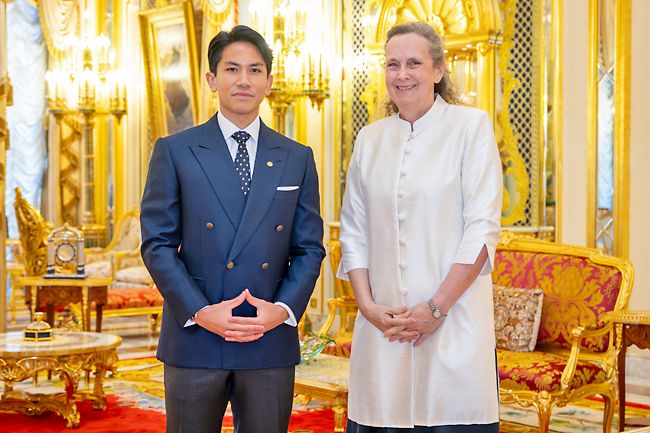
His Royal Highness Prince 'Abdul Mateen, Minister of Foreign Affairs of Brunei Darussalam, extended formal farewell courtesies to the outgoing United States Ambassador Caryn R McClelland during a ceremonial audience held at Istana Nurul Izzah in Bandar Seri Begawan on Saturday, June 20. The occasion marked a traditional diplomatic milestone, acknowledging the conclusion of McClelland's posting to the sultanate and the contributions made during her tenure representing American interests in the small Southeast Asian nation.
The occasion reflected Brunei's diplomatic protocols for honouring departing heads of mission. In his remarks, Prince 'Abdul Mateen conveyed formal appreciation for McClelland's efforts throughout her ambassadorial service, particularly highlighting her work in consolidating the historical friendship between the two nations. The prince underscored that her tenure had yielded tangible progress in strengthening institutional relationships and expanding the scope of bilateral engagement at multiple governmental and community levels.
During her period of service—which commenced with her presentation of credentials to His Majesty Sultan Hassanal Bolkiah, Sultan and Yang Di-Pertuan of Brunei Darussalam on May 24, 2022—McClelland presided over a period of intensified cooperation between Washington and Bandar Seri Begawan. The timing of her departure comes as the United States maintains heightened engagement with Southeast Asia amid broader geopolitical developments in the Indo-Pacific region, where Washington seeks to strengthen partnerships with smaller nations like Brunei.
One significant area of expanded collaboration involved defence and security matters. The two nations developed closer military and security coordination during McClelland's tenure, reflecting broader American strategic objectives in Southeast Asia to maintain stability and strengthen relationships with regional partners. This dimension of the bilateral relationship carries particular importance given Brunei's geographic position near major global shipping lanes and its role within regional organisations like the Association of Southeast Asian Nations (ASEAN).
Educational exchange programmes represented another cornerstone of deepened relations during this period. American universities and educational institutions expanded their engagement with Bruneian counterparts, facilitating student mobility and academic collaboration. Such people-to-people connections serve as long-term investments in bilateral relationships, creating networks of mutual understanding that extend beyond formal governmental structures and contribute to sustained ties regardless of shifts in political administrations.
Trade and investment initiatives also featured prominently in the bilateral agenda. American businesses explored opportunities within Brunei's economy, while Bruneian entities examined access to American markets and investment avenues. These commercial dimensions complement traditional diplomatic relations, creating multiple channels through which the two societies interact and benefit from mutual economic engagement.
Cultural and people-to-people exchanges flourished as ambassadorial priorities. Through various programmes and initiatives, McClelland's office worked to facilitate greater understanding between Americans and Bruneians, organising events that promoted mutual cultural appreciation and social connections. Such grassroots engagement strengthens the foundation upon which official diplomatic relationships rest, ensuring that bilateral ties possess genuine societal support and awareness.
Brunei's position within ASEAN and the broader Southeast Asian region means that American diplomatic efforts there carry ramifications extending beyond bilateral concerns. The sultanate participates actively in regional forums and initiatives, where its stance on international issues influences collective ASEAN positions. Accordingly, ambassadors to Brunei serve not merely bilateral functions but also contribute to broader American regional diplomacy objectives.
The farewell audience represents a moment of transition within the American diplomatic mission to Brunei. McClelland's departure necessitates the appointment of a successor who will inherit the relationships and initiatives she cultivated, presenting both continuity opportunities and possibilities for recalibrated priorities reflecting any evolving American strategic interests in Southeast Asia. The principles and partnerships established during her tenure likely will form the foundation upon which her successor builds.
From Brunei's perspective, the farewell acknowledgement reflects the sultanate's commitment to maintaining strong ties with the United States across the full spectrum of bilateral cooperation. Prince 'Abdul Mateen's participation in the formal farewell underscores the priority that Brunei's government accords to its American relationship, signalling continuity in diplomatic engagement despite ambassadorial transitions.
The timing of such transitions invariably creates brief windows of uncertainty within diplomatic missions, yet the established frameworks for cooperation typically persist. For Malaysian observers and other Southeast Asian nations, the American-Brunei relationship serves as a barometer for Washington's broader commitment to the region during a period of significant geopolitical competition and evolving regional alignments. The expansion of various cooperation mechanisms during McClelland's tenure indicates sustained American interest in strengthening ties throughout Southeast Asia, reassuring regional capitals of continuing American engagement despite competing global priorities.

