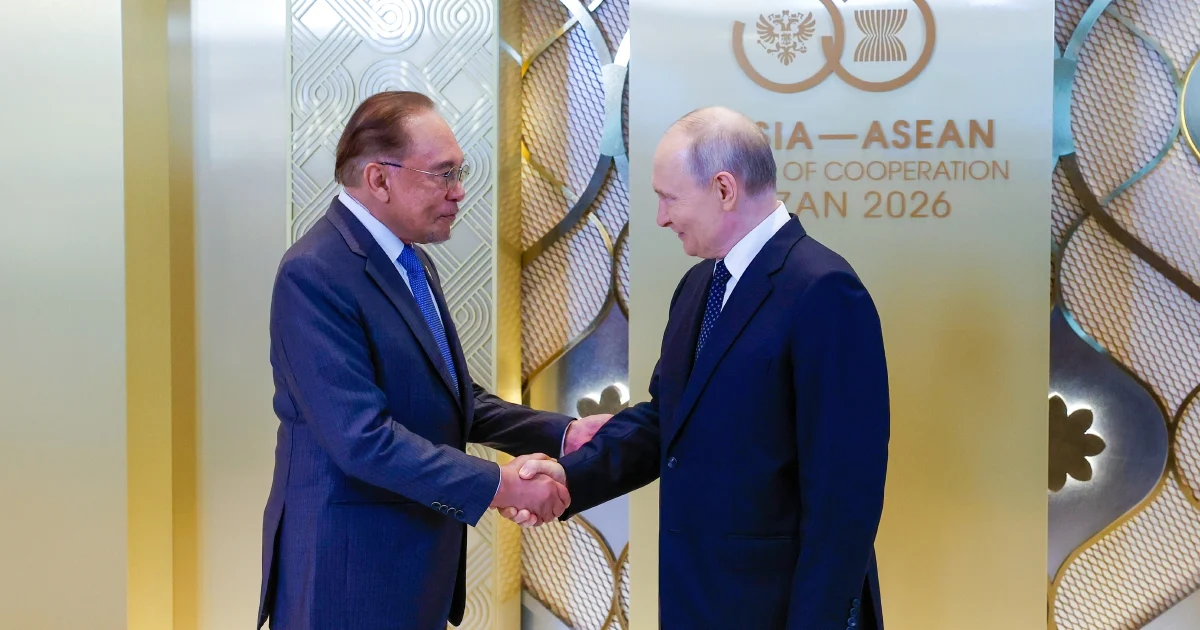
Prime Minister Datuk Seri Anwar Ibrahim has disclosed that Russian President Vladimir Putin has committed to providing Malaysia with a stable and long-term energy supply, marking a significant development in bilateral relations between the two nations. The assurance comes as Malaysia pursues a deliberate policy of engaging multiple energy-producing countries to mitigate supply risks and strengthen its position within regional and global energy markets.
Malaysia's approach to energy security reflects the strategic imperative facing many Southeast Asian economies: the need to balance demand growth with supply diversification. Rather than relying on a single source or region, the country is cultivating relationships with established energy powerhouses across different geographies and political alignments. This multi-pronged strategy acknowledges that energy infrastructure, commodity prices, and geopolitical tensions can disrupt traditional supply chains, leaving nations vulnerable to external shocks.
Russia's willingness to negotiate long-term energy arrangements with Malaysia underscores the Kremlin's continued efforts to maintain economic partnerships despite international sanctions and geopolitical tensions. For Russia, securing long-term contracts with Southeast Asian nations provides both revenue stability and diplomatic leverage in a region where Western influence has historically dominated energy sector investments. Conversely, Malaysia gains access to a reliable alternative supplier with substantial reserves and established export infrastructure.
The timing of this arrangement holds particular significance for the Malaysian economy. As Southeast Asia's second-largest natural gas producer, Malaysia possesses considerable hydrocarbon reserves, yet domestic consumption and regional demand continue to expand. Supplementing domestic production with imports from reliable foreign sources allows Malaysia to meet industrial and residential energy needs while preserving its own resources for exports, which generate crucial foreign exchange earnings.
Energy security extends far beyond simple supply contracts; it encompasses the entire infrastructure ecosystem required to transport, store, and distribute fuel across national borders. Long-term energy partnerships typically involve investments in pipelines, liquefied natural gas (LNG) facilities, and port infrastructure. Such arrangements signal confidence in bilateral relationships and often include technical cooperation on energy efficiency, renewable energy development, and technological transfer—areas where both nations stand to benefit.
The Russian commitment also reflects broader trends in global energy markets post-2022. International disruptions have prompted nations worldwide to reassess their energy portfolios and seek alternative suppliers. Malaysia, as a key Southeast Asian economy with substantial energy infrastructure already in place, represents an attractive market for diversifying energy exporters. The LNG infrastructure at Bintulu, where Anwar made this announcement, positions Malaysia as a crucial hub for energy distribution across Asia-Pacific.
From a Malaysian perspective, engaging Russia on energy matters carries both opportunities and considerations. While Russia possesses extensive natural gas reserves and proven LNG export capabilities, international sanctions create logistical complexities and potential regulatory challenges. Nevertheless, many nations, including Asian economies, continue trading with Russia through intermediaries and structured arrangements that navigate international restrictions. Malaysia's pragmatic approach emphasises commercial benefits over ideological positioning in international disputes.
The announcement also demonstrates Malaysia's broader foreign policy orientation: maintaining balanced international relationships and leveraging economic partnerships to advance national interests. This aligns with the country's historical practice of non-alignment and its ASEAN commitment to avoiding exclusive blocs or ideological camps. By engaging simultaneously with traditional Western partners and emerging alternative suppliers, Malaysia positions itself as an independent actor capable of negotiating favorable terms with multiple parties.
For Southeast Asia more broadly, Malaysia's energy partnerships have regional implications. As the region's energy hub and a major LNG producer itself, Malaysian energy security decisions influence supply chains and pricing across the wider region. Increased diversity in Malaysia's supply sources potentially stabilizes regional energy markets and reduces vulnerability to any single supplier's monopolistic pricing or supply disruptions.
Looking forward, the Russia-Malaysia energy arrangement will likely involve detailed negotiations on volumes, pricing mechanisms, delivery schedules, and payment terms. These contracts typically run for 15 to 20 years, reflecting the long-term capital investments required in energy infrastructure. Such commitments represent significant economic bets on the stability of bilateral relationships across multiple administrations and political cycles.
The broader context of this energy diplomacy reveals how energy security increasingly intertwines with foreign policy strategy. Nations compete not merely on military capability but on control of vital resources and access to critical supply chains. Malaysia's strategy of building multiple energy partnerships reflects this evolved understanding of national power and influence in an interconnected global economy.
Anwar's emphasis on strategic partnerships with major energy-producing nations indicates that Malaysia will continue cultivating diverse relationships rather than concentrating reliance on any single source. This approach, while requiring complex diplomatic and commercial navigation, ultimately provides greater flexibility and negotiating strength. As global energy markets continue shifting due to climate concerns, technological innovation, and geopolitical realignment, Malaysia's diversified energy portfolio positions the nation to adapt and thrive in an uncertain future.

