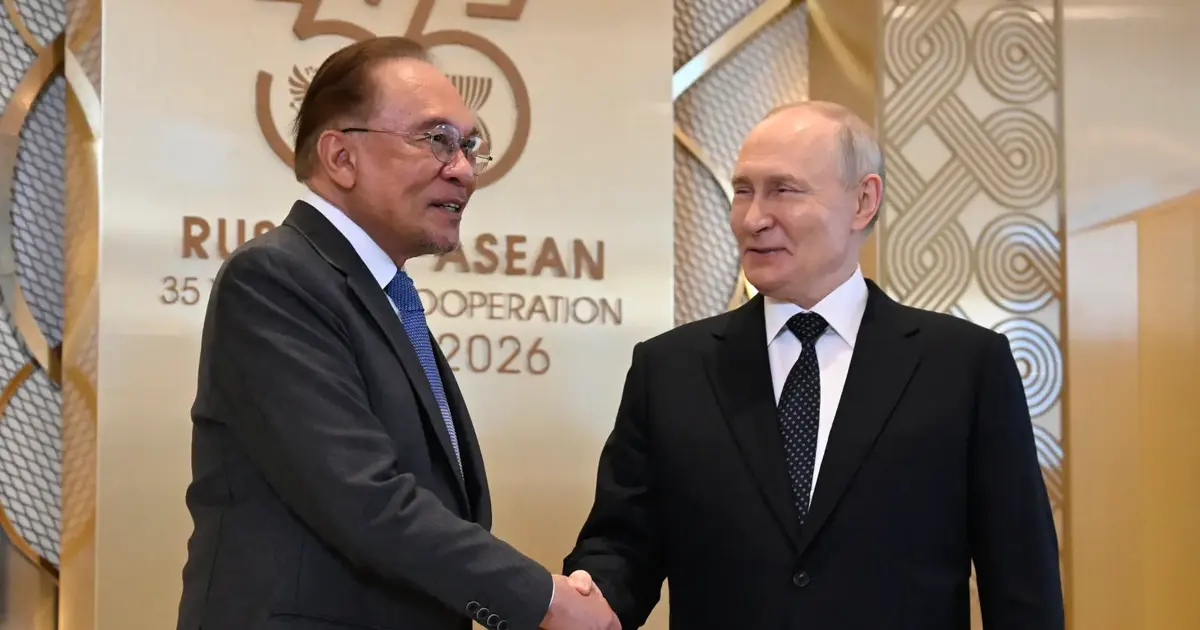
Prime Minister Anwar Ibrahim has announced that Russian President Vladimir Putin has committed to supplying Malaysia with crude oil and natural gas for the next two decades, marking a significant development in bilateral energy cooperation between the two nations. This assurance comes at a time when Malaysia continues to seek stable and diversified energy sources to support its industrial base and economic growth trajectory.
The long-term supply guarantee represents a strategic hedge against energy volatility in global markets, where prices and availability have become increasingly unpredictable. For Malaysia, which remains dependent on energy imports to fuel its petrochemical industries, manufacturing sector, and growing electricity demands, securing such a commitment from a major producer like Russia adds an important pillar to its energy portfolio. The reliability of energy supplies directly impacts Malaysia's competitiveness as a manufacturing and export hub in Southeast Asia.
Beyond the energy dimension, Anwar's diplomatic engagements extend to Turkmenistan, a Central Asian nation with substantial hydrocarbon reserves and emerging strategic importance in global energy markets. The Prime Minister's regional outreach reflects Malaysia's broader approach to energy diplomacy, seeking to develop relationships with multiple suppliers across different geographies to reduce dependency risks. This multi-pronged strategy acknowledges the realities of modern energy markets, where supply disruptions in one region can quickly impact prices and availability worldwide.
Malaysia's efforts to expand its presence in major Asian export markets such as China, Japan, and South Korea form another critical dimension of Anwar's international economic agenda. These three economies collectively represent some of the world's largest and most sophisticated consumer bases, with enormous purchasing power and complex supply chain requirements. By leveraging energy partnerships and trade relationships with Central Asian nations alongside existing arrangements, Malaysia seeks to position itself as a reliable gateway for resource-rich Central Asian producers seeking access to East Asian markets.
China, in particular, represents a massive destination for energy imports and has been aggressively expanding its Belt and Road Initiative, which encompasses critical infrastructure projects linking Central Asia to East Asia. Malaysia's geographical position along major shipping routes and its established trade relationships provide natural advantages for facilitating such commerce. The nation's ports, logistics infrastructure, and trading expertise make it an attractive intermediary for connecting Central Asian suppliers with the massive consumer markets of East Asia.
Japan's position as a highly developed economy with significant energy requirements also offers opportunities for Malaysia to facilitate trade flows and partnerships. Japan has been increasingly focusing on energy security and diversification, particularly following its nuclear policy shifts in recent years. South Korea similarly depends heavily on imported energy resources to sustain its advanced manufacturing and technology sectors, making it a natural partner in energy-related trade arrangements and cooperation frameworks.
The broader context of Malaysia's energy strategy must be understood against the backdrop of regional concerns about supply reliability and geopolitical tensions affecting traditional supplier relationships. Southeast Asian nations have watched carefully as global energy markets have experienced significant disruptions, trade restrictions, and shifting alliances. For Malaysia specifically, maintaining access to diverse energy sources helps insulate the economy from shocks that might emanate from political or military conflicts affecting traditional supply routes or producer nations.
The commitment from Putin also carries implications for Malaysia's relationship with other energy suppliers, particularly in the Middle East and Southeast Asia itself. Malaysia possesses its own oil and gas reserves, though production has been declining and domestic reserves are insufficient to meet the nation's full requirements. Balancing imports with domestic production while maintaining relationships with multiple suppliers represents a delicate diplomatic and economic balancing act that Malaysian policymakers must navigate carefully.
Moreover, energy partnerships often extend beyond simple commercial transactions to encompass technological cooperation, joint ventures, and industrial development opportunities. Russian expertise in oil and gas extraction, refining, and distribution could potentially support capacity building within Malaysia's energy sector. Such collaboration might encompass training programs, technology transfer, and joint investments in infrastructure projects that strengthen Malaysia's long-term energy independence and industrial capabilities.
The geopolitical dimensions of these energy arrangements deserve careful consideration as well. Energy partnerships frequently signal broader alignments in international relations, and Malaysia's engagement with Russia on this front occurs within a complex regional security environment. Southeast Asian nations generally maintain non-aligned positions in major power competitions, and Malaysia has been careful to maintain balanced relationships with various global powers while prioritizing its own economic and security interests.
From a domestic policy perspective, the availability of long-term energy supplies at predictable costs supports Malaysia's ability to develop industrial policies, attract foreign investment, and plan infrastructure projects with greater certainty. Industries relying on stable energy inputs, such as petrochemicals, aluminum smelting, and cement production, benefit directly from such supply security. Businesses seeking to establish long-term operations in Malaysia gain confidence from government commitments regarding energy availability and pricing stability.
The financial implications of this arrangement warrant consideration as well, as the terms and pricing mechanisms of the supply agreement will significantly influence Malaysia's overall energy costs and, by extension, the competitiveness of Malaysian industries in global markets. Long-term contracts typically offer price stability but may lock Malaysia into arrangements that could be less favorable if global market conditions shift substantially. Balancing these considerations requires sophisticated economic analysis and negotiation skills.
Anwar Ibrahim's concurrent focus on Turkmenistan and the Central Asian region reflects an understanding that Malaysia's future prosperity depends on successfully positioning itself within multiple networks of international trade and cooperation. Rather than relying on traditional partnerships alone, the nation is actively cultivating relationships with emerging partners and exploring new avenues for economic engagement. This forward-looking approach recognizes that global trade patterns are continuously evolving and that maintaining competitiveness requires constant adaptation and expansion of economic partnerships.

