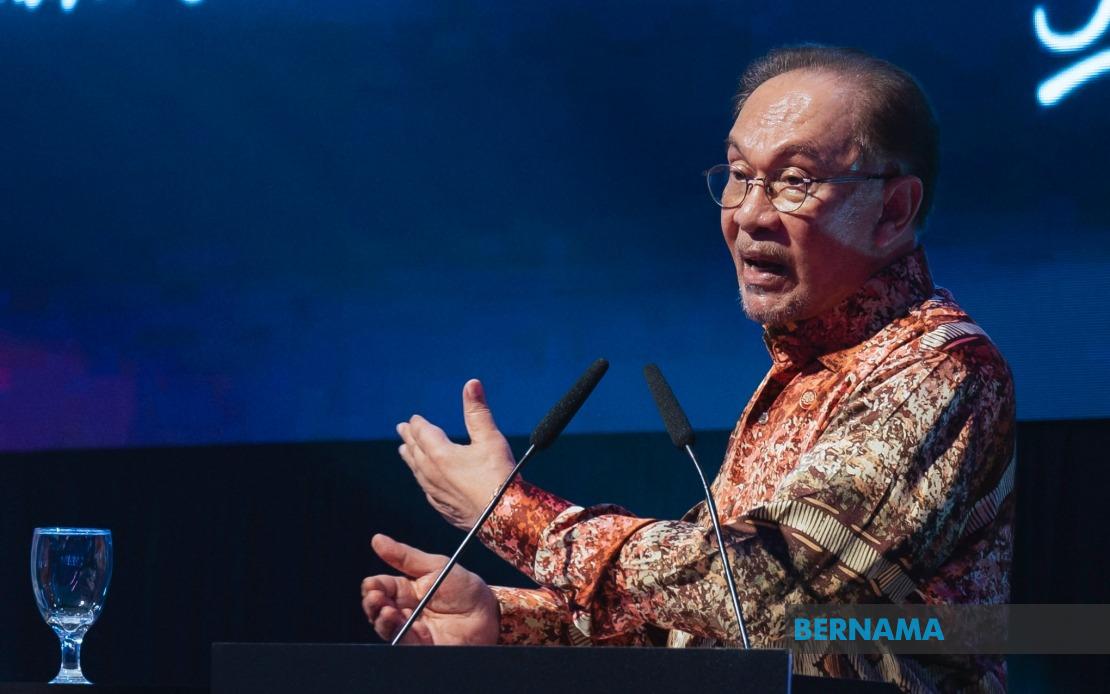
Prime Minister Datuk Seri Anwar Ibrahim's recent observations about Taiwan have drawn scrutiny, particularly his acknowledgment that China reserves the right to use force if peaceful reunification efforts falter. Yet this statement, while sensitive, does not constitute support for military action. Instead, it reflects a sophisticated understanding of how deterrence operates in international relations—a concept that becomes increasingly important as regional tensions simmer.
At its heart, Anwar's position rests on a straightforward premise: no government would passively accept the fracturing of its own state without mounting some form of resistance. This is neither radical nor unique to China. Malaysia itself would resist attempts to dismember its federation, just as any functioning nation-state would. The Prime Minister drew precisely this parallel, using the country's own constitutional integrity as a reference point to contextualise Beijing's concerns. This analogy carries weight because it grounds an abstract geopolitical principle in something tangible that Malaysians understand directly.
The distinction between possessing deterrent capacity and actually wielding it remains critical to understanding Anwar's argument. A state that reserves the option to defend itself through force does not automatically intend to use it. Rather, the credible possibility of military response serves as a brake on attempts to challenge the territorial status quo. Without such a deterrent—without the demonstrated will and capability to respond—potential adversaries may calculate that they can move with impunity. This represents classic deterrence theory: maintaining defensive capabilities precisely so they need not be deployed in anger.
Anwar explicitly prioritised alternatives. Negotiation, legal frameworks, and political settlement emerge as the preferred pathways in his formulation, deployed before any consideration of coercive measures. The argument is not that force comes first, but rather that foreswearing it entirely removes a crucial lever that maintains stability. A government that publicly commits to accepting territorial dissolution without resistance essentially invites precisely that outcome. Conversely, demonstrating preparedness to defend boundaries, even if that preparedness is never tested, reinforces deterrence and protects the status quo.
This logic sits uneasily but coherently within Malaysia's established One China policy. Malaysia diplomatically recognises the People's Republic of China exclusively and does not treat Taiwan as a sovereign state in formal terms, yet maintains robust economic relationships and people-to-people exchanges with the island. Within this framework, Anwar's point acquires particular resonance: Malaysia cannot simultaneously accept the One China principle while dismissing Beijing's concerns about national sovereignty and territorial integrity as wholly illegitimate. To do so would involve a logical inconsistency. If Malaysia accepts that Taiwan is part of China, it cannot reasonably object to China viewing Taiwan's status through the lens of reunification rather than separation.
The Taiwanese perspective diverges fundamentally. Taipei views Taiwan as a functioning democracy and a distinct political entity whose population has exercised meaningful self-determination. From this viewpoint, any reference to the possibility of force—even in abstract deterrence terms—risks normalising coercion and lending legitimacy to threats. The government and many Taiwanese citizens reject the premise that Taiwan constitutes a separatist territory whose reintegration is merely an internal matter. This representation reflects genuine differences in how the two sides conceptualise Taiwan's status and future.
Yet understanding Anwar's framing does not require endorsement of it. Rather, it requires recognition that he articulated a realist proposition about state behaviour and military deterrence, not an advocacy brief for warfare. China's position, as Anwar articulated it, holds that maintaining uncertainty about the consequences of attempting to prevent reunification serves deterrent purposes. Whether one philosophically accepts this reasoning or rejects it as dangerous, the underlying logic remains internally consistent and reflects how many states approach security.
For Malaysia and the broader Southeast Asian region, however, the stakes of any Taiwan Strait conflict extend far beyond the parties directly involved. A military confrontation would reverberate through global supply chains, destabilise regional commerce, rupture ASEAN's carefully maintained strategic balance, and potentially drag in extra-regional powers. The economic consequences alone—disruption to semiconductor manufacturing, shipping routes, and energy supplies—would impose severe costs across Southeast Asia. Malaysia's strategic interests therefore lie in supporting sustained dialogue, promoting restraint from all parties, and continuing to advocate for peaceful resolution mechanisms.
This imperative explains why Malaysia must walk a careful line. The country cannot reject Beijing's sovereignty claims without undermining its own One China recognition, yet it cannot afford escalation in the Taiwan Strait. The solution lies in consistent advocacy for negotiated settlement, support for confidence-building measures, and vocal opposition to any unilateral moves that could spark crisis. Malaysia should simultaneously emphasise the catastrophic regional implications of conflict while maintaining diplomatic channels with all stakeholders.
Anwar's comments, properly understood, amount to an observation about how interstate deterrence functions rather than a warmongering agenda. States maintain the capacity to defend themselves not because they seek confrontation but because they seek to avoid being forced into surrender. This reflects a realist worldview in which intentions matter less than capabilities and credible commitment. Malaysia's own strategic position—a middle power navigating great power competition—mirrors this logic. The country must maintain sufficient defensive capacity while avoiding actions that escalate tensions unnecessarily.
The broader implication for Malaysia's foreign policy involves maintaining strategic equilibrium. Recognition of One China does not require Malaysia to endorse any particular approach to resolving Taiwan's status. Rather, it permits Malaysia to maintain the One China framework while simultaneously championing peaceful resolution, respecting Taiwan's de facto autonomy in practice, and pushing for dialogue over confrontation. This balanced approach reflects Malaysia's genuine national interests in regional stability and economic prosperity.
Ultimately, Anwar's Taiwan remarks deserve reading as a sophisticated articulation of deterrence theory rather than as inflammatory rhetoric. The Prime Minister recognised that China, like any state, would not pre-commit to accepting territorial dismemberment. He noted that maintaining defensive capacity serves peace by discouraging aggression. None of this constitutes warmongering. At the same time, Malaysia must remain vigilant in promoting dialogue and restraint, ensuring that abstract strategic logic does not translate into regional catastrophe. The challenge lies in supporting deterrence stability while actively working toward resolution of the underlying dispute.

