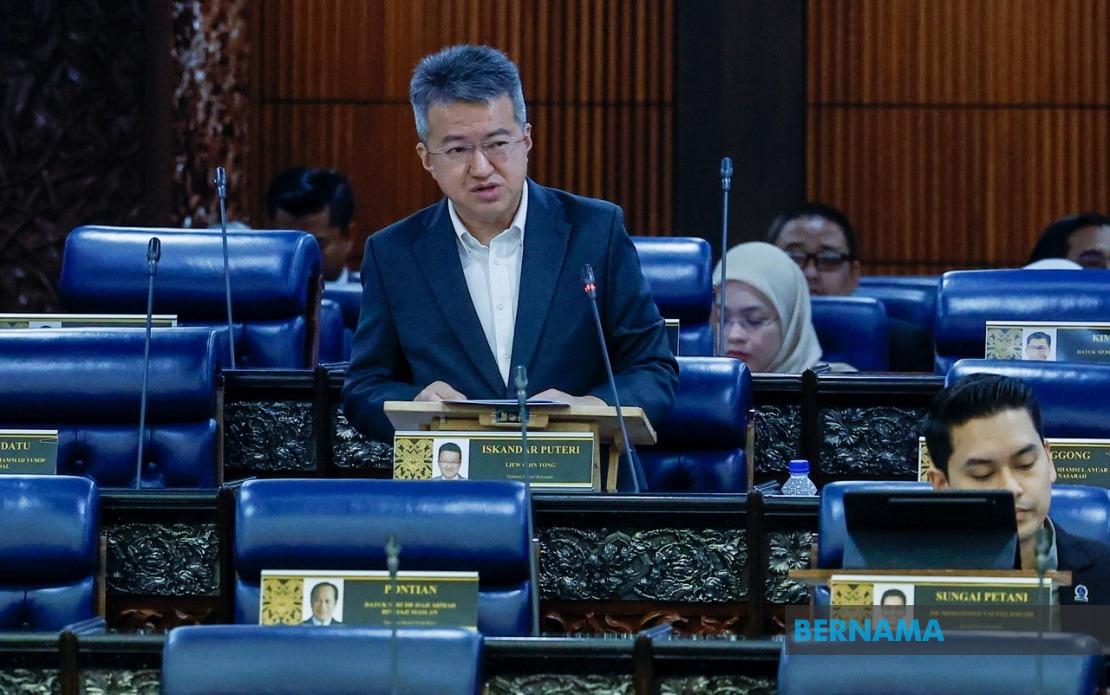
The federal government moved to dispel concerns that Sabah's newly increased interim special grant would compromise the state's development spending, with Deputy Finance Minister Liew Chin Tong providing reassurances in Parliament on July 14. The clarification follows Prime Minister Datuk Seri Anwar Ibrahim's announcement in May of the RM1.5 billion elevation to Sabah's special grant, an initiative aimed at addressing longstanding fiscal disparities between the East Malaysian state and Peninsular Malaysia under constitutional provisions governing intergovernmental transfers.
Liew's statement underscores a fundamental tension within Malaysian fiscal federalism: reconciling Sabah's constitutional entitlements under Article 112C of the Federal Constitution with broader national budget constraints. The deputy minister emphasised that the special grant increase operates independently of the state's annual operating and development allocation ceiling, a distinction that carries significant implications for how the federal government structures support to resource-rich but economically developing regions. This separation matters because it allows the federal government to honour constitutional obligations while maintaining committed spending levels for infrastructure and services.
The state's development allocation has grown to RM6.9 billion this year from RM6.7 billion previously, reflecting federal priorities in addressing Sabah's infrastructure gaps. Major projects anchoring this commitment include the ongoing Pan Borneo Highway, a transformative infrastructure project intended to improve connectivity across Malaysian Borneo and unlock economic potential in remote areas. Complementing these headline initiatives are investments in rural road networks, electricity infrastructure reaching dispersed communities, and water supply systems—foundational services that remain inadequate in many Sabahan localities despite decades of development planning.
Healthcare and education facilities represent another critical dimension of the development agenda. Federal funding supports construction and upgrading of hospitals and clinics in underserved areas, alongside rehabilitation of deteriorating school buildings and police stations. These investments reflect recognition that development cannot be measured purely in economic metrics; equitable access to public services is essential for social cohesion and human capital development. For a state with challenging geography and dispersed population centres, concentrating resources on basic facility improvement addresses structural disadvantages that market forces alone will not resolve.
Electricity subsidy arrangements reveal the complex interdependencies in Malaysia's federal structure. Although regulatory authority over electricity supply transferred to Sabah's government in 2024—granting the state greater autonomy in energy policy—the federal government continues underwriting consumption costs through subsidies. The 2026 allocation for electricity subsidies is projected to reach RM880 million, demonstrating that devolution of powers does not automatically eliminate federal financial responsibility. This arrangement essentially allows Sabah to exercise regulatory control while maintaining affordability protections for consumers, creating a hybrid model increasingly common in federations managing cost-of-living pressures.
Rural water supply investments have accelerated notably, with allocations jumping from RM103.5 million in 2025 to RM143 million in the current year. This increase signals federal recognition that water security remains inadequate across Sabah's hinterland, where many communities lack reliable piped supply. Access to clean water constitutes a foundational development indicator, and expanded investment reflects both humanitarian imperatives and practical acknowledgment that water insecurity undermines economic productivity and public health outcomes. Similar expansion patterns appear across multiple service domains, indicating systemic prioritisation rather than ad hoc allocations.
Social safety nets amplify the federal commitment beyond traditional infrastructure channels. Combined allocations through the Sumbangan Tunai Rahmah and Sumbangan Asas Rahmah schemes—targeted cash assistance programmes—reach approximately RM1.2 billion for Sabah. These direct transfers buffer households against inflation and provide economic stimulus through consumption. Particularly during periods of cost-of-living pressure, such targeted assistance serves as countercyclical policy protecting vulnerable groups while sustaining demand in local economies. The magnitude of these transfers reflects deliberate policy to ensure that development gains translate into improved living standards for ordinary Sabahans.
The procedural dimensions of special grant payments warrant attention given historical disputes over federal-state fiscal arrangements. Liew confirmed that both the federal and Sabah state governments must observe processes stipulated under Article 112D of the Federal Constitution, mirroring procedures implemented during 2022, 2023, and 2025. Constitutional compliance provides predictability and legitimacy, though tensions remain. The federal government has appealed aspects of the Kota Kinabalu High Court's ruling on special grants, indicating unresolved disagreements about grant calculations and constitutional interpretation. This legal contestation occurs even as both governments pursue negotiations toward a new mechanism for determining future special grant amounts.
These negotiations carry profound significance for federal-state relations and regional equity. The current special grant framework, rooted in Malaysia's constitutional architecture recognising Sabah's particular circumstances upon federation, has proven inadequate for contemporary realities. Neither side disputes the principle of special grants; instead, disagreement centres on quantum and calculation methodology. Establishing a forward-looking mechanism represents an attempt to depoliticise grant determination and create certainty for medium-term planning. Success would strengthen intergovernmental cooperation and validate both Sabah's constitutional position and federal commitment to equitable development.
For Malaysian observers tracking federal fiscal policy, Liew's parliamentary statement reflects broader coalition dynamics within the current government. Maintaining coalition stability requires visible federal investment in constituent states, particularly those in East Malaysia where development gaps relative to Peninsular Malaysia remain conspicuous. Sabah's political importance has intensified given shifting alignments in recent years, making credible commitments to development and fiscal support strategically necessary. The explicit disconnection between the special grant and development allocations thus serves multiple audiences: reassuring Sabahan policymakers of federal seriousness while signalling to other states that fiscal transfers will not cannabilise development spending.
Looking forward, the sustainability of this fiscal arrangement depends on Malaysia's broader economic trajectory. Continued expansion of federal revenue permits simultaneous increases in both special grants and development allocations, but revenue pressures would force difficult trade-offs. The government's commitment to honouring constitutional obligations while maintaining service delivery reflects optimistic assumptions about growth and fiscal management. For Sabah, the challenge lies in converting federal transfers into tangible development outcomes and institutional capacity that can sustain progress beyond budget cycles. For Malaysia's federation more broadly, success in managing Sabah's fiscal relationship increasingly influences perceptions of federal fairness and national cohesion.

