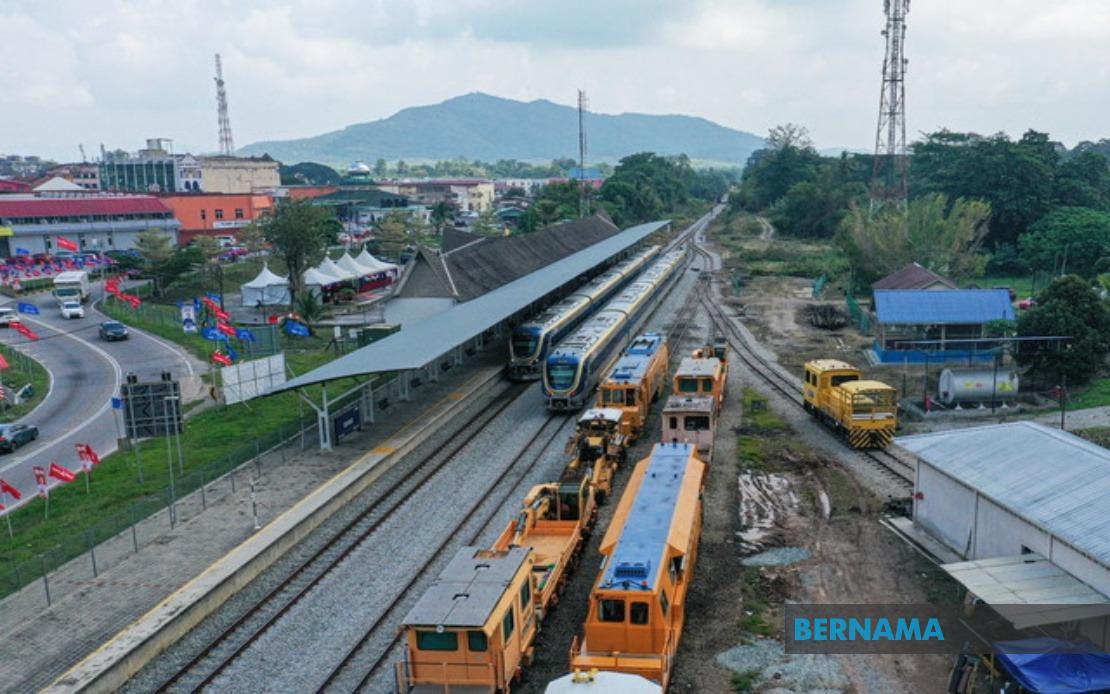
Malaysia's Transport Ministry has completed a major railway restoration project linking Gemas in Negeri Sembilan with Mentakab in Pahang, finishing on June 19 after seven years of work and an investment of RM41.7 million. The completion marks a significant milestone in rehabilitating critical rail infrastructure that serves as a vital connector between the peninsula's East and West Coast rail networks.
Transport Minister Anthony Loke acknowledged that the project, which began in 2016, faced substantial delays beyond its original 2019 completion target. The primary setbacks stemmed from severe flood damage inflicted by major East Coast disasters that compromised the railway track condition, combined with the original contractor's inability to meet contractual timelines. These challenges underscore the vulnerability of Malaysia's rail infrastructure to climate-related events and the operational complexities of managing large-scale transport projects across multiple states.
The upgraded corridor spans three states—Negeri Sembilan, Pahang, and Kelantan—making it essential infrastructure for regional connectivity. Gemas has now solidified its status as a strategic interchange hub within Malaysia's national rail system, functioning as the convergence point where East Coast and West Coast routes meet. This geographical positioning elevates its importance for both passenger movements and freight operations across the peninsula.
Loke emphasised that the restored track now accommodates freight loads of up to 20 tonnes per carriage, a capacity enhancement that directly supports government policy encouraging modal shift from road transport to rail-based logistics. This increased carrying capacity addresses Malaysia's ongoing efforts to reduce congestion on highways and decrease transportation sector emissions, aligning with broader sustainability and economic efficiency objectives. The upgraded infrastructure enables more cost-effective bulk cargo movement, particularly beneficial for regional commerce between the developed West Coast and developing East Coast regions.
The completion of the Gemas-Mentakab segment represents one component of a broader rail modernisation effort. Loke contextualised this achievement within Malaysia's expanding rail network, noting that the finished track complements the concurrent Gemas-Johor Bahru double-track railway project and the extension of Electric Train Service operations into Johor Bahru Sentral. Together, these initiatives are progressively strengthening the country's backbone rail corridor, establishing a more integrated and efficient transport network.
Progress across the broader East Coast corridor remains uneven, however. Package B of the larger project, covering the Mentakab-Gua Musang section, was actually completed ahead of schedule, demonstrating that portions of the work proceeded smoothly. However, Package C, which includes the Gua Musang-Tumpat stretch, continues experiencing delays attributable to contractor implementation difficulties. This final segment presents exceptional engineering challenges, having sustained the most catastrophic flood damage during previous East Coast disasters and encompassing forested terrain, remote interior regions, and slopes susceptible to landslides.
Immediate operational improvements are already being considered to maximise the benefits of the restored infrastructure. Loke has directed Keretapi Tanah Melayu Berhad to investigate increasing service frequency along the Gemas-Kuala Lipis route and coordinating schedules with Electric Train Service timetables to address passenger demand patterns. Currently, the route operates only three return trips daily, a frequency that Loke acknowledged requires examination given growing travel volumes and the need to accommodate effective train connections.
The minister outlined an integrated passenger journey scenario that reflects modern intermodal transport planning. Passengers boarding the Gemas-Kuala Lipis service can now disembark at Gemas with a connection window of approximately 10 to 15 minutes before transferring to an Electric Train Service train bound for destinations like Johor Bahru Sentral. This planned waiting period, if achieved consistently, would provide a seamless transition experience that encourages multimodal journeys and maximises the utility of the expanded network.
For Malaysian business and commuter communities, the project completion carries practical implications. The East Coast region, encompassing Pahang and Kelantan, has historically experienced logistical disadvantages due to longer road transport times to West Coast industrial and commercial centres. Improved rail connectivity directly addresses this regional disparity, potentially attracting manufacturing and distribution investments to the East Coast by reducing transportation costs and transit times. Small and medium enterprises engaged in inter-regional trade will benefit from reduced shipping expenses and more predictable delivery schedules.
The project's journey from 2016 initiation to 2024 completion also offers lessons for Malaysian infrastructure management. The combination of environmental vulnerabilities—demonstrated by flood impacts—and contractor performance issues highlights the necessity for more robust contingency planning and stronger accountability mechanisms in large transport projects. As Malaysia pursues increasingly ambitious rail expansion plans, incorporating climate resilience into design and scheduling flexibility into contracts will prove essential.
Look ahead, the focus must shift to operationalising the upgrade's full potential. Completing Package C and establishing reliable, frequent services along the entire corridor will determine whether the investment translates into meaningful improvements in regional connectivity and economic activity. For Malaysia's broader vision of developing a world-class rail network capable of competing with regional transport hubs, the Gemas-Mentakab completion represents progress toward that goal, though sustained commitment to service quality and continuing infrastructure investment remains critical.

