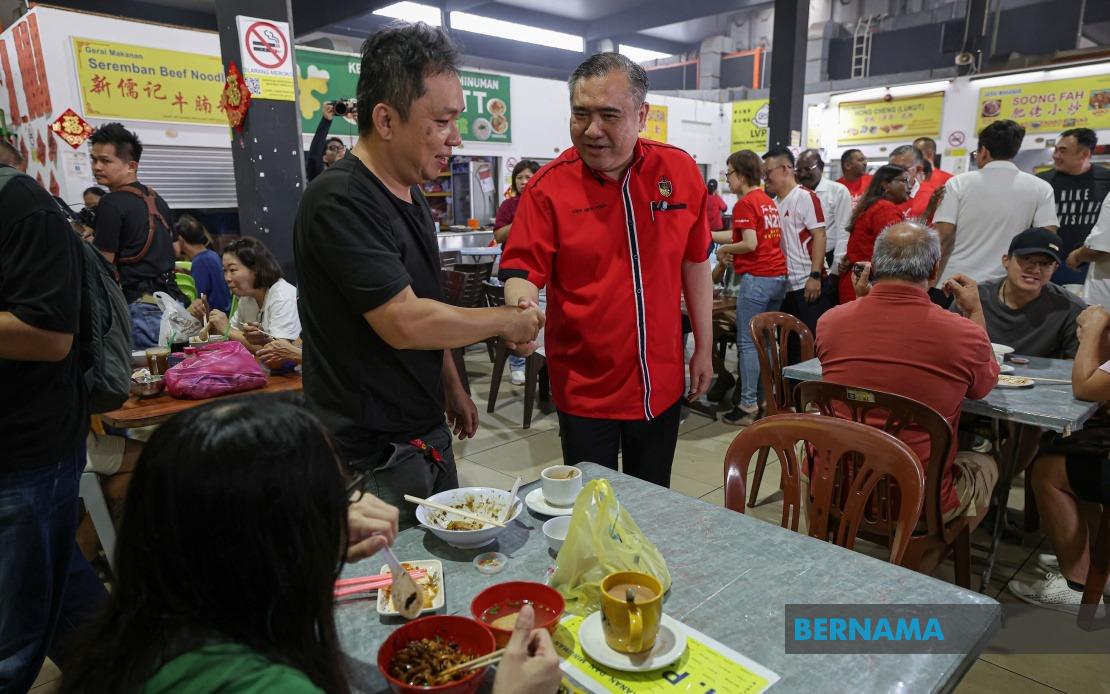
Transport Minister Anthony Loke has made clear that traffic compliance and road safety will be strictly enforced throughout the ongoing 16th Negeri Sembilan state election campaign, establishing expectations that candidates and supporters must follow all vehicular regulations without exception. Speaking in Seremban on July 19 after a walkabout with Pakatan Harapan candidates, the DAP secretary-general framed traffic rules as non-negotiable safeguards designed to prevent accidents and maintain order during what will be an intensive period of political activity across the state.
The minister's position reflects growing concern among election supervisors about safety hazards that emerge when campaign activities intensify. With candidates and supporters conducting motorcades, convoys, and public gatherings across multiple constituencies, the combination of increased road activity and political enthusiasm can create environments where standard precautions are overlooked. Loke's intervention signals that the transport ministry will not treat such oversights as minor infractions but as matters demanding intervention at the highest levels of party leadership.
Loke has personally instructed DAP campaign teams to wear helmets at all times when riding motorcycles, establishing this as a baseline requirement rather than a discretionary safety measure. This instruction carries particular weight given his position as transport minister, whose portfolio directly encompasses road safety policy. By demonstrating personal commitment to the standard he is asking others to follow, Loke attempts to model compliance rather than simply issuing directives from a distance.
During the nomination proceedings on July 18, when Loke participated in a convoy travelling from Pekan Titi to Kuala Klawang, he enforced a simple rule: no helmet meant no participation in the convoy. This practical application of the safety principle demonstrates his willingness to exclude participants who refuse compliance, establishing consequences beyond verbal warnings. The approach acknowledges that voluntary compliance often requires enforcement mechanisms to succeed, particularly in competitive environments where political pressure may incentivise rule-bending.
Beyond helmet use, Loke has also specifically warned candidates and supporters against riding on the tailgates of moving four-wheel-drive vehicles, characterising this common campaign practice as recklessly dangerous. This particular warning addresses a widespread habit during Malaysian political campaigns where supporters stand on vehicle tailgates while moving between locations, creating obvious hazards if vehicles brake suddenly or navigate sharp turns. The practice, while visually striking for campaign imagery, violates basic physics principles regarding vehicle stability and passenger safety.
The timing of Loke's warnings coincides with intensive campaign activity following the dissolution of the Negeri Sembilan state assembly on June 5. With polling day scheduled for August 1 and early voting on July 28, the campaign period spans roughly seven weeks of concentrated political engagement. During such periods, the volume of campaign movements—convoys, public events, door-to-door canvassing, and evening rallies—multiplies significantly, increasing accident risk proportionally. The compressed timeframe and competitive intensity mean safety standards may face pressure from candidates eager to maximise visibility and supporter engagement.
The electoral stakes in Negeri Sembilan add context to Loke's concerns. The state election involves approximately 889,490 registered voters across ordinary voters, military personnel and their spouses, and police officers eligible for early voting. This represents a substantial number of potential supporters who campaigns must reach, necessitating extensive movement across constituencies. The six Pakatan Harapan candidates Loke campaigned alongside—Ho Weng Wah in Temiang, Lee Kai Yet in Mambau, Siau Meow Kong in Rahang, Nicole Tan in Bukit Kepayang, S. Mugunthan in Seremban Jaya, and Chew Seh Yong in Lobak—represent varied constituencies with different geographic and demographic characteristics, requiring diversified campaign approaches.
Loke's appeal extends beyond Pakatan Harapan to encompass all parties and candidates contesting the election, positioning road safety as a collective responsibility rather than a partisan concern. This framing seeks to depoliticise traffic compliance, suggesting that regardless of party affiliation or electoral competition, all participants share an obligation to maintain standards that protect public safety. Such appeals often prove more effective when they transcend partisan boundaries, as they appeal to shared values rather than asking parties to disadvantage themselves competitively.
The emphasis on leadership by example represents a sophisticated approach to compliance. Rather than relying solely on enforcement mechanisms or regulations, Loke suggests that when prominent figures and party leaders visibly comply with standards, supporters naturally follow their example. This principle recognises that political campaigns operate through demonstration as much as through directives, with candidates' behaviour providing templates that supporters replicate. If candidates wear helmets, speak against dangerous practices, and visibly enforce safety rules within their campaigns, supporters internalise these standards as normal within campaign culture.
Road safety during elections remains a persistent challenge across Southeast Asia, where campaign periods frequently coincide with spikes in traffic accidents. Malaysia's experience in previous election cycles has documented instances of campaign-related accidents caused by unsafe convoy practices, excessive speeding, inadequate attention to traffic signals, and overcrowded vehicles. These incidents not only claim lives and cause injuries but also undermine public confidence in the electoral process, as voters witness candidates and supporters flouting laws that govern ordinary citizens.
Loke's intervention also reflects broader conversations about governance standards during elections. When public figures—especially ministers—visibly ignore regulations they are responsible for enforcing, it sends contradictory messages about the importance of legal compliance. Conversely, when ministers actively ensure their own campaigns meet high standards, they reinforce the principle that electoral competition should not require abandoning the rule of law or public safety principles. This consistency between stated values and demonstrated behaviour strengthens institutional credibility during periods when public trust in political processes may be questioned.
The minister's approach also carries implications for how future campaigns in Malaysia and the region might establish their cultural norms around safety. If the Negeri Sembilan campaign successfully maintains traffic compliance without disadvantaging any party competitively, it could establish a replicable model for state and federal elections elsewhere. Conversely, if safety standards are perceived as selectively enforced or as disadvantaging particular candidates, it could undermine support for such measures in future contests. The success of Loke's initiative thus depends partly on consistent application and visible fairness in implementation across all parties.
As the campaign continues toward August 1 polling day, the practical challenge will involve translating Loke's stated expectations into sustained compliance across multiple constituencies and hundreds of campaign events. The test will be whether campaign teams genuinely internalise safety standards or whether they view compliance as a temporary accommodation to avoid political embarrassment. For Malaysian voters observing the campaign, the visible adherence to traffic rules by their political leaders offers a tangible measure of governance quality—demonstrating whether those seeking public trust will honour commitments even when inconvenient.

