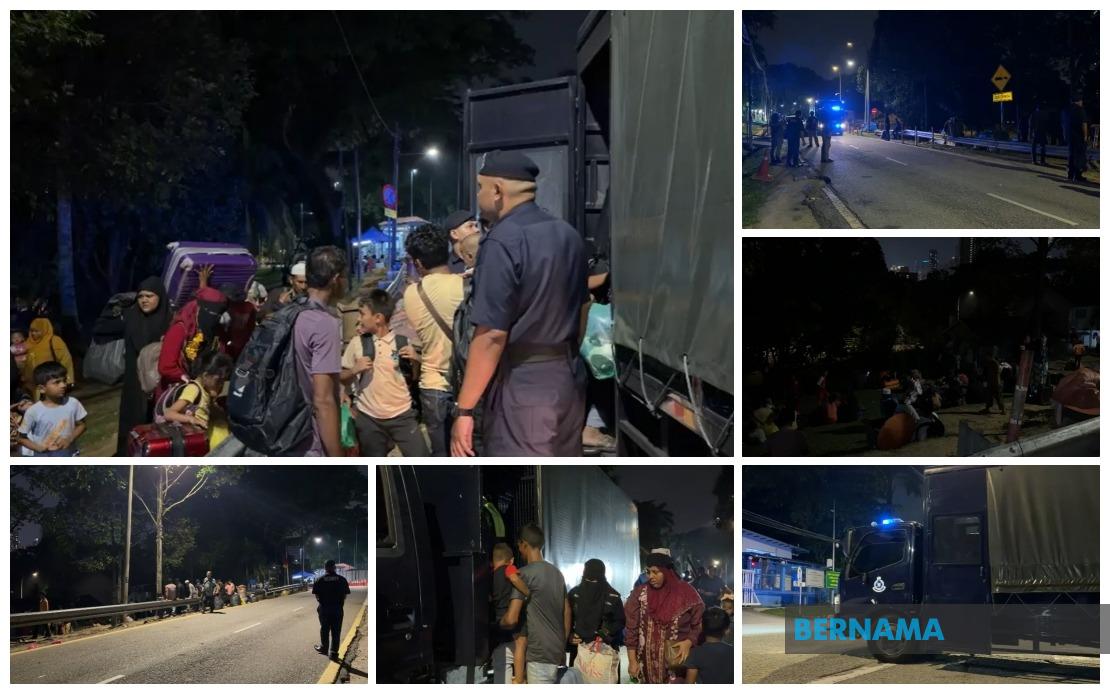
Hundreds of Rohingya refugees who assembled outside the UNHCR office in Jalan Bukit Petaling were transferred to the Kuala Lumpur Police Contingent Headquarters on July 27 for systematic identity verification and documentation procedures. The relocation marked an intensified government response to the gathering, which had drawn attention to the precarious situation facing stateless populations in Malaysia's urban centres. Police chief Datuk Fadil Marsus confirmed the overnight operation, which involved deploying four police trucks to accommodate the large number of people, many of whom were carrying personal items and luggage.
The logistics of the operation underscored the scale of the gathering. Initial deployments of two vehicles proved inadequate for transporting the refugees, necessitating additional resources. The transfer commenced at 8.20 pm and continued throughout the evening as authorities worked to process the displaced persons. This operational adjustment reflected both the unexpectedly large turnout and the preparedness challenges authorities faced in managing what amounted to an unscheduled humanitarian movement within the capital city.
Authorities explained that the refugees were undergoing comprehensive identity checks as a preliminary step before determining appropriate next measures. The process involved verifying personal documentation and cross-referencing information with existing records. Officials anticipated that the National Security Council would coordinate follow-up actions the following day to classify individuals based on their refugee status documentation. This multi-agency approach revealed the complexity of Malaysia's refugee management framework, where several government bodies maintain overlapping jurisdictions.
According to source reports, individuals possessing valid UNHCR documentation would be identified and considered for appropriate placement within Malaysia's existing refugee support mechanisms. Those unable to produce recognised UNHCR cards or substantiate legitimate refugee claims faced transfer to the Immigration Department for processing at designated immigration detention facilities. Repatriation to countries of origin represented the anticipated outcome for individuals classified as non-eligible for protected status under Malaysian law.
Prime Minister Datuk Seri Anwar Ibrahim issued a firm public statement regarding the government's position on refugee gatherings and public order. He indicated that Malaysia would maintain a zero-tolerance approach toward any refugee populations engaging in activities perceived as disruptive to social stability or territorial control. The Prime Minister instructed enforcement agencies, including the Royal Malaysia Police, JIM, and municipal authorities, to implement vigorous enforcement measures against any individuals breaching legal prohibitions. This declaration signalled heightened official scrutiny of refugee communities and established clear parameters for state response to future assemblies.
The circumstances leading to the UNHCR office gathering had roots in earlier movements among Rohingya populations residing in Malaysia. Media reports indicated that the refugee group had journeyed to Kuala Lumpur from a settlement in Penang, arriving early on July 27 aboard three chartered buses. This coordinated relocation suggested organisational capacity within refugee communities but also triggered concerns among authorities regarding potential coordination of public assemblies without permits or notifications. The transit from Penang to the capital represented a geographical shift in refugee activism and drew scrutiny regarding community organising.
Malaysia's approach to refugee management reflects broader tensions between humanitarian obligations and national security considerations. The country hosts one of Southeast Asia's largest displaced populations, with Rohingya communities particularly vulnerable given the ongoing instability in Myanmar and Bangladesh's capacity constraints. However, rapid urbanisation of refugee populations and visibility in city centres periodically generate political friction and policy adjustments. The July 27 incident represented one manifestation of these underlying pressures.
The relocation operation also illustrated enforcement capabilities available to Malaysian authorities for managing large-scale population movements. The coordinated multi-vehicle response, personnel deployment, and rapid processing infrastructure demonstrated institutional readiness for such scenarios. However, observers noted that such operations required advance intelligence and planning, raising questions about how authorities obtained information regarding the gathering beforehand and whether communication channels existed with refugee community leaders.
Regional implications of Malaysia's refugee policies extend across Southeast Asia, where several nations struggle with managing displaced populations from Myanmar and elsewhere. Malaysia's increasingly stringent approach potentially influences policy trajectories in neighbouring countries and may affect burden-sharing arrangements within ASEAN frameworks. The tension between Malaysia's significant refugee hosting contributions and its periodic enforcement crackdowns reflects the political economy of refugee management in middle-income developing nations facing competing development priorities.
Looking forward, the incident highlighted ongoing challenges in reconciling international refugee protection obligations with domestic policy preferences around public order and state sovereignty. The multi-agency coordination demonstrated institutional capacity but also revealed potential gaps in early communication with affected communities. Future refugee policy development in Malaysia will likely balance humanitarian concerns with security considerations, requiring sustained engagement between government bodies, UNHCR, civil society organisations, and refugee communities themselves to prevent recurrence of such incidents.

