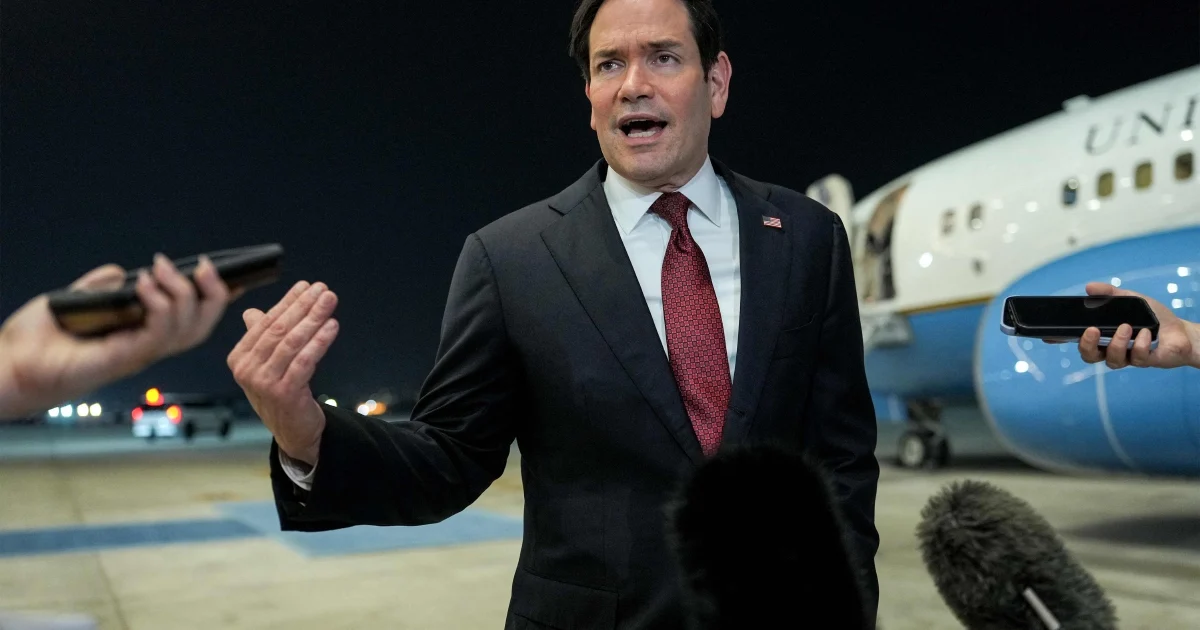
The United States has made clear it will not entertain Iranian proposals to impose tolls or levies on commercial shipping passing through the Strait of Hormuz, according to remarks by US Secretary of State Marco Rubio delivered on Tuesday. The statement underscores the mounting friction between Washington and Tehran over control of one of the world's most strategically vital waterways, through which roughly one-third of global seaborne oil transits annually.
Rubio's rejection of the Iranian toll scheme comes as preliminary negotiations aimed at resolving the broader Middle East conflict have already begun to fray under the weight of multiple unresolved disputes. The disagreements extend well beyond the question of Hormuz access fees, touching on equally contentious issues including the scope and intrusiveness of international nuclear inspections and the status of Iran's ballistic missile development programme. Each of these matters carries profound implications not only for regional stability but for global energy security and the delicate balance of power in the Persian Gulf.
The Strait of Hormuz represents a chokepoint of extraordinary geopolitical significance. Any attempt by Iran to tax or regulate shipping through these waters would directly impact the cost and reliability of energy supplies for nations across Asia, including Malaysia and other regional economies dependent on predictable oil and gas flows. The prospect of Iranian tolls on Hormuz traffic would effectively grant Tehran leverage over global markets, a prospect that the United States views as categorically unacceptable and contrary to established principles of international maritime law regarding freedom of navigation.
The timing of Rubio's statement reveals the speed at which early diplomatic momentum appears to be dissipating. Discussions that commenced with cautious optimism have quickly encountered the hard realities of negotiating with adversaries whose core interests often prove irreconcilable. The American position reflects a fundamental determination not to cede to Iran any mechanism through which it could exert economic coercion over international commerce. Washington has signalled that certain red lines remain immutable, even as broader negotiations attempt to chart a path toward conflict resolution.
Nuclear inspections present another flashpoint in these talks. The international community, through mechanisms established under the Joint Comprehensive Plan of Action framework, has sought robust and unfettered access to Iranian nuclear facilities to verify compliance with non-proliferation commitments. Iran, however, has resisted what it characterises as intrusive inspection regimes that violate its sovereignty. This standoff reflects a deeper trust deficit between Tehran and the Western nations that have pursued nuclear containment policies. For Southeast Asian nations monitoring these developments, the stakes involve the potential for nuclear proliferation in a region already characterised by volatile geopolitics.
Missile capabilities constitute the third major point of contention in these nascent talks. The United States and its allies view Iran's expanding ballistic missile arsenal as a destabilising force that threatens regional partners including Saudi Arabia, the United Arab Emirates, and Israel. Iran insists on its sovereign right to develop defensive capabilities and views external constraints on its missile programme as infringements on its security interests. The inability to find common ground on this issue suggests that even preliminary negotiations will struggle to overcome the philosophical divide separating the parties.
The Strait of Hormuz itself has been a recurring flashpoint for Iranian-American tension spanning decades. Iran has periodically threatened to close or restrict passage through the waterway in response to sanctions or military pressures. Analysts have repeatedly cautioned that such actions would carry catastrophic consequences for global energy markets and could trigger military confrontation. By preemptively rejecting the toll proposal, the United States aims to signal that it will not tolerate any Iranian actions that could be construed as weaponising the strait or its commercial traffic.
For Malaysian policymakers and regional economies, the implications of failed negotiations remain substantial. Disruption to Hormuz shipping would immediately elevate energy costs and create supply uncertainties that would ripple through Southeast Asian markets. Malaysia, as an energy exporter itself and as a nation deeply integrated into global trade networks, has a vested interest in maintaining the predictable, rules-based international maritime system that allows vessels safe passage through chokepoints without fear of arbitrary taxation or closure.
The accumulation of unresolved disputes signals that achieving any comprehensive agreement between the United States and Iran will require extraordinary diplomatic skill and mutual willingness to compromise on issues that both sides currently treat as non-negotiable. The pattern evident thus far suggests negotiators face a prolonged and challenging process, with numerous opportunities for talks to collapse entirely. Regional powers and trading nations worldwide will be monitoring these developments closely, recognising that Middle East instability directly affects their economic wellbeing and strategic interests.

